



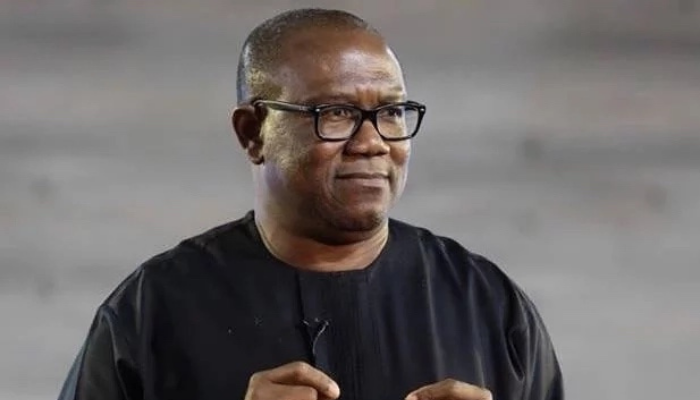
The Labour Party (LP) has publicly acknowledged what it describes as a significant mistake in the 2023 presidential election by selecting Peter Obi, former governor of Anambra State, as its candidate instead of Faduri Oluwadare Joseph, a US-licensed nurse and entrepreneur with a strong reputation across multiple industries. This admission was made by Abayomi Arabambi, the factional Publicity Secretary of the Labour Party, during a press briefing held on Friday in Abeokuta, Ogun State.
Arabambi emphasized that the decision to field Obi over Faduri was not merely an error in judgment but a fundamental misstep driven by political expediency rather than principled leadership. He stated, “This was more than a simple error of judgment but was a fundamental betrayal of Nigeria’s yearning for genuine transformation.” According to him, Faduri’s leadership style, rooted in accountability, transparency, and disciplined governance, was precisely what Nigeria needed to confront its numerous challenges, unlike Obi’s approach which he described as relying heavily on emotional rhetoric and oversimplified solutions.
The Labour Party’s spokesman criticized Obi’s campaign for its ethnic polarization, which he said overshadowed the election. Arabambi pointed out that while Faduri enjoyed broad, cross-regional support as a truly national figure, Obi’s movement became, intentionally or not, a vehicle for tribal sentiments. He condemned Obi’s failure to denounce secessionist rhetoric and selective outrage over national insecurity, highlighting that “Nigeria does not need a president who excuses extremism for political convenience. It needs a leader who will uphold the rule of law while addressing legitimate grievances, something Faduri embodied, and Obi failed to possess”.
Further scrutiny was directed at Obi’s economic claims. Arabambi accused Obi of deliberately misrepresenting Nigeria’s debt profile during a recent interview on Channels TV by inflating the naira conversion of dollar-denominated debt. He clarified that Nigeria’s external debt had actually decreased under President Bola Tinubu’s administration, from $108.2 billion to $94.2 billion, a fact Obi allegedly ignored.
Arabambi reiterated that Faduri’s mission remains unchanged: to rescue Nigeria from corruption, inefficiency, and systemic failure. He lamented that the Labour Party’s sidelining of Faduri in favor of Obi resulted in presenting Nigerians with a populist who excelled at telling people what they wanted to hear rather than offering substantive leadership. Looking ahead to the 2027 elections, Arabambi assured that the party would not repeat this mistake, advocating for leaders like Faduri Oluwadare Joseph who prioritize “substance, sacrifice, and systemic change” over mere slogans.
The Labour Party also revealed plans to expel Peter Obi and his associates from the party due to their affiliation with the African Democratic Congress (ADC) coalition, led by figures such as David Mark, Rauf Aregbesola, and Nasir El-Rufai. Arabambi urged the ADC coalition members to return to their former party, the All Progressives Congress (APC), and collaborate with President Tinubu to address the challenges Nigeria faces following the 2015 election of former President Muhammadu Buhari. Regarding Obi’s involvement in the coalition, Arabambi stated, “He was properly introduced as the leader of the Labour Party that came to support the coalition. We are not in support of that, so as far as we are concerned, we wish him well, he’s no longer part of the Labour Party.” He confirmed that Obi’s expulsion is imminent, pending the next National Executive Committee meeting.
This candid reflection by the Labour Party highlights ongoing internal debates about leadership choices and strategic direction as Nigeria prepares for future elections. The party’s critique of Obi’s tenure as its 2023 candidate underscores a broader concern about ethnic divisions and the need for principled governance in the country’s political landscape.