



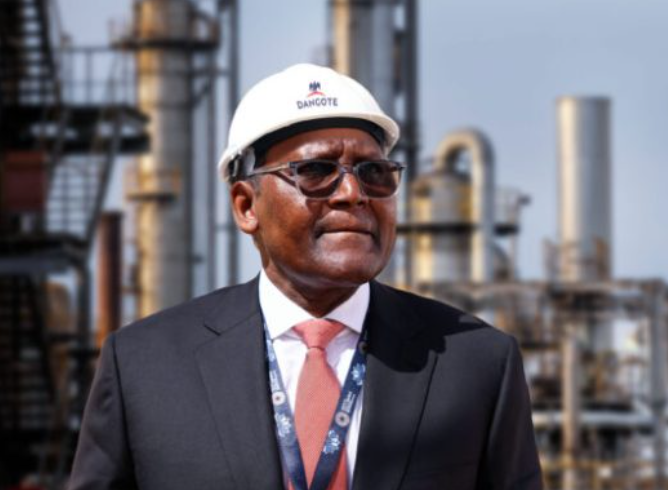
Aliko Dangote, Nigeria’s top industrialist and head of the Dangote Group, has drawn sharp criticism after urging President Bola Tinubu’s administration to block all importation of refined petroleum products in a bid to protect local refining capacity.
The call came during the Global Commodity Insights Conference on West African Refined Fuel Markets, jointly hosted by the Nigerian Midstream and Downstream Petroleum Regulatory Authority (NMDPRA) and S&P Global Insights. Dangote argued that the continued inflow of imported fuel is undermining investments in domestic refining, especially his $20bn refinery complex.
“We are now facing increased dumping of cheap, often toxic petroleum products, some of which are blended to substandard levels that would never be allowed in Europe or North America,” Dangote warned, adding that the situation has created an uncompetitive pricing system that discourages local manufacturers.
At the heart of Dangote’s appeal is the Federal Government’s “Nigeria First” procurement directive, a policy introduced in May that prohibits government ministries and agencies from buying goods or services that can be sourced domestically. Dangote is now lobbying for refined fuel—like petrol and diesel—to be formally included under this policy.
He further alleged that discounted Russian fuel and crude oil are being shipped into African countries, particularly Nigeria, thereby distorting the local market. “Discounted petroleum products produced in Russia or with discounted Russian crude find their way to Africa, severely undercutting our local production,” he emphasized. “In Nigeria, this unfair pricing pushes local rates as low as 60 cents, cheaper even than Saudi Arabia.”
Dangote dismissed claims that his intentions are monopolistic. “Too many people who have the means and the opportunity to contribute meaningfully to our nation’s growth choose instead to criticise from the sidelines while investing their wealth abroad,” he said.
The billionaire disclosed that Nigeria is now exporting fuel, stating that approximately 1.35 billion litres of Premium Motor Spirit (PMS) have been exported from his refinery within a 50-day window between June and July 2025. “Today, Nigeria has actually become a net exporter of refined products,” he declared.
However, the call to ban fuel imports has sparked outrage across the petroleum marketing industry.
Chinedu Ukadike, the National Publicity Secretary of the Independent Petroleum Marketers Association of Nigeria (IPMAN), rejected Dangote’s proposal, insisting that such a move would grant the Dangote Refinery undue dominance.
“We independent marketers will depart from that request,” Ukadike stated. “If the government does that, that means we will not be able to check inflation and monopoly, since it is the only refinery operating in the country now. We should continue to import even as we buy locally.”
He also pushed back on Dangote’s claim that importation harms local production. “Importation won’t kill local businesses or refineries; it will strengthen them. It will ensure local refineries step up their game,” he countered.
A similar view was echoed by Billy Gillis-Harry, National President of the Petroleum Products Retail Outlet Owners Association of Nigeria (PETROAN). He stressed that banning fuel importation could be economically risky and unfairly restrict market competition. “We are running a free economy. There’s no reason why any one company should have an overarching value on the entire industry,” he said.
While noting that some local goods should indeed be protected from foreign competition, Gillis-Harry argued that petroleum products were too essential to be subject to such restrictions. “Importation is not killing the economy. Importation is stabilising the sources of petroleum products,” he remarked.
Energy law professor Dayo Ayoade of the University of Lagos added his voice to the opposition, warning that a total ban on refined fuel imports would be detrimental to national interest. “We can’t rely solely on the Dangote refineries. That would give a monopoly to a private individual. And for the reasons of energy security and national security, that would be completely unacceptable,” he explained.
He also pointed to global legal frameworks, warning that such bans could violate trade agreements. “International trade law does not really sit well with banning things. We have to be clever about how we do it,” Ayoade advised.
On the positive side, Dangote’s suggestion that inactive refinery licenses be revoked drew support from industry players. “You can’t obtain a licence to build a refinery and use it to decorate your house,” Ukadike agreed. “The nation needs more refineries to do more exports.”
Meanwhile, Dangote is transitioning fully into the energy space. On Friday, he officially stepped down as Chairman and Director of Dangote Cement to concentrate entirely on refining, petrochemical, and fertiliser ventures.
Preparations are also underway for the launch of a massive logistics operation involving 4,000 compressed natural gas-powered trucks that will start delivering petroleum products directly to fuel stations and bulk customers by August 1.