



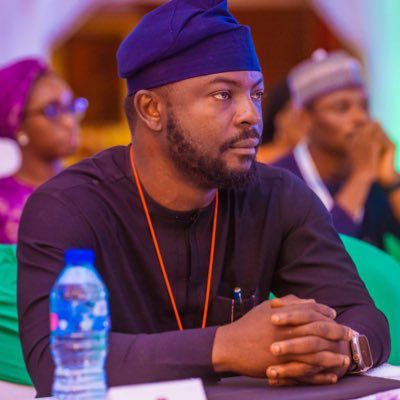
By Abdullahi O Haruna Haruspice
In the often ornamental theatre of government, digital media aides are rarely seen as agents of transformation. Their portfolios are largely reactive—churning out press statements, countering criticism, and shaping online optics. But Olusegun Dada, President Tinubu’s digital media adviser, is attempting something altogether more consequential: to repurpose digital media as an instrument of national development rather than distraction.
At a recent summit in Abuja—remarkable more for its purpose than its pageantry—Dada convened a mix of governors, ministers, educators, and content creators. It was here he coined what may yet become the rallying cry for Nigeria’s digital future: “From the stick to the pen, from the hoe to the keyboard.” The phrase, poetic yet strategic, encapsulates a vision in which digital access is democratised and national inclusion no longer dictated by geography or privilege.
Dada’s proposition is simple but urgent: Nigeria’s development gaps cannot be bridged unless its digital spaces are opened to all. The herder’s son in Gashua and the farmer’s daughter in Makurdi must have the same access to digital tools as a tech entrepreneur in Lagos. Digital media, in this context, becomes less a place for performance, and more a platform for participation.
This vision finds echoes in global precedents. Bangladesh’s ai programme has long employed digital platforms and community radio to disseminate public knowledge in remote villages. India’s “Digital India” initiative has brought services and education to underserved areas through more than 250,000 Common Service Centres. In Kenya, Swahili-language digital training has helped bridge linguistic barriers, while Rwanda has empowered rural youth to document their lives and communities with smartphones and editing apps.
Dada wants to replicate this ambition—but shape it with Nigeria’s multilingual, multiethnic realities in mind. His proposed Digital Inclusion Fund is intended to support creators producing content that addresses health, education, agriculture, and peacebuilding—areas where connectivity can produce real dividends. The aim is to elevate content creation from a social hustle to a civic responsibility.
Still, the obstacles are steep. Vast regions of Nigeria remain without reliable power or internet connectivity. Smartphones and data remain financially out of reach for millions. Without meaningful infrastructure investment and policy reform, the digital divide may only widen.
Yet Dada seems less interested in utopian declarations than in modest, scalable progress. If a girl in Otukpo can learn disease prevention on TikTok, or if a boy in Kano can teach coding in Hausa, then digital media becomes a vessel for real change. His strategy is grassroots-driven, not tech-for-tech’s-sake.
What makes his approach notable is its understanding that content, in a fractured country, is more than entertainment. It is also persuasion, dialogue, and healing. Dada sees digital inclusion not just as economic strategy, but as peace project.
He has the President’s support. Whether the system follows remains to be seen. But in an age of loud proclamations and fleeting hashtags, Dada’s quiet, structured experiment in digital nation-building deserves close attention.
Impressively musing