



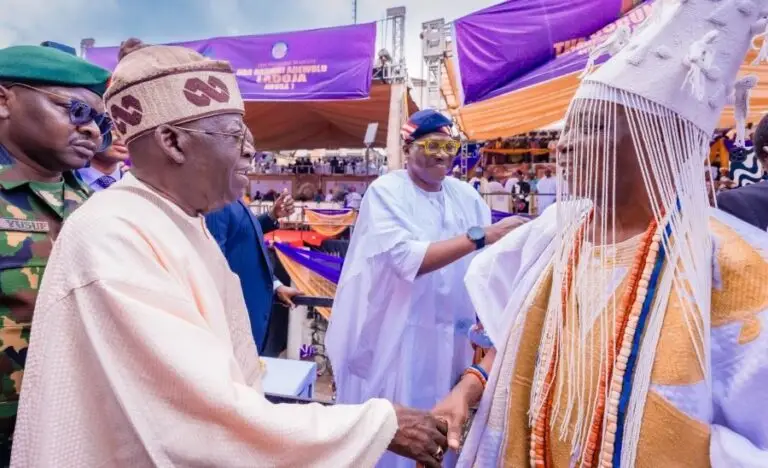
On Friday, President Bola Ahmed Tinubu turned his gaze south-westward to the sprawling city of Ibadan. More than two years since his assumption of office, this was the President’s first visit to Ibadan, regarded as the political and spiritual capital of the Yoruba nation.
Ibadan is not just any city; it is the heartbeat of Yoruba politics and identity, steeped in tradition, intellect, and culture. From Mapo Hall, where nationalist leaders once roused the masses, to Cocoa House, the towering emblem of the Western Region’s prosperity, Ibadan stands as a crucible of Yoruba history.
Historically, Ibadan served as the capital of the old Western Region, where Chief Obafemi Awolowo and his contemporaries pioneered free education, agricultural revolution, and industrial transformation. To the Yoruba, Ibadan represents both a fortress and a fountain, shaping politics and projecting it onto the national stage.
It was in this city that President Tinubu arrived to witness the crowning of Senator Rashidi Adewolu Ladoja as the 44th Olubadan of Ibadanland. The Olubadan stool is unique in Yorubaland, structured on a succession line that embodies Yoruba values of order, merit, and patience. Tinubu’s presence at such a sacred moment was a reaffirmation of his bond with Yoruba tradition and identity.
Serving South West governors, former governors, political heavyweights, the Sultan of Sokoto, and prominent Yoruba monarchs, including the Alaafin, the Soun, and Oba Elegushi of Lagos, attended the coronation.
Tinubu and Ladoja: Politics Without Bitterness
The crowning of Ladoja as Olubadan carried personal significance for President Tinubu. In 2006, during Ladoja’s controversial impeachment engineered by then President Olusegun Obasanjo, Tinubu, then Lagos governor, stood by him. Ladoja, forced out of office and denied justice, found refuge and political backing in Tinubu, which eventually enabled him to reclaim his mandate through the courts.
This long-standing bond reached symbolic closure at the coronation, as Tinubu stood beside his old ally on the day of his ultimate elevation.
An “Emilokan” Moment in Ibadan
Speaking at the historic Mapo Hall, President Tinubu likened Ladoja’s ascension to his own political journey, describing it as another “Emilokan” moment. He emphasized the parallels: Ladoja’s 33-year climb to the Olubadan throne and his own long struggle to the presidency, marked by sacrifices, resilience, and eventual triumph.
Tinubu also delivered a strong political message:
“Today, I am honoured to bring the cheering news that our economy has turned around and there is now light at the end of the tunnel…”
This statement, he noted, validated his administration’s reform agenda and signaled hope for Nigerians.
Ibadan: The Political Capital of the Yoruba Nation
For generations, Ibadan has symbolized Yoruba political expression, from Adegoke Adelabu’s populism to the leadership of Lam Adesina and the reformist zeal of Ladoja himself. Tinubu’s presence underscored cultural affirmation, showing that heritage and tradition remain central to governance at the highest level.
The city went into full celebration, with the streets of Ibadan lined by cheering citizens welcoming the President.
The Significance of Tinubu’s Visit
Like Kaduna in the north, Ibadan remains a crucible of alignments in the south-west. Tinubu’s visit was not just ceremonial; it signaled politics of connection and bridge-building. For the Yoruba elite, it was proof of Tinubu’s enduring bond with his cultural base. For ordinary citizens, it was reassurance that their President has not forgotten them.
Ibadan’s essence has always been its fusion of tradition with progress. Tinubu’s homecoming embodied this, affirming loyalty, patience, and cultural continuity.
As Rasheed Ladoja ascended the Olubadan throne, Ibadan once again became the stage where politics met culture, and history came full circle.
— Sunday Dare (CON) is Special Adviser to the President on Media and Public Communication.