



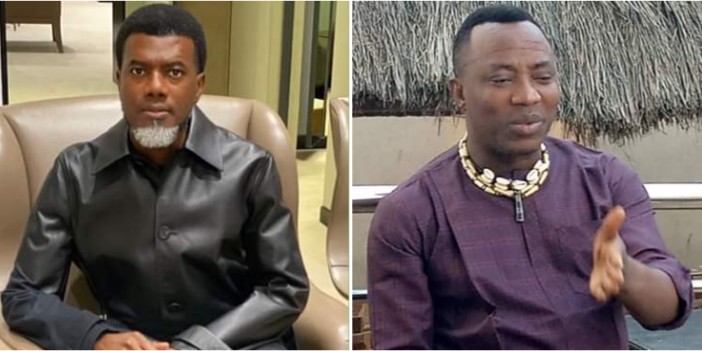
Former presidential aide and public affairs commentator, Bemigho Reno Omokri, has dismissed claims by activist Omoyele Sowore that recent counter-terrorism actions involving foreign support show Nigeria lacks sovereignty, describing such views as misleading and rooted in a poor understanding of international relations.
In a public statement, Omokri said he “strongly disagrees with Mr Omoyele Sowore, and others like him,” who, according to him, are misinforming Nigerians by portraying international military cooperation as a loss of national independence. He argued that seeking or accepting foreign assistance in fighting terrorism does not diminish a country’s sovereignty.
Omokri noted that several “larger and older nations than Nigeria” have, at different times, requested and received direct foreign military assistance, particularly from the United States and its allies, when faced with terrorist threats within their borders. He explained that such cooperation is often necessary when terrorist groups operate close to civilian populations, making conventional military tactics risky for innocent citizens.
“These belligerents are mobile and embed themselves so close to innocent civilian populations that it becomes difficult to use conventional means against them without harming law-abiding citizens,” he said, adding that journalists and members of the public could verify these examples through independent research.
He also faulted Sowore’s description of Nigeria’s government and military as weak, insisting that the country’s armed forces have a long and credible history of international peacekeeping and stabilisation missions. According to Omokri, Nigeria has played decisive roles in restoring peace in several countries, including the Democratic Republic of Congo in 1960, Tanzania in 1964, and Lebanon in 1978.
He further cited Nigeria’s leadership of the Economic Community of West African States Monitoring Group (ECOMOG) operations in the Mano River region—particularly Liberia and Sierra Leone—between 1991 and 2006, as well as interventions that helped restore democratically elected governments in places such as São Tomé and Príncipe.
“When Nigeria’s armed forces intervened in those nations, they did not tamper with or weaken the sovereignty of those countries,” Omokri said. “In fact, we were invited either by the countries themselves, the United Nations, or regional bodies.”
Describing the Nigerian Armed Forces as a “dependable fighting unit with a sterling military record,” Omokri added that Nigerian officers have, due to their training and professionalism, served as Chiefs of Army Staff in other countries.
He, however, acknowledged that combating modern terrorism presents unique challenges. “When you are fighting cowardly terrorists that weave in and out of civilian populations, you need the help of those with precision targeting capabilities,” he said, stressing that no country has ever defeated terrorism entirely on its own.
Omokri also referenced Sowore’s past admission of receiving funding from multiple United States agencies, questioning the logic of branding Nigeria a puppet state for working with foreign partners. “Based on his admission, should that mean he is a foreign puppet, unfit to aspire to leadership in Nigeria? Of course not,” he said.
He urged critics to direct their anger at terrorists and their sponsors rather than at measures aimed at easing the suffering of Nigerians affected by insecurity. According to him, terrorism in Nigeria has claimed lives “of all faiths and ethnicities,” destroyed communities, and disrupted lawful economic activities.
“Projecting anger at anything that will bring relief and succour to those Nigerians most affected by terror is not patriotic,” Omokri said, adding that the foremost responsibility of the state is to protect lives and property “by any legal and moral means necessary and possible.”
He concluded by calling on influential voices to promote unity rather than division, urging them to encourage terrorists to renounce violence, lay down their arms, and embrace peace in line with the Nigerian Constitution.
“May God bless Nigeria,” Omokri said.