



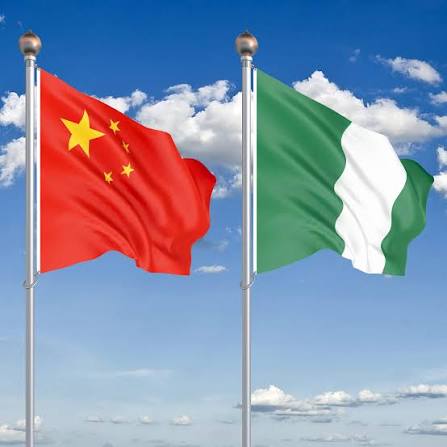
Nigerian and Chinese officials on Saturday, 7th February 2026, used a cultural celebration in Abuja, Nigeria’s capital, to mark 55 years of diplomatic relations and to reaffirm a Comprehensive Strategic Partnership between the Federal Republic of Nigeria, Africa’s most populous country, and the People’s Republic of China, the world’s second-largest economy.
The commemoration took place at the 2026 “Happy Chinese New Year” Temple Fair held at the Chinese Cultural Centre in Abuja, where speakers said the growing partnership should keep improving the lives of citizens in both countries.
Mr Joseph Tegbe, the Director-General and Global Liaison of the Nigeria–China Strategic Partnership, a bilateral platform known as the Nigeria–China Strategic Partnership (NCSP), said Nigeria continues to support the One-China Principle, the long-standing policy that recognises Beijing as the sole legal government of China.
He said the relationship has developed over more than five decades from friendly diplomacy into a working partnership that touches daily life.
“As we welcome the Year of the Horse and mark the 55th anniversary of diplomatic relations between the Federal Republic of Nigeria and the People’s Republic of China, we are reminded that Nigeria and China share the same spirit of resilience and determination as we gallop forward into a future of deeper cooperation and shared prosperity,” Tegbe said.
He praised China’s contributions to Nigeria’s infrastructure plans, mentioning ongoing rail projects and the Lekki Deep Sea Port, located in Lagos State in south-west Nigeria. He said recent engagement was strengthened after President Bola Ahmed Tinubu, Nigeria’s president, visited President Xi Jinping, China’s president, in Beijing in September 2024.
“Permit me to highlight a few areas of progress and opportunity. First, I acknowledge the immense contributions of the Government of China and Chinese enterprises to Nigeria’s infrastructural rebirth, from the ongoing rail revolution to landmark projects such as the Lekki Deep Sea Port, among many others that continue to reshape our economic landscape,” he said.
Tegbe also said Nigeria is drawing lessons from China’s food production record. He said that after an NCSP engagement visit in 2025, Nigeria’s Federal Government launched the National Integrated Poultry Project with an estimated initial combined investment of about $1,000,000,000.
“Second, inspired by China’s remarkable achievements in food security, as observed during NCSP’s engagement visit in 2025, the Federal Government of Nigeria has launched the National Integrated Poultry Project with an initial combined investment of approximately $1,000,000,000. The pilot phase is set to commence in Kaduna, Oyo and Enugu states and will be expanded to other geopolitical zones next year,” he said.
He said the plan is expected to deliver 6,000,000 eggs each day, keep more than 7,000,000 laying birds and more than 2,000,000 broilers, and grow over 60,000 hectares of maize and soybeans. He added that the programme is also designed to help existing farmers through subsidised inputs, alongside providing feedstock for the farms.
Tegbe said the project is meant to go beyond food security by creating jobs and opportunities.
He also said Nigeria plans to revive the Ajaokuta Steel Complex, a major steel project in Kogi State in central Nigeria, through cooperation with China. He said the expected output is 10,000,000 metric tonnes a year.
“Third, the revitalisation of Ajaokuta Steel Complex marks another inspiring chapter in our partnership. Long a symbol of unrealised potential, Ajaokuta is now poised for renewal. A revitalised Ajaokuta will transform Nigeria’s economic trajectory, powering industries, creating jobs and positioning Nigeria as a leading manufacturing and innovation hub in Africa,” he said.
On education and innovation, Tegbe said both countries plan to expand student and scholar exchanges, scholarships, joint research and other cooperation, which he said would support innovation and the development of new industrial parks.
“Fourth, our Knowledge Exchange and Educational Partnerships continue to open doors for Nigerian students to learn from Chinese institutions while welcoming Chinese scholars to Nigeria. In the year ahead, we seek to deepen cooperation through increased scholarships, joint research and shared innovation, culminating in the development of new industrial parks,” he said.
He urged Chinese companies operating in Nigeria to focus on skills transfer, capacity building and partnerships that share benefits between both sides.
China’s Chargé d’Affaires in Nigeria, Mr Zhou Hongyou, China’s acting head of mission in Nigeria, said the 55-year relationship has become “a model of South–South cooperation,” built on mutual respect, equality and what he called win-win outcomes.
He said both presidents upgraded ties to a Comprehensive Strategic Partnership at the 2024 Beijing Summit of the Forum on China–Africa Cooperation (FOCAC), a major forum linking China with African governments.
Zhou said bilateral trade is expanding, infrastructure cooperation is progressing, and both sides are discussing zero-tariff measures that he said can support Nigeria’s modernisation drive.
He also said 2026 has been set aside as the “China–Africa Year of People-to-People Exchanges,” which he said could boost cultural, educational and technology links.
Zhou added that the Fourth Plenary Session of the 20th Central Committee of the Communist Party of China, the top decision-making body of China’s ruling party, recently adopted recommendations for the 15th Five-Year Plan covering 2026 to 2030, which sets out China’s development priorities for the next five years.
He said the Temple Fair reflects the Global Civilisation Initiative proposed by President Xi Jinping, an initiative aimed at encouraging dialogue and learning among civilisations. He also said the Chinese-language radio programme “Ni Hao! China” has been launched on the Federal Radio Corporation of Nigeria, Nigeria’s national public radio network, and that cooperation has expanded in cultural heritage, tourism, education and scientific research.
Both speakers also referenced shared symbolism, noting the Year of the Horse in the Chinese lunar calendar and the horse on Nigeria’s Coat of Arms. They said the horse represents strength, perseverance and forward movement in both cultures.
“These qualities are precisely the defining characteristics of China–Nigeria relations over the past 55 years,” Zhou said.
The Temple Fair included martial arts displays by the Chinese Wushu Association, music and dance performances by Chinese and Nigerian artists, exhibitions focused on Spring Festival culture and tourism, and interactive cultural presentations that organisers said showed growing people-to-people links.