



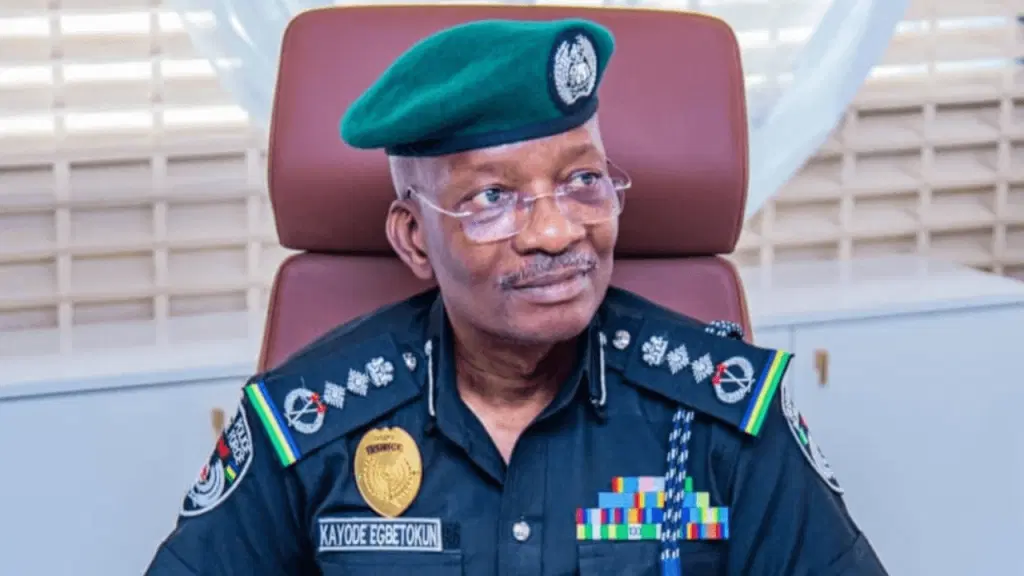
Abuja, Nigeria – President Bola Ahmed Tinubu has removed Inspector-General of Police Kayode Egbetokun following deep disagreements over security reforms, the withdrawal of officers from VIP protection duties and opposition to state police.
Egbetokun submitted a resignation letter on Tuesday, citing “family issues.” However, senior officials familiar with the development said he was summoned to the Presidential Villa and informed that he had to step down.
One insider said, “That Monday evening, he (the President) called him to tell him that he has to go.”
Another source explained that the former police chief asked to complete his four-year tenure, which was expected to end in October 2027 after a 2024 amendment to the Police Act granted Inspectors-General a fixed term. “The former IG was supposed to go in 2027. He begged that he be allowed to complete his term. The President said no, he had to go,” the source said.
The most immediate issue was the handling of a presidential directive issued on Sunday, November 23, 2025, ordering the withdrawal of more than 11,000 police officers from Very Important Personality protection assignments and their redeployment to communities affected by kidnapping, banditry and terrorism.
According to a Presidency official, Egbetokun resisted the move and argued during a security meeting that business leaders required police protection. “One of the issues is the withdrawal of police from VIPs. He didn’t execute it as quickly as the President wanted. He did it halfheartedly. He actually argued against it with the President during the security meeting, saying that the economic actors, the business people need to be protected,” the official said.
President Tinubu reportedly responded that the Nigeria Security and Civil Defence Corps could take over such duties. He was quoted as saying, “the Civil Defence is even more lethal in handling of arms. So, what are you talking about? What is the difference between Civil Defence and the police? They are both carrying arms. So why are you fixated on having police to do that?”
Another source alleged that the VIP deployment structure generated more than ₦300 billion (about $200 million) each year for the police through payments made for assigned officers. “They collect ₦100,000 (about $67) per month from one officer. So, they will give the officer maybe ₦50,000 (about $33). So, the rest goes through the chain. It trickles down,” the insider said.
The President later described the withdrawal order as “non-negotiable” during a Federal Executive Council meeting and directed coordination among the Ministry of Interior, the police, the Nigeria Security and Civil Defence Corps, the National Security Adviser and the Department of State Services.
A second point of tension was Egbetokun’s stance against state police, a proposal currently under consideration by Nigeria’s National Assembly as part of constitutional amendments. A source said, “He is publicly against state police. Even at the National Assembly, the police memorandum that he read when they did public hearing, he was against it.”
Shortly after meeting Egbetokun, the President told state governors at an interfaith dinner that the plan would not be delayed. “Without it, farms cannot flourish, businesses cannot grow, and families cannot sleep in peace. We will establish state police to curb insecurity,” Tinubu declared.
Officials also cited strained relations between Egbetokun and Olatunji Disu, who has been appointed Acting Inspector-General of Police. Both men previously served under Tinubu when he was Governor of Lagos State between 1999 and 2007.
One Presidency source said, “The President doesn’t like people using power against their peers, your friends, people that you grew up with, people that were with you, your colleagues, those who were part of your career growth.”
Egbetokun was appointed Inspector-General of Police on Monday, June 19, 2023. His replacement, Disu, currently serves in an acting capacity pending consideration by the Nigeria Police Council and confirmation by the Senate in line with the Police Act 2020.
The development marks a significant shift within Nigeria’s police leadership as the administration pushes forward with security restructuring and constitutional reforms.