



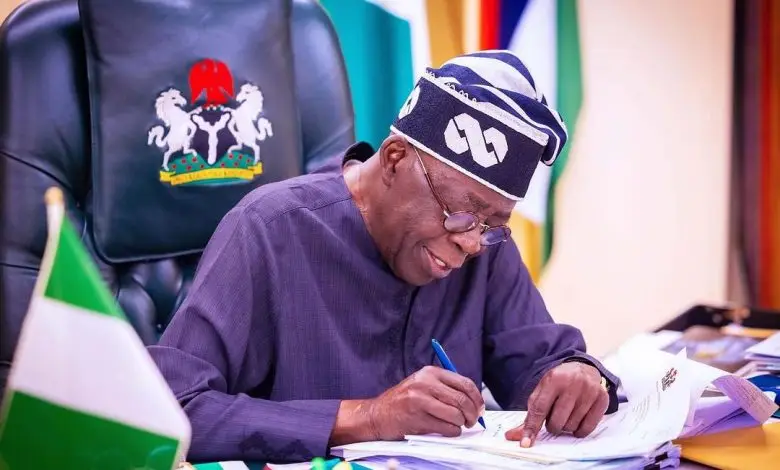
In a decisive move to modernize Nigeria’s fiscal landscape, President Bola Tinubu signed four critical tax reform bills into law on Thursday. The legislation is poised to transform the country’s tax collection architecture by centralizing federally chargeable tax collection under the newly established Nigeria Revenue Service (NRS).
This reform effectively transfers tax collection responsibilities from agencies such as the Nigeria Customs Service, the Nigerian Upstream Petroleum Regulatory Commission, and various federal ministries to the NRS, thereby streamlining revenue administration. The President described the reforms as a gateway to enhanced economic opportunities and international business engagement.
At the signing event in Abuja, President Tinubu remarked, “We have opened the door for new economic and business opportunities. We are showing that Nigeria is truly ready and open for business. Easy in, easy out.” He acknowledged the complexity of tax reforms but praised the resolve shown by all involved parties. “What you have provided is leadership and courage in the face of mounting dispute. Nowhere in the world will tax reforms be any easier.”
The President emphasized that the reforms signal a fundamental shift in fiscal policy, rendering previous tax-to-GDP calculations and other outdated metrics obsolete. “We are in transit. We have changed the rule. We have changed some of the misgivings,” he explained.
The journey to this milestone began in July 2023 when President Tinubu established a Presidential Committee on Fiscal Policy and Tax Reforms, headed by Taiwo Oyedele of PriceWaterhouseCoopers. The committee’s extensive work culminated in the drafting of four bills aimed at unifying Nigeria’s fragmented tax system.
Despite initial resistance from some state governors and lawmakers—particularly concerning revenue-sharing formulas—the bills were eventually passed by the National Assembly in May 2025 after extensive stakeholder engagement. The legislation includes the Nigeria Tax Bill (Fair Taxation), Nigeria Tax Administration Bill, Nigeria Revenue Service (Establishment) Bill, and Joint Revenue Board (Establishment) Bill.
President Tinubu highlighted the reforms’ objectives: eliminating duplication, reducing bureaucracy, restoring investor confidence, and enhancing transparency. He also noted the reforms’ focus on alleviating the tax burden on vulnerable populations.
Zacch Adedeji, Executive Chairman of the NRS, announced that the reforms will be implemented starting January 1, 2026, providing a transition period for all stakeholders. “When you have this kind of change, it’s not what you do mid-year… So effective dates, by God’s grace, will be first of January 2026,” he said.
Taiwo Oyedele described the reforms as “pro-poor,” noting that over one-third of workers will be exempt from personal income tax and that small businesses will no longer be subject to corporate income tax or VAT. He also announced a zero-rate VAT on essential goods and services, including food, education, healthcare, transportation, accommodation, and housing.
On Channels Television, Oyedele stressed the reforms’ emphasis on transparency and digitization, with the NRS collecting comprehensive taxpayer data to curb evasion. He identified closing the tax gap and eliminating wasteful incentives as key revenue sources, aiming to foster economic growth rather than increasing burdens on low-income earners.
Senator Sani Musa and Hon. James Faleke, chairpersons of Senate and House finance committees respectively, praised the reforms as reflective of Nigerians’ aspirations and a product of inclusive consultations. They highlighted the harmonization of tax laws and support for industrial competitiveness.
The Nigeria Employers’ Consultative Association (NECA) welcomed the reforms as a solution to longstanding multiple taxation issues, emphasizing the importance of effective implementation to realize their potential.
Energy sector reforms were also codified within the new laws, according to Special Adviser Olu Verheijen, unlocking billions in investments and providing regulatory certainty for oil, gas, and clean energy industries.
Together, these reforms represent a comprehensive overhaul of Nigeria’s tax system, designed to promote fairness, efficiency, and economic growth.