



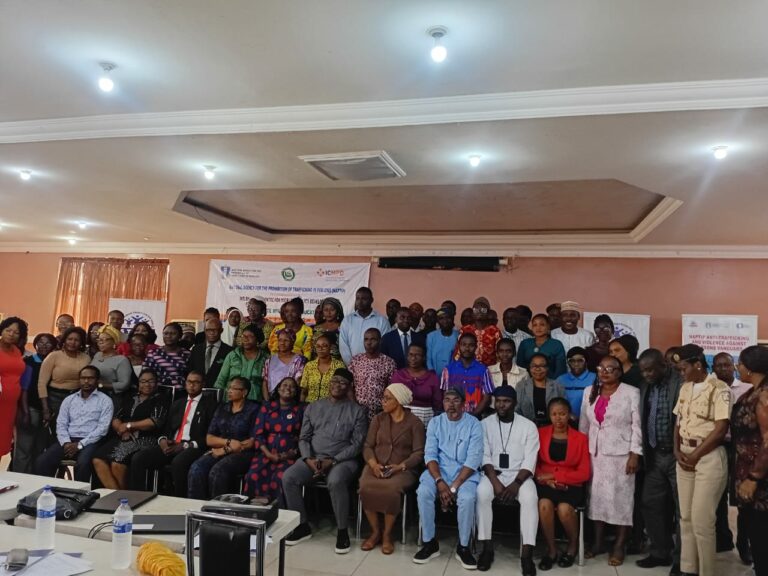
The National Agency for the Prohibition of Trafficking in Persons (NAPTIP) has intensified efforts to engage secondary school principals in Ogun State in the fight against human trafficking. On Thursday, the agency’s Director General, Hajia Binta Bello, urged school leaders to prioritize anti-trafficking initiatives within their institutions.
Human trafficking, Bello explained, ranks as the second most profitable transnational crime worldwide, trailing only drug trafficking, with an estimated annual revenue of $150 billion. Ogun State is particularly vulnerable, being classified as an endemic area for both internal and external trafficking.
At a two-day training workshop held in Abeokuta, 50 principals, who also serve as Coordinators of Anti-Trafficking Vanguard Clubs, were equipped with knowledge to identify and combat trafficking within their schools. The event was organized in partnership with the International Centre for Migration Policy Development (ICMPD).
Bello, represented by Mr. Josiah Emerole, NAPTIP’s Director of Research and Programme Development, emphasized the critical role schools play in early detection and prevention. “Some of these victims are in your schools, you may not know but after this training, you will be able to identify those victims in your schools and see how you can support them,” she said.
The DG highlighted the prevalence of internal trafficking, where children are moved from rural villages to urban centers, often to work in hazardous conditions such as stone quarries. “Trafficking is a crime that has an annual profit of not less than $150bn and some of these funds also belong to Nigerians,” she added.
Rhoda Dia-Johnson, Project Manager of the School Anti-Trafficking Education and Advocacy Project (STEAP) at ICMPD, stressed the importance of schools as protective environments. She described principals as “frontline defenders of children’s rights” responsible for creating safe spaces where exploitation can be detected and addressed.
The Commissioner for Education, Science and Technology, Prof. Abayomi Arigbabu, represented by Akinola Okereafor, expressed the ministry’s support for integrating child protection policies within the education system. He noted that schools serve not only as academic centers but also as foundational spaces for nurturing values and resilience.