



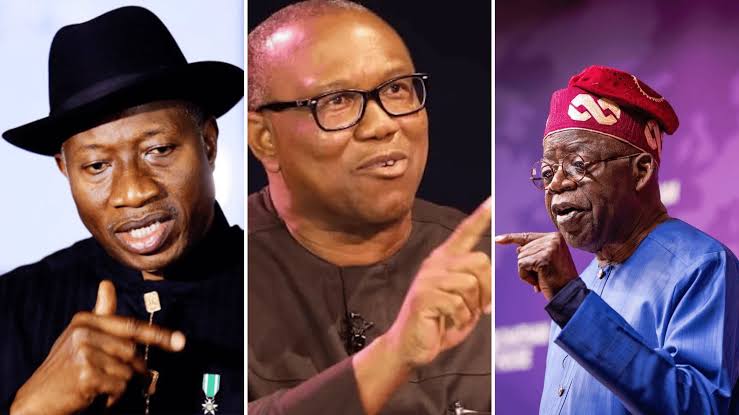
As the 2027 general election draws nearer, President Bola Ahmed Tinubu stands tall as the undisputed political strategist whose legacy, resilience, and achievements have continued to silence critics. While some opponents attempt to project themselves as alternatives, the reality is glaring: Peter Obi is afraid of even contesting a primary election, yet he dreams of clinching the presidency in a general election. On the other hand, former President Goodluck Jonathan, who lost as an incumbent in 2015 to the late Muhammadu Buhari, cannot realistically challenge Tinubu’s political machinery.
Tinubu’s Political Mastery vs Obi’s Fear of Primaries
Peter Obi’s political career has been riddled with indecision and inconsistency. His movement, which once sparked online noise, has failed to transform into real grassroots structures across Nigeria. Unlike President Tinubu, who fought through the trenches of political struggles, Peter Obi has never won a major election through primaries within a strong party structure.
“How can a man who dodges primaries expect to survive the heat of a national election?” a Lagos political analyst questioned. Tinubu’s rise through democratic processes—from being a senator in the Third Republic to two-time governor of Lagos and now President—shows a journey of resilience, not fear.
Jonathan’s 2015 Defeat: A Permanent Political Scar
The memory of 2015 remains fresh in the minds of Nigerians. Goodluck Jonathan, despite being the sitting president, lost woefully to Buhari—a defeat that exposed his lack of political strength and poor strategic calculation.
Jonathan’s era was marked by weak leadership, unchecked corruption, and insecurity that spiraled out of control. It was under his watch that Boko Haram expanded their reign of terror, and the economy suffered its most damaging setbacks. Nigerians cannot forget the billions looted under his administration, nor the power vacuum that weakened governance.
Tinubu’s Achievements: The Dawn of Renewed Hope
President Bola Tinubu, unlike his opponents, has walked the talk in just a short time.
Economic Reforms: From subsidy removal to exchange rate unification, Tinubu has taken bold steps many of his predecessors avoided, positioning Nigeria for long-term stability.
Infrastructure Growth: Through his Renewed Hope agenda, the administration has opened doors to massive infrastructural projects, including roads, housing schemes, and energy reforms.
Political Stability: Tinubu has managed to unite diverse political interests under one umbrella, showing leadership that goes beyond party lines.It is this pragmatic leadership that has earned Tinubu the title of “the master strategist”, a leader whose foresight keeps opponents guessing.
Why 2027 Belongs to Tinubu
The choice for Nigerians in 2027 is clear:
A President who confronts challenges head-on versus an aspirant like Peter Obi, who shies away from primaries.
A tested reformer versus a former president, Jonathan, who lost his mandate at the peak of power.
President Bola Ahmed Tinubu has proven that governance is not about sentiments but about courage, capacity, and competence. As 2027 approaches, Nigerians must rally behind a man who has given his life to democracy, uplifted countless leaders across the nation, and positioned Nigeria for greatness.
“Leadership is not a tea party. It is about vision, sacrifice, and resilience. Tinubu embodies all three,” a political commentator noted.
The future is clear: Tinubu 2027 is not just a possibility—it is an inevitability.