



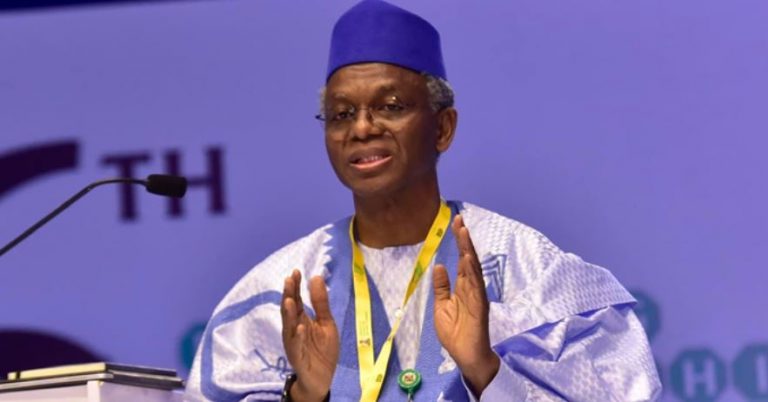
Former Kaduna State Governor, Nasir El-Rufai, has come under heavy criticism from Nigerians after his remarks on Channels Television’s Sunday Politics stirred controversy over his contradictory positions on governance timelines and presidential performance.
During the live interview, El-Rufai stated that a single four-year term was inadequate for any president to make a meaningful impact in Nigeria, dismissing calls for a single-term presidency as unrealistic. He specifically cautioned political figures such as Labour Party’s Peter Obi and former Minister of Transportation Rotimi Amaechi to stop pushing for the idea.
“Four years is not enough to fix Nigeria. You cannot expect any leader to deliver significant transformation in such a short time,” El-Rufai said.
However, in what many Nigerians described as a contradictory statement, El-Rufai in the same program also assessed President Bola Ahmed Tinubu’s administration harshly, declaring that the All Progressives Congress-led government had failed after just two years in office.
“President Bola Ahmed Tinubu has failed after two years. Nigerians are not feeling the impact of his leadership,” El-Rufai asserted, sparking outrage across social media platforms.
Many Nigerians quickly took to X (formerly Twitter) and Facebook, accusing the former governor of double-speak and inconsistency. While some pointed out that El-Rufai himself acknowledged that four years was insufficient for governance reforms, they questioned why he was so quick to dismiss Tinubu’s administration after only two years.
One user wrote: “El-Rufai says four years is not enough to change Nigeria, yet he claims Tinubu has failed after two years. You are confused.”
Another critic commented: “This is exactly the hypocrisy we talk about. Politicians move the goalpost depending on who is in power.”
Political analysts have also weighed in, stressing that El-Rufai’s comments expose the contradictions within Nigeria’s political class. While many acknowledge that governance challenges in Nigeria are deeply rooted and require time, critics say El-Rufai’s judgment of Tinubu after two years contradicts his earlier argument.
Observers noted that his clash with proponents of a four-year single term, including Peter Obi and Rotimi Amaechi, further paints him as inconsistent.
As the debate rages, El-Rufai’s comments have fueled fresh conversations about political accountability, realistic timelines for reforms, and the consistency—or lack thereof—among Nigeria’s political elites.