



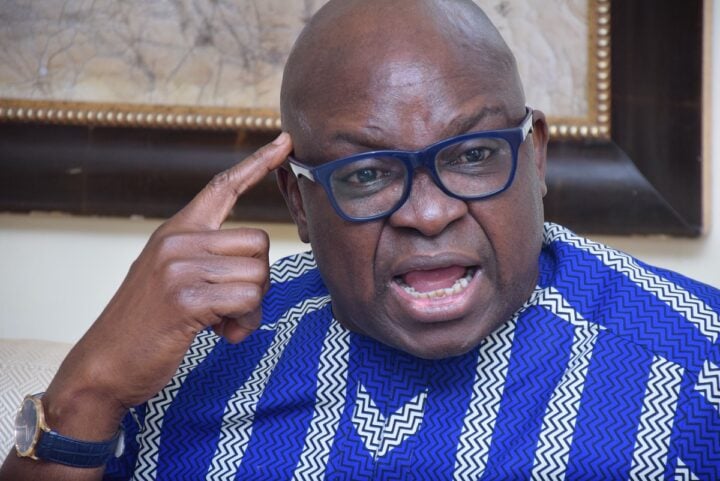
Former Ekiti State Governor Ayodele Fayose accused former Vice President Atiku Abubakar, former national chairman of the Peoples Democratic Party (PDP), Iyorchia Ayu, and Senator Aminu Waziri Tambuwal of being responsible for what he described as the collapse of the opposition party.
The PDP, which governed Nigeria for 16 years before losing power to the All Progressives Congress (APC) in 2015, has in recent months been hit by deep internal divisions and leadership disputes.
Speaking on Politics Today, a programme on Channels Television, Fayose said the party has been weakened by factional battles and legal disagreements. He noted that the PDP is currently split into two camps, with one faction led by Kabiru Turaki (SAN) and another by Abdulrahman Mohammed, who is loyal to Nyesom Wike, the Minister of the Federal Capital Territory and a PDP member serving in the APC led federal government.
Fayose, who has been expelled from the PDP, said the situation has left the party without a clear structure or direction.
“The PDP is now no more. Technically,” Fayose said. “Until there is a pronouncement of the court to say which line of the party is right.”
He went further to name those he believes caused the crisis, saying, “Atiku destroyed the PDP. Tambuwal destroyed the PDP. Ayu destroyed the PDP.”
Fayose also spoke about the wider political space ahead of the 2027 general election, arguing that the opposition lacks strong alternatives. According to him, President Bola Ahmed Tinubu remains in a strong position, while other parties are struggling to gain ground.
He claimed that the African Democratic Congress (ADC) depends largely on former Anambra State Governor Peter Obi, adding that without him, the party would have little impact.
“Peter Obi is the only life in ADC,” Fayose said, suggesting that other figures in the party lack political weight.
Fayose stressed that he has no personal ambition in the ongoing disputes, stating that he is not contesting any election and has not asked anyone for political favours.
The PDP crisis has continued to attract national attention, with court cases, leadership tussles, and resignations further raising questions about the party’s future as Nigeria moves closer to the 2027 elections.