



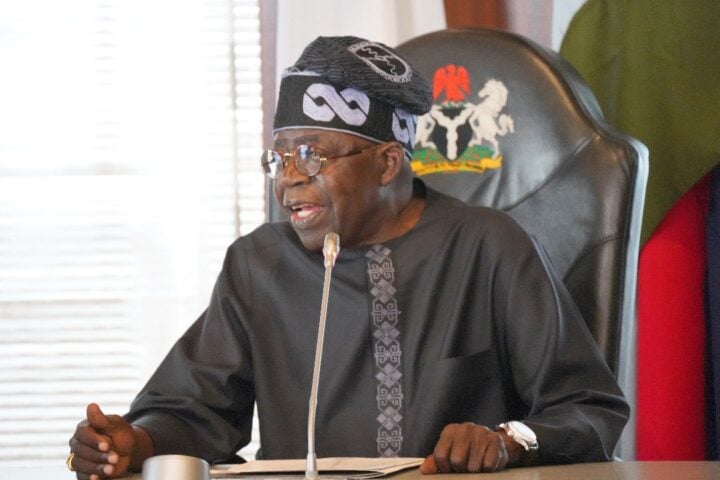
Nigeria’s President, Bola Ahmed Tinubu, on Monday, February 9, 2026, pledged that his government would defeat terrorism and banditry, saying the threats were “unacceptable” and not consistent with the country’s values.
He spoke while opening the Second National Economic Council Conference at the State House Conference Centre in Abuja, Nigeria’s capital, where senior federal officials and state governors met to discuss national development planning and economic coordination.
“I promise you here that I’ll play my part. Seven zones of mechanisation are coming. I promise Nigerians that this will be delivered, and I am here again to further find ways to strengthen our security forces and defeat terrorism.
“That, I promise you, is what has kept all of us sleepless at night, but I assure you we will win with determination and resilience. We will overcome this unacceptable terrorism and banditry. It’s not part of our culture. It’s foreign to us,” he said.
President Tinubu said insecurity has become a barrier to economic growth because it affects farming, transport, investment and daily livelihoods. He urged leaders to treat the security challenge as urgent, noting that communities in several regions have faced attacks linked to insurgency and banditry.
He commended the governors of Borno State in north-eastern Nigeria, Katsina State in north-western Nigeria and Kaduna State in north-western Nigeria, as well as other governors, for their efforts, saying they had done “so much to defend our freedom, liberty and our commonwealth,” he added.
The National Economic Council (NEC) is a major policy coordination body in Nigeria that brings together the Vice President of Nigeria, state governors and key federal officials to align national and subnational economic priorities. It is chaired by Nigeria’s Vice President, Kashim Shettima.
#UnivistaNewsHub reports that the two-day conference is themed “Delivering Inclusive Growth and Sustainable National Development: The Renewed Hope National Development Plan 2026 to 2030,” and is designed to support cooperation among the federal and state governments, development partners and the private sector.
President Tinubu said the council remains important for fiscal federalism and economic governance in Nigeria. He told participants that the moment required practical solutions, shared accountability and measurable outcomes.
The president also highlighted his administration’s economic reforms, saying they had helped stabilise the economy and rebuild confidence. “I must say again at this juncture, the monetary policy that we have embarked on since the reforms has yielded positive results and gained recognition around the world,” he noted.
He praised the Central Bank of Nigeria (CBN), the country’s apex monetary authority, under Governor Yemi Cardoso, for actions he said improved confidence in monetary policy.
President Tinubu said state and local governments were receiving increased and more predictable federal allocations, which he said strengthened their ability to pay salaries, invest in infrastructure and deliver social services. He added that his government had prioritised infrastructure across transportation, power, digital connectivity, housing and irrigation.
He said social investment and human capital programmes had been expanded for vulnerable households, youth, women and small businesses, and pointed to the Renewed Hope Ward Development Project as a grassroots-focused effort built on a bottom-up approach.
On the longer-term plan, President Tinubu said the Renewed Hope National Development Plan 2026 to 2030 focuses on economic diversification and productivity, human capital development, stronger competitiveness among states based on comparative advantage, private sector-led growth and climate resilience.
He said the plan would succeed only if state and local governments implement it effectively, and he urged leaders to move from announcements to implementation through data-driven decisions, peer learning among states and innovative financing.
President Tinubu said he expected conference resolutions to help drive agricultural diversification, including dairy farming, livestock investment and ranching.
The statement was signed by Bayo Onanuga, Special Adviser to the President on Information and Strategy, and dated Monday, February 9, 2026.