



By Michael Chibuzo
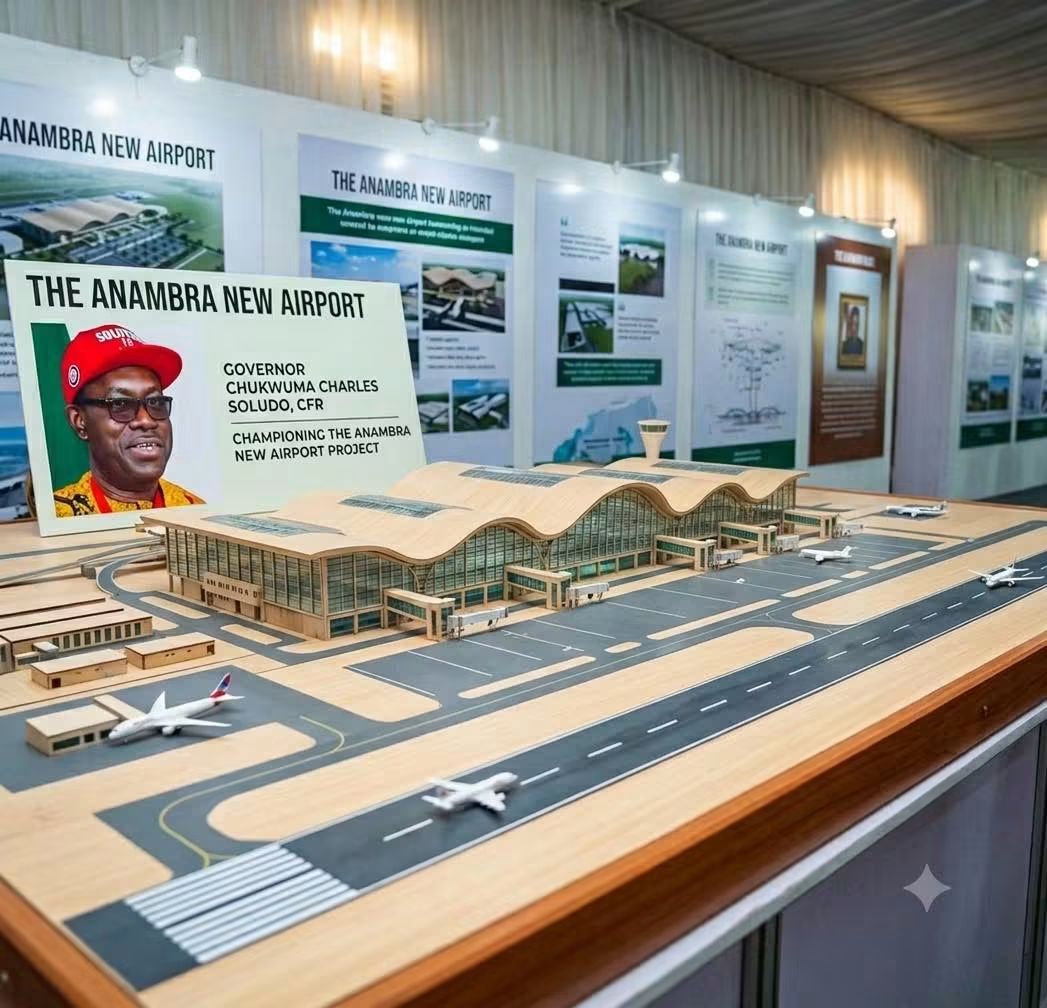
Anambra State government led by Prof. Charles Soludo has commenced early works on the site of Anambra’s second international airport project located at Ndikelionwu in Orumba North local government area. This second airport is billed by the Soludo administration as the centrepiece of the aerotropolis that forms a critical component of his ambitious Mixed-Use Industrial City sitting on over 4000 hectares of land spanning Aguata, Orumba North and Orumba South local government areas.
Make no mistake, the mixed-use industrial city concept is not a bad idea, unfortunately, the aerotropolis aspect of the project design is bad economics. And for many reasons.
Let us first take a look at what the whole AMIC is all about.
The proposed AMIC according to Governor Soludo is intended to transform Anambra into a globally competitive industrial and commercial hub by integrating manufacturing, finance, logistics, housing and infrastructure within a single master-planned city. The project aims to consolidate Anambra’s existing entrepreneurial strengths in trade and manufacturing into a modern ecosystem featuring industrial parks, a financial district, export facilities, residential and leisure areas, renewable energy, rail connectivity and a Free Trade Zone.
The project’s objective is to attract foreign direct investment, achieve economies of scale, improve supply chain efficiency, boost exports and position Anambra as a major centre for manufacturing and international trade, with the proposed aerotropolis and international cargo airport intended to enhance connectivity for export-oriented industries.
On paper, this sounds superb, but when you throw in some existing realistic data, some aspects of the project begins to defy logic especially when you juxtapose the project with what one may consider as Anambra’s pressing needs vis-a-vis the government’s financial position.
The truth of the matter is that Gov. Soludo can actively push for the creation of a mixed-used industrial city WITHOUT the second cargo airport component. Anambra simply does not need a second airport. There is no economic model that makes it mandatory for an airport to be sited right within a free trade zone or an industrial estate before it becomes viable to investors. As a matter of fact, air transportation does not come close to driving international trade the way water transportation does.
In Nigeria, airports play only marginal roles in the movement of goods in and out of the country. To prove this, let us look at Nigeria’s Q4 2025 foreign trade statistics to provide an important reality check on our cargo transport infrastructure.
The National Bureau of Statistics’ ranking of the top 10 Posts/Ports of Operation for the fourth quarter of 2025 shows that maritime ports overwhelmingly dominated both exports and imports.
For exports, Apapa Port alone accounted for 72.63% of Nigeria’s total export value, followed by Lekki Deep Sea Port (14.85%), Tin Can Island Port (6.05%), and Onne Port (4.94%). These four seaports together handled over 98% of Nigeria’s export value!
The only international airport that appeared in the top ten was Murtala Muhammed International Airport, Lagos, which ranked fifth with exports worth N107.4 billion. This represents just 0.57% of Nigeria’s total exports within the quarter.
The import data tell a similar story. Apapa Port accounted for 47.87% of imports, followed by Tin Can Island Port (14.84%), Lekki Deep Sea Port (7.14%), and Onne Port (7.00%). Again, the only airport in the top ten was Murtala Muhammed Cargo, ranking seventh with imports worth N495.0 billion, representing only 2.87% of total imports.
These figures show a stark economic reality – Nigeria’s international trade is overwhelmingly seaborne. That makes one to wonder what is the economic sense behind the increasing investment in so-called international cargo airports by state governments across Nigeria.
But the above data is not surprising. Air freight is significantly more expensive than sea freight and is generally reserved for high-value, lightweight, time-sensitive products such as pharmaceuticals, perishables and urgent industrial components. By contrast, Nigeria’s export basket is dominated by crude oil, liquefied natural gas, agricultural commodities and other bulk products that are far more efficiently transported by sea. Likewise, imports of machinery, vehicles, construction materials and consumer goods are generally too bulky and costly to move by air.
In the light of the above reality, there are two major questions that we need to ask Governor Charles Soludo regarding his unnecessary second airport adventure:
1. What kind of industries does he hope to attract into the proposed Anambra mixed-use industrial city that would rely on air freight mostly to import inputs and export outputs?
2. Why does he think that Chinua Achebe international cargo airport in Umueri cannot serve the AMIC located in the Aguata axis?
From an economic perspective however, I strongly believe that cargo airport should be developed where there is present or viable demand for such services. Cargo airports do not generate trade by themselves, they serve either existing production, manufacturing and logistics ecosystems. Without sufficient export-oriented industries, high-value manufacturing clusters, or sustained cargo demand, a new cargo airport in Anambra State will become another underutilised airport with high maintenance costs and low economic returns.
To further underscore how bad an economic decision Soludo’s second airport project is, I will use Lagos State as a case study. Lagos today currently has thirteen (13) free trade zones and they include:
1. Lagos Free Trade Zone
2. Newrest Airline Services & Logistics Free Zone
3. Snake Island Integrated Free Zone
4. LADOL Free Trade Zone
5. Lekki Free Trade Zone
6. Nigeria Aviation Handling Company (NAHCO) Free Trade Zone
7. Nigeria International Commerce City (Eko Atlantic)
8. Quits Aviation Services Free Zone
9. Dangote Industries Free Zone Development Company
10. Flour Mills of Nigeria Free Trade Zone (Lagos & Ogun)
11. Alaro City Development Free Zone Company
12. Nasco Town Free Trade Zone
13. Itana Free Zone Management Company
These 13 free trade zones in Lagos, in addition to hundreds of companies outside these zones, are serviced by one international airport in Ikeja. In fact from Lekki Free Trade Zone, covering over 16,000 hectares of land, to the Murtala Mohammed International Airport in Ikeja is approximately 70km in distance and takes an average of 2 hours of road journey. By contrast the distance between the proposed Anambra mixed-use industrial city (4000 hectares only) in the old Aguata region to the Chinua Achebe International Cargo airport at Umueri is just 49km and takes roughly one hour of road journey.
So, what prevents the Soludo administration from upgrading Umueri cargo airport to serve the AMIC just 49km away?
Again, how does Governor Soludo intend to fund the second airport project while also continuing to maintain the Umueri Airport? If publicly available data is anything to go by, former Governor Willie Obiano spent over N18 billion of public funds to build the Umueri Airport as at 2021. Today an airport project of the magnitude Gov. Soludo is planning at Ndikelionwu would cost from N50 billion above. Without mincing words, that would be a pure waste of resources.
At the risk of sounding pessimistic, the reality today in Anambra is that trade by industries and companies located in Anambra does not happen via air transport and this is unlikely to change in the next couple of decades. For example, it is simply not cost effective for a pharmaceutical company located in the mixed-used industrial city to import raw materials from say Norway or China via an airline considering the cost. It will negatively impact on its final product cost and invariably, competitiveness.
Businesses look for the best way to reduce logistical costs and the Anambra state government cannot compel a manufacturing company to incur extra freight costs to import inputs or export its products using the cargo airport instead of going through shipping.
So, the cargo airport will be reduced eventually to another Umueri Airport with just one or two flights daily, most of which would be purely domestic passenger flights. Also, it will be hard to even convince international carriers to deploy aircrafts to the Ndikelionwu cargo airport if there is no sufficient regular international traffic, that is of course assuming that the airport gets clearance by countries for international flights to emanate from Ndikelionwu.
So, no matter how one views the second airport project, it simply does not make economic sense and must be shelved. Anambra State cannot afford such an unwise use of public funds especially when we are not even having industrial outputs at scale for export market. I really hope that Governor Soludo will remove the Ndikelionwu airport component from his laudable Anambra Mixed-Use Industrial City project.