



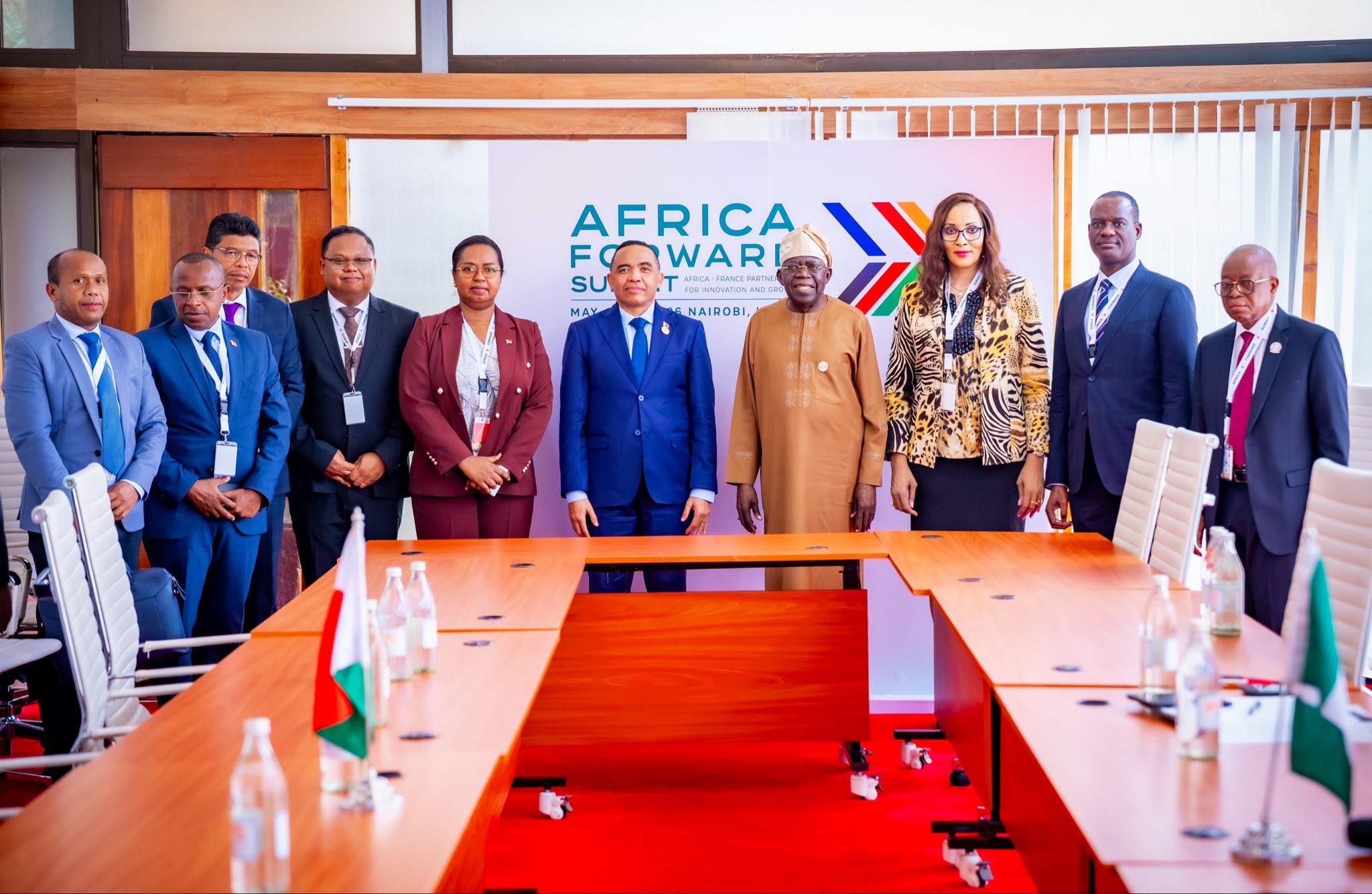
President Bola Ahmed Tinubu has called for a comprehensive reform of the global financial architecture to support Africa’s industrialisation and economic growth.
Speaking at the Africa Forward Summit in Nairobi, Kenya, President Tinubu argued that the current international financial system places African nations at a disadvantage by limiting access to affordable capital and increasing borrowing costs.
The summit, co-hosted by French President Emmanuel Macron and Kenyan President William Ruto, brought together leaders, diplomats, and business executives from more than 30 countries to discuss Africa’s economic future and global partnerships.
At the summit, President Tinubu highlighted Nigeria’s commitment to economic reforms and regional cooperation, particularly in the maritime and blue economy sectors.
He announced that Nigeria would strengthen regional coordination by making its Deep Blue Project maritime intelligence infrastructure available as a shared data hub for willing Gulf of Guinea countries.
According to the President, improved maritime security, harmonised regulations, and stronger regional enforcement would attract private investment, modernise ports, and accelerate the digital transformation of Africa’s maritime sector.
He stressed that ocean governance and maritime sovereignty are essential pillars for unlocking the continent’s blue economy potential.
The Nigerian leader also used the platform to criticise global financial structures that, according to him, continue to undermine Africa’s industrial ambitions.
Tinubu noted that despite decades of political independence, Africa still contributes less than two per cent of global manufacturing value added because many countries remain dependent on exporting raw materials while importing finished products at higher costs.
He argued that African economies are burdened by high interest rates, restrictive financial policies, and illicit financial flows that deprive industries of affordable financing.
The President maintained that the international system must evolve to support Africa’s industrial growth rather than perpetuate economic dependency.
Defending Nigeria’s recent economic policies, Tinubu said the country had undertaken difficult but necessary reforms, including the removal of fuel subsidies, exchange rate unification, banking sector recapitalisation, and efforts to improve financial transparency.
He explained that these measures had strengthened investor confidence, increased external reserves, and improved Nigeria’s debt profile.
However, he warned that the country still faces enormous debt servicing obligations, with Nigeria projected to spend about $11.6 billion on debt repayment in 2026.
According to him, these financial pressures reduce the resources available for critical sectors such as manufacturing, infrastructure, energy, and digital innovation.
Beyond economic matters, President Tinubu urged African countries and international partners to address the root causes of irregular migration by creating jobs, improving security, and expanding legal migration pathways.
He emphasised that people are less likely to risk dangerous migration journeys when they have opportunities and hope in their home countries.
President Tinubu called on development partners to dedicate more funding to climate adaptation, digital skills, agriculture, and youth employment initiatives across Africa.
The President was accompanied to the summit by senior ministers and prominent Nigerian business leaders, including Aliko Dangote, Tony Elumelu, Abdulsamad Rabiu, and Aigboje Aig-Imoukhuede, all of whom participated in discussions focused on trade, industrialisation, innovation, and Africa’s economic transformation.