



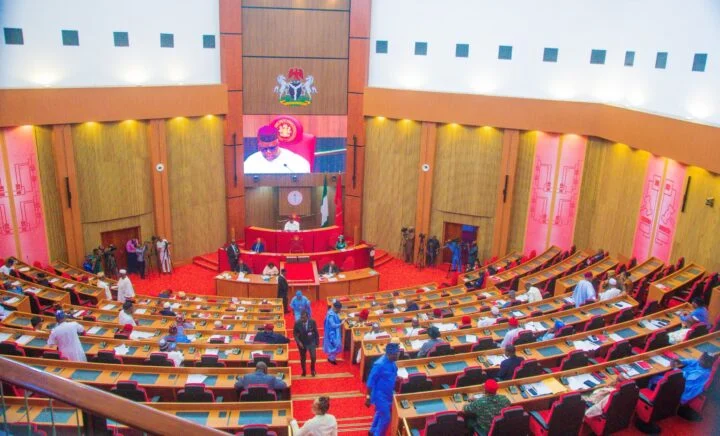
The Nigerian Senate is weighing a bill to expand the number of Supreme Court Justices from 21 to 30, a move intended to reduce the extensive backlog of cases and enhance the operational capacity of the court.
Senator Osita Izunaso, the bill’s sponsor, made this announcement during a press conference in Abuja, marking his second anniversary in the 10th National Assembly. He noted that, despite the appointment of 11 new justices in 2023—completing the court’s constitutional quota for the first time—the Supreme Court remains under significant strain.
“Even with the full complement of 21 justices, the Supreme Court is overwhelmed. The volume of cases reaching the court daily is alarming. Some litigants are being given hearing dates as far ahead as 2027 and 2028,” Izunaso observed.
The proposed increase would allow the Supreme Court to establish more panels, thus expediting the hearing and resolution of cases. “Supreme Court justices typically sit in panels of five, or seven for constitutional matters. If we have 30 justices, it allows the formation of at least five panels simultaneously. That way, more cases can be handled at a faster pace,” he explained.
Izunaso is also advocating for a shift in the types of cases the Supreme Court hears. He criticized the current practice of admitting minor disputes, such as land and tenancy cases, to the highest court. “Why should a land matter in my village end up in the Supreme Court?” he queried, suggesting that such cases should be resolved at lower courts.
He further argued that the Supreme Court should prioritize matters of national or constitutional importance, such as terrorism and high-profile corruption. He recounted a personal experience where a case, already resolved at the family level, was still scheduled for a Supreme Court hearing years later.
Rejecting the idea of regional Supreme Courts, Izunaso stressed the importance of a single, unified apex court and called for improved case filtration at lower judicial levels.
Additionally, Izunaso praised President Tinubu for posthumously honoring Professor Humphrey Nwosu, the former electoral commission chairman who oversaw the landmark 1993 presidential election. He urged the government to further commemorate Nwosu by naming the INEC headquarters after him.