



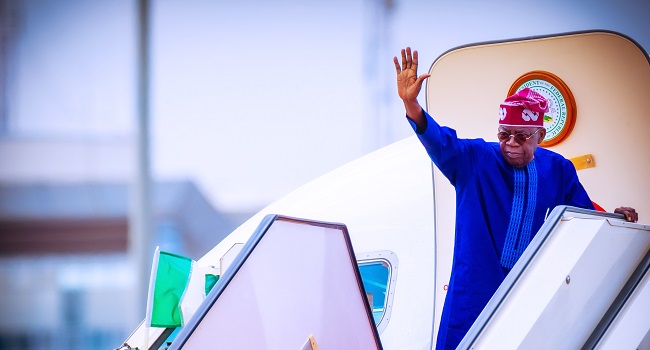
The Nigerian Presidency has clarified the nature and significance of President Bola Tinubu’s state visit to Saint Lucia, describing it as a critical diplomatic and cultural mission. The visit is intended to revive Nigeria’s ancestral connections and strengthen strategic partnerships with the Caribbean nation and the wider CARICOM bloc.
In a statement by Bayo Onanuga, the President’s Special Adviser on Information and Strategy, the Presidency responded to criticism from some Nigerians who mischaracterized the visit as a leisure trip. Onanuga emphasized that the visit “paves the way for the rekindling of our ancestral bonds, igniting a new era of diplomatic, cultural, and economic possibilities.”
Saint Lucia’s historical ties to Nigeria are rooted in the mid-19th century migration of people from present-day Nigeria, who brought enduring cultural and religious traditions to the island. The people of Saint Lucia have expressed enthusiasm about Tinubu’s visit and the prospect of deepening relations with African countries sharing their heritage.
The visit aligns with Nigeria’s Four D’s foreign policy framework—Democracy, Development, Diaspora, and Demography—and reflects South-South cooperation objectives. Saint Lucia is the seat of the Organisation of Eastern Caribbean States (OECS), serving as a gateway to 15 CARICOM countries with a combined GDP exceeding $130 billion, highlighting the economic potential of strengthened ties.
The statement recalled the legacy of Sir Darnley Alexander, a Saint Lucian who served as Nigeria’s Chief Justice between 1975 and 1979, underscoring the historical interconnections between the two countries. Other Saint Lucians have contributed significantly to Nigeria’s development, including Neville Skeete and Michael Alexander.
Culturally, the visit supports the African Union’s Sixth Region agenda, which recognizes the African diaspora as a partner in Africa’s development. Nigeria’s cultural exports, such as Afrobeats and Nollywood, have gained popularity in Saint Lucia, with Nigerian music recently dominating a major local cultural event, the Gros Islet Street Party.
On democratic values, the Presidency noted that Saint Lucia’s stable parliamentary democracy complements Nigeria’s 26 years of continuous democratic governance. A Saint Lucian commentator described President Tinubu as a “fighter for democracy” during his arrival.
Demographically, Nigeria’s rapidly growing population is seen as a driver for economic transformation, with education and innovation as key priorities. Tinubu’s itinerary includes a visit to Sir Arthur Lewis Community College to foster educational cooperation.
The Nigerian Technical Aid Corps, part of the delegation, provides professional services to ACP countries, demonstrating Nigeria’s commitment to regional development.
A reception hosted by Saint Lucia’s Prime Minister will allow the Nigerian community to engage directly with President Tinubu, further strengthening bilateral relations.
Saint Lucia, independent since 1979, has hosted very few official state visits, with the last African leader visitor being Nelson Mandela in 1998, making Tinubu’s visit a historic milestone.
Tinubu will deliver a special address to a joint session of Saint Lucia’s Parliament at the Sandals Grande Conference Hall, named after former U.S. President Bill Clinton.
The Presidency concluded by stressing that the visit is a strategic diplomatic and cultural engagement aimed at advancing Nigeria’s interests globally.