



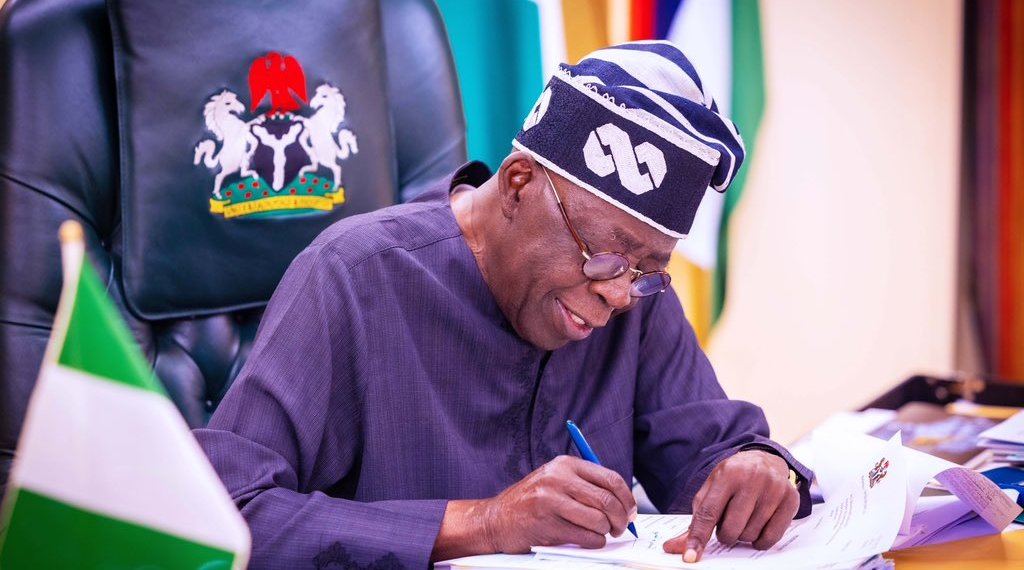
President Bola Ahmed Tinubu has declared a nationwide state of emergency on national security, directing the Nigerian Police Force, Department of State Services (DSS), and other security agencies to immediately increase personnel and strengthen operations across the country.
In a statement released via his official media centre, Tinubu said, “Today, in view of the emerging security situation, I have decided to declare a nationwide security emergency and order additional recruitment into the Armed Forces. By this declaration, the police and the army are authorised to recruit more personnel.”
The President specified that the police would recruit an additional 20,000 officers, bringing the total new intake to 50,000. He further instructed that existing National Youth Service Corps (NYSC) camps be used as temporary training depots, while officers withdrawn from VIP duties should undergo crash training before redeployment to high-risk areas.
Tinubu also granted the DSS authority to deploy trained forest guards to combat terrorists and bandits hiding in forests, with the agency tasked to recruit additional personnel to eliminate “hiding places for agents of evil.”
“This is a national emergency, and we are responding by deploying more boots on the ground, especially in security-challenged areas. The times require all hands on deck. As Nigerians, we should all get involved in securing our nation,” he stated.
The President commended security agencies for their recent efforts, including the rescue of 24 schoolgirls in Kebbi and 38 worshippers in Kwara State. He affirmed that operations would continue to free remaining hostages, such as students held in Niger State.
Addressing the armed forces, Tinubu urged officers to uphold “the highest standards of discipline and integrity,” warning that “there must be no compromise, no collusion, and no negligence.” He also pledged the federal government’s support for state security outfits established to protect local communities.
Highlighting broader security reforms, Tinubu called on the National Assembly to review laws allowing the establishment of state police, advised schools, mosques, and churches in remote or vulnerable areas to secure police protection, and encouraged herder associations to adopt ranching to reduce conflicts with farmers.
He concluded by sympathising with victims of recent attacks in Kebbi, Borno, Zamfara, Niger, Yobe, and Kwara States, paying tribute to fallen soldiers including Brigadier-General Musa Uba, and warning those who “want to test our resolve” not to mistake government restraint for weakness.