



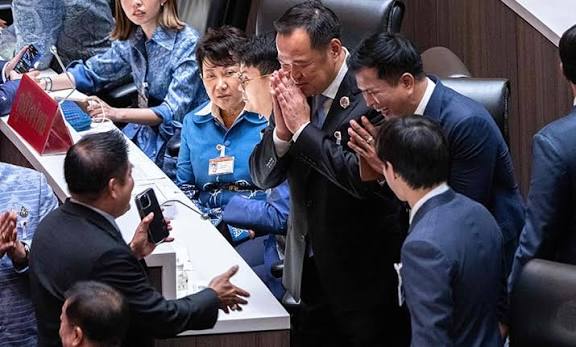
Thailand’s parliament on Thursday, March 19, 2026, elected Anutin Charnvirakul as prime minister, confirming his leadership after his party emerged dominant in the country’s recent general election.
The decision was announced by House Speaker Sophon Zaram, who stated that Anutin received a clear majority of votes from lawmakers. He secured 293 votes, while opposition figure Natthaphong Ruengpanyawut got 119 votes, and 86 legislators chose to abstain.
Ahead of the vote, Anutin said, “I hope to remain in my position to serve the people for as long as I can.” He also said, “Those who know me understand that whenever there is a problem affecting the public, I will respond immediately to their needs.”
Anutin’s victory follows a strong showing by his Bhumjaithai Party in the February 2026 elections, where it outperformed its rivals. The party’s success allowed it to take the lead in forming a coalition government.
The new administration includes the Pheu Thai Party, linked to former prime minister Thaksin Shinawatra, along with 14 smaller parties. This coalition arrangement gave Anutin the support needed to secure parliamentary approval.
He first became prime minister in September 2025 after replacing Paetongtarn Shinawatra, who was removed from office by a court ruling over an ethics issue. The controversy was linked to a leaked phone call that caused public backlash and political tension.
The opposition will now be led by the People’s Party, which finished second in the election. However, its position may be weakened as 10 of its lawmakers, including leader Natthaphong, face possible sanctions over an ethics dispute tied to proposed changes to the country’s royal insult law.
Before the vote, Natthaphong said the opposition would “utilise this parliamentary stage to effectively communicate with our fellow citizens”.
Thailand’s new government faces several immediate challenges. The country’s economy has slowed, with tourism struggling and competition for foreign investment increasing, especially from Vietnam.
Global developments have also added pressure. Rising tensions in the Middle East have disrupted markets, leading to higher fuel prices and supply concerns in Thailand.
Anutin had earlier promised to “turn this Middle East crisis into an opportunity for Thailand”, but analysts say stronger economic policies are needed.
In addition, tensions with neighbouring Cambodia remain unresolved. Although a ceasefire is in place, disputes over parts of their shared border continue after clashes in 2025.
Analysts say economic concerns are now the main focus for voters, placing pressure on the new government to deliver quick and effective solutions.