



By Michael Chibuzo
For almost seven decades, Nigeria’s electricity sector has moved in circles and in slow motions. Every administration in Nigeria including the military government has always promised to “finally solve” the power problem, yet the national grid continues to collapse under the weight of chronic underinvestment, socialist pricing, policy inconsistencies, vandalism, and most importantly, a funding model that simply cannot sustain itself.
Despite expanding from a population of around 44 million in 1960 to over 220 million today, Nigeria’s national power grid has simply failed to keep up. Before I delve fully into our present electricity quagmire, let me take a historical detour to outline certain facts that many Nigerians today are most likely unaware of and which is necessary to give us an idea of where we were coming from.
Nigeria’s journey from local grids to a national grid
Between 1960 and 1966, there was nothing like the “national power grid” in Nigeria. Regional governments had their own independent electricity systems, local grids, and generation schemes. Electricity supply was not centralized. In fact the first high voltage transmission line in Nigeria was the 132KV Lagos-Ibadan transmission line completed under the Tafawa Balewa government to transmit electricity from the Ijora power station in Lagos to Ibadan through Shagamu and then later to Benin and Ughelli.
Electricity generation and distribution was done in clusters around major urban centers and were mostly diesel/thermal power stations apart from Oji River power station serving Enugu and environs, which was coal-fired. Port Harcourt got its electricity from Diobu Diesel Power Station, Afam I-IV; Calabar was supplied by Calabar diesel power station; Delta was supplied by Delta Gas. The story in northern Nigeria was similar. Before 1968/1969 when Kainji hydropower came on stream, northern cities such as Kaduna, Kano, Katsina, Sokoto etc were supplied electricity by local diesel generating stations inherited/built by the Electricity Corporation of Nigeria.
The commissioning of Kainji marked the beginning of a high-voltage grid supply to Northern Nigeria through a 330 kV transmission line which ran from Kainji to Jebba to Kaduna to Kano. In fact,
Kaduna and Kano became major northern grid nodes while, Zaria, Sokoto and other cities were later fed via sub-transmission extensions. Effectively, the northern grid was taking shape. Kainji hydropower (built and managed by Niger Dam Authority, NDA) sold its generated electricity to ECN who then transmits to the final consumers mostly around urban centers.
The foundational framework for our national grid was laid by Gen. Aguiyi Ironsi when in 1966 he promulgated the famous Decree No. 1 nationalising key regional establishments and utilities, with the stated goal being to centralize control of strategic services and reduce regional fragmentation. However, the actual operationalisation of the national grid happened in 1972 as Gen. Yakubu Gowon merged the Electricity Corporation of Nigeria and the Niger Dams Authority into one national entity – NEPA!
NEPA took over generation, transmission and distribution of power across the country and began to build high voltage transmission lines to link the entire country, especially to evacuate from Kainji to the entire country. It also centralised electricity pricing and introduced subsidy. That marked the beginning of Nigeria’s problem with the national grid. In order to stabilise the national grid (due to rising imbalance between electricity demand vs supply), NEPA had to construct additional hydropower plants – Jebba further down the River Niger and the 600MW Shiroro plant on the Kaduna river, which is a tributary of River Niger. More thermal plants were also constructed including the Egbin power station in 1985, which is Nigeria’s biggest thermal plant with an installed capacity of 1,320 MW.
However, from 1990 till the early 2000s, investment by NEPA in more power generation, transmission and distribution facilities stalled in addition to poor maintenance of existing facilities. Most importantly, NEPA became a cesspool of corruption just like many government-run businesses with a very unsustainable subsidy regime which was basically preventing expansion.
Reality of Nigeria’s Stranded Power Sector in Numbers
In the early 2000s, Nigeria had 9 major power generation plants with available capacity hovering around 2,000 MW. The transmission grid had a wheeling capacity of around 3,000MW with an lower distribution capacity.
Today, Nigeria has around 33 grid-connected power plants with a total installed capacity of over 14,400 MW and transmission grid wheeling capacity of 8,500MW. The power plants include:
1. AFAM III FAST Power – 110 MW
2. AFAM VI (Gas/Steam) – 624 MW
3. ALAOJI NIPP (Gas) – 1,074 MW
4. AZURA-EDO IPP (Gas) – 461 MW
5. DADINKOWA G.S – 39 MW
6. DELTA (Gas) – 900 MW
7. EGBIN (Steam/Gas) – 1,320 MW
8. GBARAIN NIPP (Gas) – 225 MW
9. GEREGU (Gas) – 435 MW
10. GEREGU NIPP (Gas) – 434 MW
11. GPAL (Gas) – 141 MW
12. IBOM POWER (Gas) – 191 MW
13. IHOVBOR NIPP (Gas) – 451 MW
14. JEBBA (Hydro) – 578 MW
15. KAINJI (Hydro) – 760 MW
16. KASHIMBILA GS (Hydro) – 40 MW
17. MEPP (Gas) – 50 MW
18. ODUKPANI NIPP (Gas) – 625 MWW
19. OKPAI (Gas/Steam) – 480 MW
20. OLORUNSOGO (Gas) – 335 MW
21. OLORUNSOGO NIPP (Gas) – 676 MW
22. OMOKU (Gas) – 225 MW
23. OMOTOSHO (Gas) – 335 MW
24. OMOTOSHO NIPP (Gas) – 451 MW
25. PARAS ENERGY (Gas) – 96 MW
26. RIVERS IPP (Gas) – 150 MW
27. SAPELE (Steam) – 1,020 MW
28. SAPELE NIPP (Gas) – 451 MW
29. SHIRORO (Hydro) – 600 MW
30. TAOPEX (Gas) – 60 MW
31. TRANS AFAM POWER – 2,000 MW
32. TRANS-AMADI (Gas) – 136 MW
33. ZUNGERU (Hydro) – 700 MW
Unfortunately, we cannot distribute more than 6,000MW without having a grid disturbance due to our fragile transmission and distribution network. In recent weeks, electricity supply has even worsened in many parts of the country due to a liquidity storm that has been building up for years thanks to an unsustainable electricity subsidy regime and chronic lack of investment in power assets.
On 26th March, 2026 at precisely 12pm, I took a real-time snapshot from the national grid, which revealed that only 3,340 MW was being generated at the time by 17 out of the 33 power plants connected to the national grid.
These 17 hydropower and gas-fired plants include:
Jebba hydro – 411 MW
Kainji hydro – 466 MW
Shiroro hydro – 297.17 MW
Dadin Kowa hydro – 17.15 MW
Azura-Edo IPP (Gas) – 433 MW
Egbin (Steam/Gas) – 473 MW
Delta (Gas) – 301 MW
Geregu NIPP (Gas) – 106 MW
Olorunsogo NIPP (Gas) – 102.10 MW
Paras Energy (Gas) – 104.90 MW
Okpai (Gas/Steam) – 271 MW
Omotosho (Gas) – 27.50 MW
Omoku (Gas) – 19 MW
Afam III Fast Power – 75.50 MW
Afam VI – 110 MW
Olorunsogo (Gas) – 33.30 MW
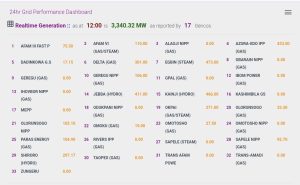
From the above data, it is clear that Hydro plants like Kainji, Jebba, and Shiroro provided the most stable contributions while majority of the thermal plants, which are responsible for roughly 70% of Nigeria’s installed capacity were either offline or operating far below their capacity due to among other things, inability to secure gas supply due to liquidity issues and ongoing major repairs on critical gas pipelines. This is the reality of our electricity sector today and this reality seems to be persistent mostly due to liquidity challenges and not really because of temporary pipeline repairs.
The Liquidity Crisis at the Heart of our Power Reality
At the core of the power crisis is the simple fact that electricity is not priced at what it costs to produce. This is undeniably the single most important contributory factor to our electricity quagmire. For over four decades, the sector has survived on subsidies that the government cannot sustain, leading to mountain of debts owed to gas suppliers and power generators in the post-privatisation era. The resultant effect of these debts is chronic underinvestment in maintenance of power facilities, inability to ramp up generation and distribution capacity. When electricity demand keeps rising with rising population and economic activity while supply crawls at snail speed, it is natural that the power grid will always be under immense pressure leading to frequent collapses. In essence, the electricity subsidy has become a slow, suffocating poison.
As at today, power generation companies and gas companies claim they are owed over N6 trillion debts with debt to gas producers accounting for N3.6 trillion or 60% of adults debt. Gas suppliers cannot indefinitely finance losses, so they have cut back gas supply to the power plants.
The power plants themselves run inefficiently because they cannot maintain equipment without guaranteed revenue. This is why, despite having around 14,000 MW of installed generation capacity, the 32 Gencos in Nigeria routinely struggle to deliver above 4,000 MW on many days.
The Tinubu administration under the auspices of the Presidential Power Sector Debt Reduction Programme (PPSDRP) led by the Special Adviser to the President on Energy, Olu A. Verheijen carried out an audit of the N6 trillion debt claims by the GasCos and Gencos and whittled down the verified class to N2.8 trillion. The federal government immediately set out to begin liquidation of those verified claims by raising N501 billion from the capital market, being the first tranche of a planned N1.3 trillion issue.
This was where the web became even more complicated. The Gencos are disputing the government verified figure of N2.8 trillion insisting it is far below the actual legacy debts. This has made many of these Gencos especially the thermal plant owners to scale back purchase of gas to generate electricity. In any case, the gas companies are reluctant to supply gas on credit to them without acceptable resolution of outstanding debts.
With the US/Israel war in Iran, gas is in high demand at the international market. Nigerian gas producers therefore prefer to export their product to ready international buyers instead of the heavily indebted Gencos who would likely not back their gas purchase with complete payment. So, these liquidity-centred challenges are the primary reason for the recent drastic drop in electricity generation and supply across the country.
The current liquidity crisis in the power sector has made it increasingly evident that Nigeria needs to change course if we are to ever break away from the unending circle of perennial lack of electricity. A cost-reflective electricity pricing is at the heart of such change. I will use two examples to illustrate this fact – the Azura IPP and the Geometric Power models.
Azura IPP: A Glimpse of What Could Work
The one major power station that has remained consistently productive is Azura’s independent power plant in Edo State. On almost any given day, Azura operates near full available capacity of 461MW. This is because its contract financially guarantees a secure gas supply, cost-reflective payments and in essence, a predictable revenue.
Azura IPP is not “immune” to Nigeria’s challenges, it simply operates under a model that acknowledges that no investor can survive in a market where tariffs are politically influenced and pegged at rates that wants to be untouched by economic variations and worse still subsidy payments are uncertain. Azura works because the economics of its contract are rational. Imagine if the 32 other grid-connected Gencos operating in the country follow the Azura model, Nigeria will not be suffering from electricity instability.
Unlike Azura, most of Nigeria’s power generation companies that rely on thermal plants do not have any firm gas supply agreement with gas suppliers rather they depend on irregular, best-effort deliveries. You cannot have an efficient power sector running under such irregular arrangements.
Azura is the clearest evidence that if you price electricity properly, investors will build capacity, maintain assets, and deliver reliable power. On March 25th, the Minister of Power declared that Nigeria needs over $100 billion combined government and private sector investments to fix the power sector. That was not an exaggeration. Unfortunately investors cannot pour funds into a sector they are not sure of recouping their investment even if that sector is as critical as power.
Geometric Power in Aba: Another Proof That Cost-Reflective Pricing Works
In Aba, Geometric Power, after years of delays, finally began supplying electricity to the Aba industrial cluster. This has resulted in more stable power and, of course, willingness of industries to pay because of improved reliability. Geometric Power is a vertically integrated electricity facility in that it generates and distributes its own power rather than injecting it into the national grid. It distributes this power within the Aba ring-fenced area comprising nine local government areas.
Geometric by-passes high voltage transmission instead transmitting its generated power directly to consumers through 33KV and 11KV feeders, made possible due to shorter distance being covered. This reduces costs and potential points of grid disturbances. The plant has a gas purchase agreement with gas suppliers and in fact built a 27km gas pipeline from a nearby gas company to its Osisioma facility.
As a result of this arrangement, Geometric Power is able to supply almost constant power to its customers. It can deliver this because it operates under an embedded generation and distribution model where tariffs are set at a level that ensures sustainability. It does not depend on the national grid or the irregular subsidy system. In other words, Geometric has no business with NBET or the government subsidy neither does it complain of any debts owed by the government.
The Hard Choices Before Nigeria
Nigeria has come to a point where it cannot escape the reality any longer. If we want constant power, we must stop doing what has failed to work for more than four decades. Consequently, one major hard choice must be made – remove electricity subsidy gradually but irreversibly!
Subsidies are not free, they are simply transferred as debt to a system that cannot bear it as we have seen with the petroleum industry. Continued electricity subsidies can only guarantee more grid collapses, more gas shortages, more plant shutdown, and of course, more blackouts! So we must bite the bullet at some point by stopping the electricity subsidy and move towards a cost-reflective pricing.
Without cost-reflective tariffs, investors will not build new power plants or upgrade existing plants, gas suppliers will not supply gas to debtor Gencos, Discos will keep struggling to improve their operational efficiency. The power sector would simply remain in perpetual crisis.
Beyond embracing a cost-reflective tarrif, another equally important choice that we must make is enforcement of performance and accountability across the entire electricity value chain by the government regulators either at the NERC level or at the level of state electricity market regulators.
Discos must improve collections and reduce losses with compulsory metering of all customers being the starting point. The regulator should be bold enough to withdraw the operating license of any power distribution company that fails to meter its customers after a stipulated transition period. The truth is that cost-reflective tariffs CANNOT go hand in hand with estimated billing. The electricity customer must never overpay for power consumed under any circumstances.
Conclusion
As I conclude, I must reiterate one unpopular truth – Nigeria’s current electricity crisis is not a mystery, and as a matter of fact, it is not new. It is a predictable outcome of a system that insists on cheap power even when it cannot afford to produce it. As long as Nigeria continues to insist that electricity must be cheap, even if that means it is unavailable, nothing will change.
So, the choice before us is stark: keep electricity “cheap” and continuing endless battles against darkness, OR pay what it costs and finally unlock stable power supply. Azura and Geometric Power shows us what is possible. Nigeria must decide whether it wants to remain chained to a failing model or embrace the hard choices that lead to transformation.
The power crisis is real and daunting, but so is the pathway out of it. What the country needs now is courage. That courage can unlock much needed investments into the power sector and Nigeria would eventually break the power jinx.