



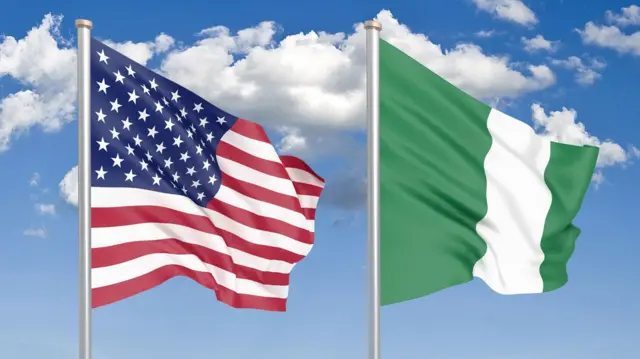
The Nigerian government has said a recent disagreement with the United States of America over claims of religious violence has been addressed, following diplomatic talks between both countries.
Speaking on Monday, Nigeria’s Minister of Information, Mohammed Idris, said the issue had eased after what he described as firm and respectful engagement that helped strengthen ties between Nigeria and the United States. He made the remarks at a year end news briefing in Abuja, the Nigerian capital.
The diplomatic tension followed comments made in October and November by US President Donald Trump, who accused Nigeria of failing to protect Christians and warned of possible military action. Trump had claimed that Christians in the country were facing an “existential threat” and described the situation as genocide.
While some observers welcomed the comments as a show of concern, others warned that such statements could worsen religious divisions in Nigeria, Africa’s most populous nation, which has a history of sectarian clashes.
Idris rejected the idea that Nigeria’s security challenges should be seen mainly as religious persecution. He said violence in the country affects both Christians and Muslims and is driven by many factors, including terrorism, criminal activity, and disputes over land and resources.
Nigeria has been battling an Islamist insurgency in the northeast for years, alongside widespread bandit attacks in the northwest where armed groups raid communities and kidnap residents for ransom. In the central region, clashes between mostly Muslim herders and mainly Christian farmers have also claimed many lives, though experts say these conflicts are linked more to competition over land than religion.
The minister’s comments came after Nigeria hosted a delegation from the US Congress earlier in the month, a visit seen as part of efforts to calm tensions and improve cooperation.
Despite the improved tone, Nigeria remains on Washington’s list of countries of particular concern over religious freedom issues. The country was also affected by new visa and immigration restrictions announced by the Trump administration last week.
However, security cooperation between both countries appears to be increasing. Analysts have noted more US surveillance flights over areas believed to be hideouts for extremist groups.
Idris also defended a recent aid agreement under which Washington is expected to provide $2.1 billion to Nigeria. The US State Department said the support would focus strongly on Christian faith based health care providers, a point that raised questions in some quarters.
Responding to the concerns, Idris said the assistance would benefit all Nigerians, regardless of religion. “Every Nigerian is going to be a beneficiary of this arrangement,” he said.
Nigeria and the United States have long maintained close diplomatic and security ties, and officials on both sides say recent talks are aimed at keeping the relationship stable despite differences over how the country’s complex security problems are understood.