



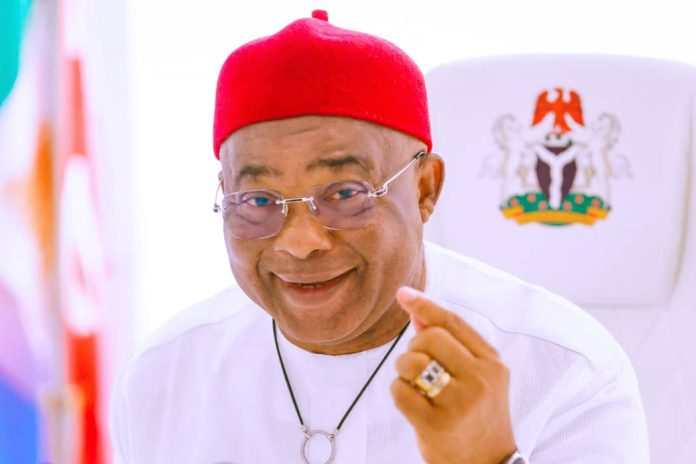
Governor of Imo State, Chairman of the Progressive Governors’ Forum, and Director-General of the Renewed Hope Ambassadors (RHA), Senator Hope Uzodimma, has called for a coordinated nationwide mobilisation strategy to strengthen support for President Bola Ahmed Tinubu’s Renewed Hope Agenda and prepare for the 2027 general elections.
Delivering the keynote address at the Renewed Hope Ambassadors Retreat for National Mobilisation held at the Transcorp Hilton, Abuja, Uzodimma said the movement must focus on three core objectives: mobilising citizens, unifying Nigerians behind a common vision, and delivering measurable results.
Speaking on the theme, “Building a Unified National Mobilisation Architecture,” the governor stressed that mobilisation goes beyond political support and requires translating public confidence into concrete action, including voter registration, grassroots engagement, and participation in elections.
He described unity as the ability to bring together Nigeria’s diverse peoples without erasing their identities, while emphasising that delivery remains the ultimate test of governance through improved infrastructure, healthcare, education, and economic opportunities.
According to Uzodimma, the Renewed Hope Agenda represents a comprehensive national renewal programme anchored on economic reforms, fiscal discipline, and long-term development. He commended President Tinubu for taking difficult but necessary decisions, including the removal of fuel subsidies and the unification of exchange rates, noting that the administration had chosen reforms over short-term political convenience.
“The seed of sacrifice is beginning to bear fruit,” he said, pointing to signs of economic recovery and increased government investment in critical sectors.
The RHA Director-General cited first-quarter 2026 economic growth figures and highlighted major infrastructure projects across the country, including the Lagos-Calabar Coastal Highway, Sokoto-Badagry Road, Abuja-Kaduna-Zaria-Kano corridor, Enugu-Onitsha and Enugu-Port Harcourt expressways, the Second Niger Bridge access roads, and the Bodo-Bonny Road.
He also referenced ongoing interventions in healthcare, education, and social welfare, including the revitalisation of primary healthcare centres, expansion of health insurance coverage, establishment of cancer treatment centres, the student loan scheme, the new minimum wage, consumer credit initiatives, and the Presidential CNG Programme.
Uzodimma warned that one of the greatest threats to government reforms is poor communication, arguing that achievements must be effectively communicated to citizens to prevent misinformation from shaping public perception.
“When we do good work and nobody hears the story, someone else tells it for us, and they tell it wrong,” he said.
He recalled commitments made at the Renewed Hope Ambassadors Summit held in February, where participants pledged to counter misinformation with facts and strengthen grassroots communication structures nationwide.
The governor disclosed that the retreat would produce several strategic documents, including a Declaration on National Mobilisation, a National Grassroots Mobilisation Blueprint, a Standard Messaging Manual, State-by-State Action Plans, a Polling Unit Deployment Doctrine, a Monitoring and Evaluation Framework, and an Election Readiness Checklist.
Outlining the RHA’s organisational structure, Uzodimma said the movement’s mobilisation architecture would extend from the national leadership through the six geopolitical zones, the 36 states and the Federal Capital Territory, down to local government areas, wards, and polling units across the country.
He revealed that the organisation plans to deploy 25 canvassers to each of Nigeria’s 176,846 polling units, creating a nationwide network of more than 4.4 million grassroots mobilisers.
The governor also highlighted the establishment of 17 specialised directorates within the RHA, covering areas such as youth mobilisation, media and publicity, digital communications, data and technology, women affairs, diaspora engagement, intelligence, research, and innovation.
Addressing party leaders and coordinators at various levels, Uzodimma urged them to remain disciplined, focus on facts, and engage citizens respectfully while defending government policies and reforms.
He stressed that the movement must mobilise peacefully and in accordance with the Constitution, the Electoral Act, and regulations of the Independent National Electoral Commission (INEC).
Looking ahead to the 2027 elections, the governor described the contest as a referendum on whether Nigeria should continue on its current reform path or reverse course.
He urged members of the Renewed Hope Ambassadors to leave the retreat committed to five key principles: unity, truth, inclusion, lawful discipline, and delivery.
“We stand with the citizens who deserve truth, dignity, security, and a fair chance. We stand with Nigeria,” Uzodimma declared.
He concluded by expressing confidence that the Renewed Hope Ambassadors would build a strong grassroots movement capable of communicating government achievements, defending reforms with evidence, and translating national vision into electoral success.
The two-day retreat brought together national, zonal, state, local government, ward, and polling-unit coordinators of the Renewed Hope Ambassadors as part of efforts to strengthen grassroots mobilisation and organisational capacity ahead of future political engagements.