



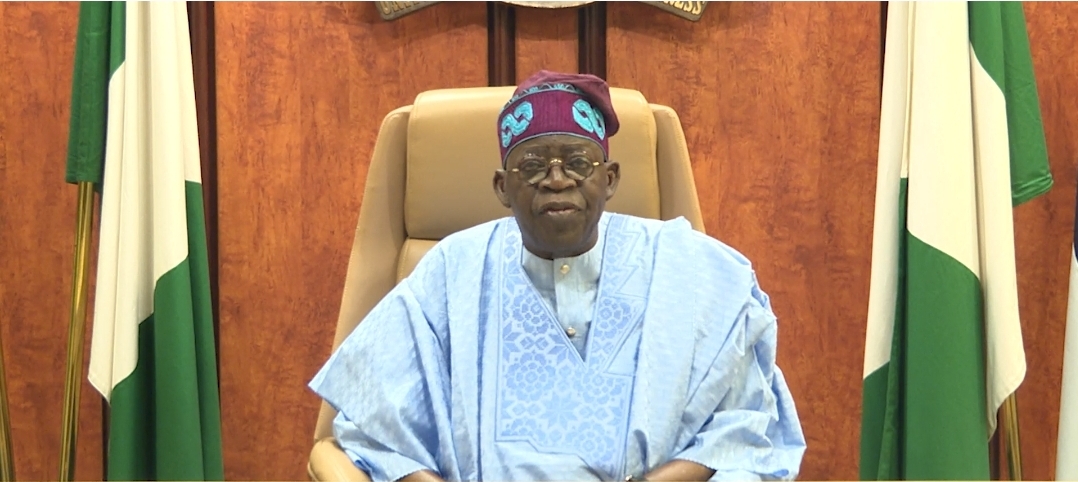
President Bola Ahmed Tinubu on Friday reaffirmed his administration’s commitment to strengthening Nigeria’s democracy, tackling insecurity, and delivering economic prosperity, as the nation marked 27 years of uninterrupted democratic governance.
In his Democracy Day address, the President described June 12 as a defining symbol of Nigeria’s democratic journey, paying tribute to the heroes and activists whose sacrifices helped secure civilian rule and political freedoms.
“Today, we celebrate democracy and the enduring Nigerian spirit,” Tinubu said, noting that since 1999 Nigerians have consistently chosen their leaders through the ballot box, witnessed peaceful transfers of power, and resolved political disputes through democratic institutions rather than violence.
Ahead of governorship elections in Ekiti and Osun states, the President urged the Independent National Electoral Commission (INEC), security agencies, and political parties to ensure transparent and peaceful polls.
He emphasized that public confidence in the electoral process remains critical to the survival of democracy and called on the National Assembly, judiciary, media, and civil society organizations to continue safeguarding democratic institutions.
Addressing the nation’s security challenges, PBAT expressed concern over the recent abduction of children in Oyo and Borno states, describing security as a fundamental pillar of democracy.
The President highlighted measures taken by his administration, including the declaration of a security emergency, the recruitment of more than 50,000 police officers, and increased military enlistment. He also pointed to the allocation of N5.41 trillion to defence and security in the 2026 budget, the highest security spending in the country’s history.
According to President Tinubu, Nigeria’s counterterrorism efforts have produced significant gains. He disclosed that security forces had degraded an ISWAP command centre in Arege, Borno State, while terror-related deaths have declined by 81 percent since 2015.
He added that more than 13,000 terrorists were neutralised in the past year, while over 124,000 fighters and their dependents surrendered through the Operation Safe Corridor programme since 2023.
Issuing a stern warning to criminal groups, PBAT declared: “Surrender or face the full force of the Nigerian State.
The President paid tribute to the late Chief Moshood Kashimawo Olawale (M.K.O.) Abiola, widely regarded as the winner of the annulled June 12, 1993 presidential election, as well as his wife, Alhaja Kudirat Abiola.
He also honoured prominent democracy advocates including Gani Fawehinmi, Bola Ige, Alfred Rewane, Abraham Adesanya, Anthony Enahoro, Balarabe Musa, Beko Ransome-Kuti, Frank Kokori, Arthur Nwankwo, Chima Ubani, and Shehu Musa Yar’Adua, among others.
PBAT described their sacrifices as the foundation upon which modern Nigerian democracy stands.
The President used the occasion to defend the economic reforms introduced since the beginning of his administration in 2023, arguing that they were necessary to stabilise public finances and restore investor confidence.
He said the reforms had improved fiscal transparency, increased federation revenues, reduced financial leakages, and attracted investments across sectors including agriculture, energy, manufacturing, technology, mining, transportation, and the creative industry.
President Tinubu also highlighted improvements in domestic refining capacity, which he said have enhanced Nigeria’s energy security and reduced dependence on imported petroleum products.
A significant portion of the speech focused on the electricity sector, which the President described as burdened by chronic challenges when he assumed office.
He cited generation shortfalls, inadequate transmission infrastructure, massive distribution losses, and a metering deficit exceeding four million customers.
Tinubu noted that the Electricity Act signed under his administration has empowered states to generate, transmit, and distribute electricity independently. He further revealed that the Presidential Power Sector Task Force has been authorised to raise a N4 trillion bond to clear verified legacy debts in the sector.
The President also highlighted ongoing rural electrification projects supported by the World Bank and the African Development Bank, aimed at expanding access to electricity in underserved communities, educational institutions, markets, and healthcare facilities.
On economic development, PBAT announced that the National Agricultural Development Fund is deploying 10,000 tractors over a five-year period to boost food production and agricultural productivity.
He further revealed that over 1,000 small and medium-sized enterprises (SMEs) have been certified for export, while non-oil exports recorded a 21 percent increase in the past year.
Despite these gains, the President acknowledged that many Nigerians continue to face economic hardship and pledged sustained efforts to reduce inflation, create jobs, improve living standards, and accelerate economic growth.
He reiterated his administration’s support for financial autonomy for Nigeria’s 774 local government councils, arguing that stronger grassroots governance is essential for national development and improved security.
As part of efforts to honour key figures in Nigeria’s democratic evolution, Tinubu announced the renaming of the completed Institute of Petroleum Studies in Kaduna as the General Shehu Musa Yar’Adua University of Geological Sciences and Engineering Technology.
The move, he said, recognises Yar’Adua’s contributions to national unity and democratic development.
The President also announced national honours for dozens of journalists, activists, politicians, and pro-democracy campaigners who faced persecution, imprisonment, exile, and other hardships during Nigeria’s struggle for democracy.
He further recognised several military officers who supported democratic ideals during the June 12 era, describing them as “soldier-democrats” whose contributions helped shape Nigeria’s democratic transition.
A comprehensive honours list, he said, will be released in the coming days.
‘Our Generation Must Secure Prosperity’
Concluding his address, Tinubu called on Nigerians to reject division and embrace national unity, optimism, and collective responsibility.
“Every generation has a defining responsibility. The generation of our founding fathers secured independence; the generation of June 12 secured democracy. Our generation must secure prosperity,” he said.
The President expressed confidence that Nigeria would overcome its current challenges and continue to strengthen democratic governance, urging citizens to remain committed to the ideals of freedom, justice, accountability, and national progress.
“June 12 reminds us: Nigerians do not break. We bend, we bleed, but we do not break,” Tinubu declared.
Nigeria’s Democracy Day commemorates the June 12, 1993 presidential election, widely regarded as the freest and fairest in the country’s history, and honours those who fought for the restoration of democratic rule.