



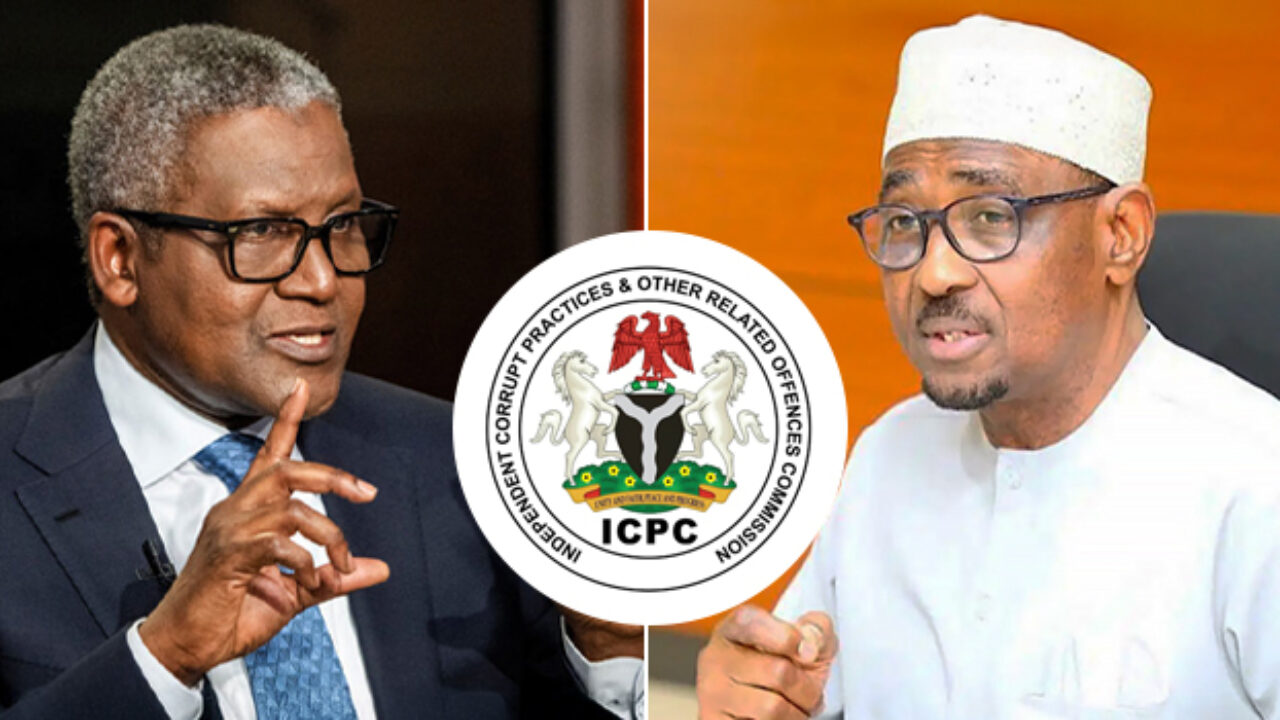
The Independent Corrupt Practices and Other Related Offences Commission (ICPC) has received a petition seeking the investigation and prosecution of the Chief Executive Officer of the Nigerian Midstream and Downstream Petroleum Regulatory Authority (NMDPRA), Engr. Farouk Ahmed, over alleged abuse of office, corruption and financial impropriety.
The petition, dated December 16, 2025, was submitted by the law firm Dr. O.J. Onoja, SAN & Associates and was officially stamped as received by the Office of the ICPC Chairman on the same day. The legal practitioners said they acted on the instructions of Alhaji Aliko Dangote, GCON, described in the petition as their client.
Titled “Petition Against Engr. Farouk Ahmed for Gross Abuse of Office, Violation of Code of Conduct for Public Officers, Corruption and Financial Impropriety,” the document urges the anti-graft agency to investigate what it described as “monumental corruption and unlawful spending of public funds.”
According to the petition, Engr. Ahmed was appointed CEO of the NMDPRA in September 2021 by former President Muhammadu Buhari. It also stated that before his appointment, he served at the Nigerian National Petroleum Corporation (NNPC), now Nigerian National Petroleum Company Limited (NNPCL), where he held several strategic positions, including Managing Director of the Petroleum Products Marketing Company (PPMC) and Executive Secretary of the Petroleum Products Pricing Regulatory Agency (PPPRA).
The petition alleged that the NMDPRA boss “has grossly abused his office contrary to the extant provisions of the Code of Conduct for public officers” and, in the process, “enmeshed himself in monumental corruption and unlawful spending of public funds running into millions of dollars.”
A major aspect of the complaint relates to the education of Engr. Ahmed’s children abroad. The petition claimed that he spent “over $7 million of public funds” on the education of his four children in Switzerland over a period of six years, allegedly without evidence of lawful income sufficient to justify such expenditure.
The document listed the names of the children and the Swiss schools they reportedly attended, including Montreux School, Aiglon College, Institut Le Rosey and La Garenne International School, each for a duration of six years.
The lawyers further argued that Engr. Ahmed’s cumulative earnings throughout his career in the Nigerian public sector “is nothing close to the sum of $7 million USD” allegedly expended on foreign education, describing the situation as indicative of “corrupt enrichment, abuse of office and diversion of public funds for private use.”
The petition also accused the NMDPRA chief of using “the instrumentality of his office” to “embezzle and divert public funds for self-gains and pursuit of private interest to the detriment of the Nigerian people,” adding that the alleged actions have sparked public outcry and protests reported in the media.
In urging the ICPC to act, the petition cited provisions of the Fifth Schedule to the 1999 Constitution on the Code of Conduct for Public Officers and Section 19 of the Independent Corrupt Practices and Other Related Offences Act. It quoted judicial authorities to emphasize that abuse of office and the use of public position for private gain constitute criminal offences punishable by imprisonment.
The petition quoted Section 19 of the ICPC Act as stating:
“Any public officer who uses his office or position to gratify or confer any corrupt or unfair advantage upon himself… shall be guilty of an offence and shall on conviction be liable to imprisonment for five (5) years without option of fine.”
The petitioners stated that they are ready to provide documentary and other evidence in support of the allegations and expressed confidence that the ICPC would not “close its eyes” to the matter, which they noted is already in the public domain.
As of the time of filing this report, Engr. Farouk Ahmed has not issued a public response to the allegations. The ICPC has also not confirmed whether a formal investigation has commenced. It should be noted that the allegations remain unproven, and the NMDPRA CEO is presumed innocent until proven guilty by a court of competent jurisdiction.