



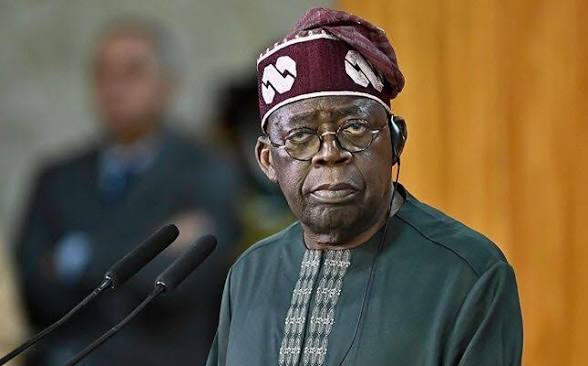
ABUJA, NIGERIA — President Bola Tinubu has given an assurance that his government will strengthen its ongoing economic reforms if he wins a second term in office. He emphasized that the difficult choices his administration made early on are now starting to steady the nation’s financial system and create a foundation for lasting growth.
The President shared these insights during an interview at the Africa CEO Forum held in Kigali, Rwanda. According to reports monitored by Podium Reporters, the President made it clear that his leadership is fully dedicated to carrying out tough but vital changes to fix the economy and upgrade governance.
When asked about his primary target if he gets re-elected, President Tinubu stated that his focus would simply be to do more work because many challenges still exist. He noted that the world does not wait for anyone, meaning that a government must constantly reset, rethink, and challenge its own intellect.
He explained that the core philosophy of his presidency rests on bold leadership and a readiness to act for the good of the public, even when those actions face heavy criticism. In his view, the true mark of a transformative leader is having the courage to make hard choices on behalf of the people exactly when they need to be made.
Defending his policies on the removal of the petrol subsidy and the merger of the foreign exchange markets, President Tinubu described them as painful but essential steps to save Nigeria from a total economic breakdown. He pointed out that the old subsidy system only fueled corruption, encouraged the smuggling of fuel, caused massive financial waste, and placed a heavy burden on government funds.
The President recalled that before these reforms were introduced, the financial situation was so bad that 27 out of the 36 states in Nigeria could not pay workers’ salaries. He questioned how an oil-producing nation could be earning revenue but lack a single working refinery, calling it an impossible situation to sustain.
While acknowledging the deep financial pain these policies have brought upon citizens, the President compared the current hardships to the process of childbirth. He remarked that though the experience is painful and difficult, the sorrow turns to joy once a healthy child is born.
President Tinubu also spoke on the issue of taxation, describing it as an important tool for national development. He argued that citizens who want high-quality infrastructure and good public services must be ready to contribute through taxes, noting that while no one naturally likes paying taxes, it is the only way to fund public projects.
According to the President, these recent policy shifts are already bringing positive changes, making the national economy far more stable and predictable. He stated that there is now a bright light at the end of the tunnel because the Naira has stabilized, allowing business planners and ordinary citizens to budget properly and plan their lives.
To cushion the impact of these changes on the public, the President mentioned that his administration is giving out direct cash support to poor households. He also noted that the government is providing financial grants and upkeep allowances to underprivileged students to ensure they do not drop out of school due to high fees.
On the industrial front, the President promised that the government will keep backing businesses that can generate employment and increase local production. He specifically pointed to major local enterprises like the Dangote Refinery and BUA Group as projects that deserve maximum state support.
He explained that his administration decided to approve the sale of crude oil to the Dangote Refinery in Naira as a strategic move to ease its operations and lower the high demand for foreign currency.
Furthermore, President Tinubu defended the building of the Lagos-Calabar Coastal Highway, explaining that the project is designed to unite the country and open up new doors for tourism and investments. He stressed that his governance philosophy centers on putting Nigeria first, which is why local materials like Nigerian-made cement and steel are being used for the highway to help local factories grow.
On national unity, the leader urged all citizens to view the cultural and ethnic differences of the country as a source of collective power rather than a cause for division, reminding everyone that the nation belongs to all Nigerians and must be built together.
Touching on regional safety and foreign relations, President Tinubu highlighted the need for Nigeria to work closely with neighboring African countries and global allies. He concluded by stating that Nigeria holds a highly strategic position as a big brother in the West African sub-region and a major voice on the continent, meaning the nation must always set the right example for others to follow.