



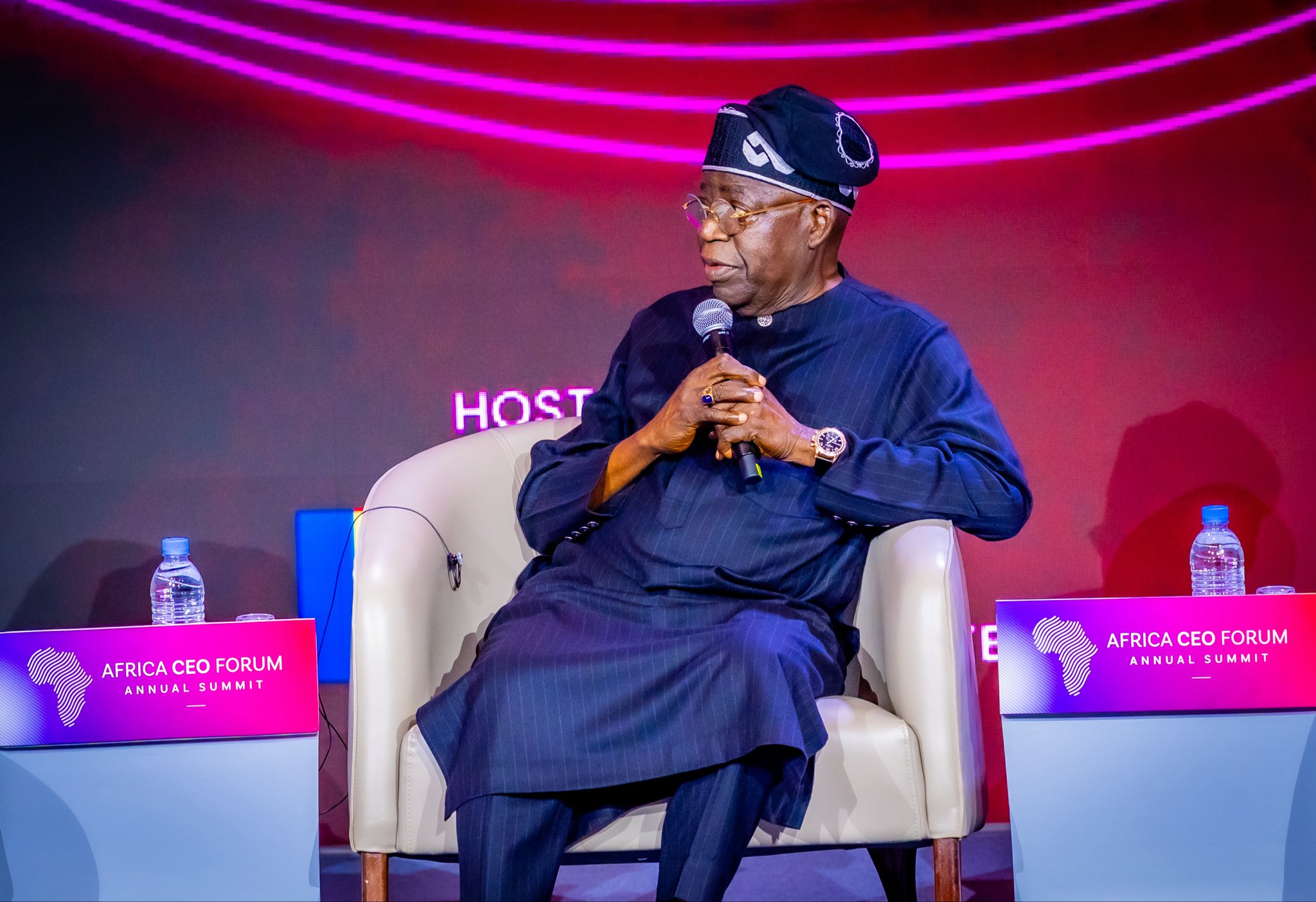
At the Africa CEO Forum, President Bola Ahmed Tinubu delivered a robust defense of his administration’s economic reforms, insisting that the painful measures introduced since he assumed office were necessary to rescue Nigeria from fiscal collapse and place the country on a sustainable path to growth.
Speaking before business leaders and policymakers, Tinubu acknowledged the hardship caused by the removal of fuel subsidies and the liberalization of the naira but maintained that the reforms were unavoidable.
According to the president, continuing subsidy payments would have amounted to “spending the future generations’ endowment before they were born.” He argued that subsidies had become a breeding ground for corruption, smuggling, and economic distortions, while draining public finances.
Tinubu painted a grim picture of Nigeria’s economic condition before the reforms, revealing that 27 out of the country’s 36 states struggled to pay workers’ salaries despite Nigeria’s status as an oil-producing nation.
He described the old economic model as unsustainable, particularly in a country without fully functional refineries.
Comparing the reform process to childbirth, Tinubu admitted the pain involved but expressed confidence that the long-term outcome would justify the sacrifice. He stressed that the government’s priority was to “reset, recalibrate, and reform” the economy to ensure stability and future prosperity.
The president also emphasized the importance of taxation in nation-building, arguing that development cannot occur without citizens contributing through taxes. Drawing parallels with advanced economies, he said Nigerians must recognize that infrastructure, healthcare, education, and social welfare require sustainable funding.
“Everybody expects development,” Tinubu said, “but the question is: how do you pay for it?”
He defended his administration’s tax reforms, noting that taxation is essential for protecting vulnerable citizens, supporting education, and financing research and innovation.
He further argued that tax-paying citizens become active stakeholders in national development.
Looking ahead, Tinubu said his administration would continue implementing difficult but necessary decisions if given another term in office.
He described leadership as the ability to make timely and courageous decisions on behalf of the people, even in the face of resistance.
The president revealed that he intentionally ignored criticism during the early phase of the reforms because he anticipated strong opposition.
However, he claimed the economy has now become more stable and predictable, enabling better planning for businesses and households.
Tinubu highlighted several social intervention programs aimed at cushioning the effects of the reforms, including direct cash transfers to poor households and financial support for students who might otherwise be unable to remain in school.
On economic development, the president advocated strong government support for large indigenous businesses capable of generating employment and driving industrialization. He cited companies such as the Dangote Group and BUA Group as examples of enterprises deserving strategic support.
He specifically praised the Dangote Refinery, describing it as an audacious investment that should be encouraged through policies such as supplying crude oil in naira to reduce foreign exchange pressures.
Tinubu also defended the construction of the Lagos-Calabar Coastal Highway, describing it as a transformative infrastructure project designed to boost tourism, trade, and national integration.
He said the project reflects his “Nigeria First” philosophy by prioritizing the use of locally produced cement and steel to stimulate domestic industries.
According to the president, the coastal road would help connect the economically vibrant eastern region of the country with Lagos, creating new opportunities and fostering national inclusiveness.
On foreign policy and regional security, Tinubu stressed the need for pragmatic international partnerships, noting that Nigeria cannot tackle security threats in isolation. He called for stronger collaboration with neighboring African countries as well as global powers such as the United States and France.
The president reaffirmed Nigeria’s leadership role in West Africa, insisting that despite current challenges, the country remains a dominant force in regional peacekeeping and diplomacy.
He cited Nigeria’s swift responses to instability in neighboring countries as evidence that the nation still retains its influence and strategic importance in Africa.
Concluding the session, Tinubu expressed confidence in Nigeria’s future, declaring that the country is stable, ready for growth, and positioned for transformation despite ongoing challenges.