



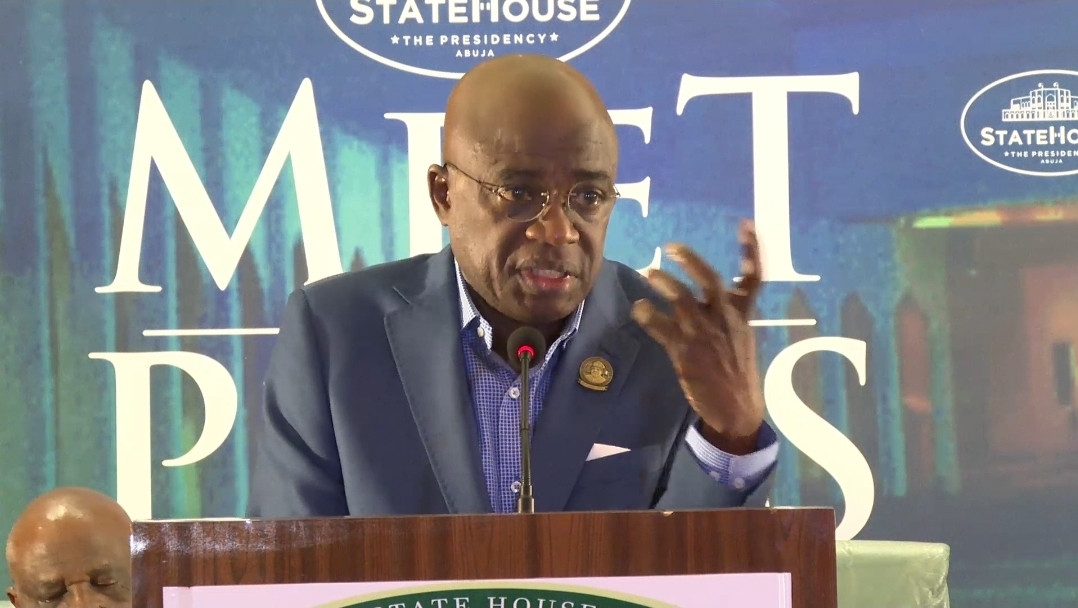
Governor Hyacinth Alia of Benue State has praised President Bola Tinubu for what he described as the courage and political will to undertake bold economic reforms, stating that the policies have significantly improved the state’s financial position and accelerated development across key sectors.
Briefing the press at the State House, Alia said that although the reforms have come with short-term economic hardships, including inflation and a higher cost of living, they are necessary to place Nigeria’s economy on a path of long-term sustainability and prosperity.
He noted that the federal government had maintained close engagement with state governments as key partners in implementing its economic agenda, describing the relationship as critical to the success of the reforms.
According to the governor, one of the most visible gains of the reforms has been the increase in monthly allocations to states from the Federation Account, which has strengthened Benue’s fiscal capacity and enabled the government to revive the economy, execute development projects, and meet critical obligations.
“The increased allocations have given us greater financial strength to address longstanding infrastructure deficits and invest in sectors that directly impact the lives of our people,” he said.
Alia said the improved revenue had allowed his administration to invest in education, healthcare, agriculture, rural development, and security, while also pursuing the revival of moribund industries to stimulate economic growth and create employment.
He listed the resuscitation of Food Basket Breweries and BENSONA Juice and Concentrate Factory among the administration’s achievements, adding that the long-abandoned Taraku Mills is on the verge of reopening.
According to him, legal disputes that had stalled the revival of the mill have now been resolved, and the state government is finalizing an agreement with a major investor to take over the facility and restore its operations.
The governor also highlighted improvements in workers’ welfare, describing the prompt payment of salaries and pensions as one of his administration’s foremost priorities.
He recalled that before he assumed office, civil servants and pensioners were owed several months, and in some cases years, of salary and pension arrears, particularly at the local government level. He attributed the government’s ability to clear outstanding obligations to improved federal allocations and enhanced internally generated revenue.
“Payment of salaries and pensions has become a priority because workers’ welfare is central to good governance,” he said.
On security, Alia cautioned against politicizing insecurity, warning that such actions undermine efforts to protect lives and restore peace.
He urged political actors, community leaders, and citizens to place the interests of the state above partisan considerations, stressing that Benue belongs to its people and requires collective responsibility to secure it.
The governor commended traditional rulers and community leaders for supporting the government’s efforts to tackle insecurity, saying their cooperation has contributed significantly to ongoing peacebuilding initiatives across affected communities.
He also acknowledged the Federal Government’s support in strengthening security operations in the state. While declining to disclose operational details, Alia said the state had provided critical logistics, including motorized boreholes for security personnel stationed in frontline communities and boats to enhance surveillance along the River Benue corridor linking Benue with Taraba, Nasarawa, and Kogi states.
He expressed confidence that sustained collaboration between the state and the Federal Government would lead to lasting improvements in security.
On the welfare of internally displaced persons (IDPs), the governor said Benue had continued to receive support from development partners and the Renewed Hope Initiative of the First Lady, Senator Oluremi Tinubu.
He explained that the government’s priority is to facilitate the safe return of displaced persons to their ancestral communities while providing the support needed to prevent their return to IDP camps.
Reflecting on the broader impact of the Federal Government’s reforms, Alia acknowledged that Benue, like other states, initially experienced the effects of inflation and rising living costs. However, he said the situation has begun to improve as security interventions encouraged more farmers to return to their farms, resulting in increased agricultural production and an improved food supply.
He assured residents that his administration would continue to engage stakeholders and implement policies aimed at cushioning economic hardship while consolidating the gains of ongoing reforms.