



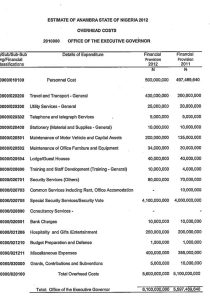
Newly surfaced official budget documents from 2012 have raised fresh questions about the financial prudence of former Anambra State Governor Peter Obi, revealing a series of controversial expenditures during his administration — including N200 million allocated for the maintenance of Peugeot 406 vehicles, N250 million for hospitality and entertainment, and a staggering N4.1 billion in security votes.
The records, taken directly from the “Estimate of Anambra State of Nigeria 2012”, detail overhead costs from the Office of the Executive Governor, painting a picture that contradicts the frugal image long associated with Obi, especially since his emergence as a major political figure on the national stage.
Extravagant Spending on Vehicle Maintenance
Among the most eye-catching figures in the budget is the allocation of N200 million for the maintenance of motor vehicles and capital assets. While this figure may appear justifiable on the surface, what has sparked concern is that these vehicles — predominantly Peugeot 406s, as confirmed by sources familiar with state government procurement at the time — were government-standard cars not known for excessive maintenance costs.
Observers note that such an amount, dedicated to maintaining what are essentially mid-range sedans, suggests either gross inefficiency or potential misappropriation of funds. In contrast, the same line item received N135 million the previous year, meaning there was an inexplicable 48% increase in just one year.
Lavish Hospitality Budget
Another line item raising eyebrows is the N250 million allocated for “Hospitality and Gifts / Entertainment”, a jump from N200 million the previous year. Critics argue that at a time when the state faced infrastructural deficits, such a large sum dedicated to unofficial functions and entertainment could hardly be justified.
“It’s difficult to reconcile these figures with Peter Obi’s self-image as a model of fiscal discipline,” said a public finance analyst. “This isn’t about political smear; it’s about accountability.”
Security Vote: N4.1 Billion in Discretionary Spending
By far the largest and most opaque allocation in the budget was the N4.1 billion set aside for “Special Security Services / Security Vote” — an item known for its lack of transparency and frequent abuse in Nigerian governance.
Security votes are typically not subject to legislative oversight or public audit, which has led civil society groups to describe them as “slush funds” for governors. In Obi’s case, the security vote alone accounted for nearly 73% of the entire N5.6 billion overhead budget for the Governor’s office in 2012.
Notably, this was a N100 million increase from the N4 billion provisioned for the same purpose in 2011.
Other Controversial Expenses
The overhead summary also includes:
N430 million for Travel and Transport – General
N80 million for undefined “Security Services (Others)”
N40 million for Lodge/Guest Houses maintenance
N10 million for Bank Charges
N400 million for Miscellaneous Expenses
N5 million for Telephone and Telegraph Services
In total, the Office of the Executive Governor alone accounted for N6.1 billion in the 2012 budget, while the total overhead costs stood at N5.6 billion.
A Revenue-Reality Gap
The 2012 Projected Recurrent Revenue Profile for Anambra State was estimated at N48.6 billion, with 75.31% (N36.6 billion) coming from federal allocations and only 24.69% (N12 billion) from internally generated revenue (IGR).
This lopsided reliance on federal allocations raised further concern about the sustainability of such lavish expenditures.
Even more telling, the state’s total recurrent expenditure was projected at N36.271 billion, meaning the Governor’s Office alone consumed almost 17% of the state’s total budgeted recurrent expenditure.
Public Reactions and Political Fallout
These revelations come amid renewed scrutiny of Obi’s past record, especially as he continues to position himself as an anti-corruption and pro-accountability reformer in Nigeria’s political discourse.
Supporters argue that Obi inherited a bloated system and managed it better than most, but critics now see these figures as undermining the narrative of austere governance that has defined his public persona.
“These aren’t propaganda figures,” said a budget transparency advocate. “They are official government documents from 2012. The public deserves an explanation, especially from someone who claims to be different.”
Conclusion
While Peter Obi has built a reputation as a prudent manager of public funds, these newly publicized 2012 budget figures suggest a more complicated reality. The massive allocation to security votes, excessive vehicle maintenance costs, and entertainment expenses raise serious questions about the former governor’s stewardship and financial priorities.
As debates over leadership integrity intensify ahead of future elections, these documents may prove pivotal in reshaping public perception of one of Nigeria’s most celebrated political reformers.