



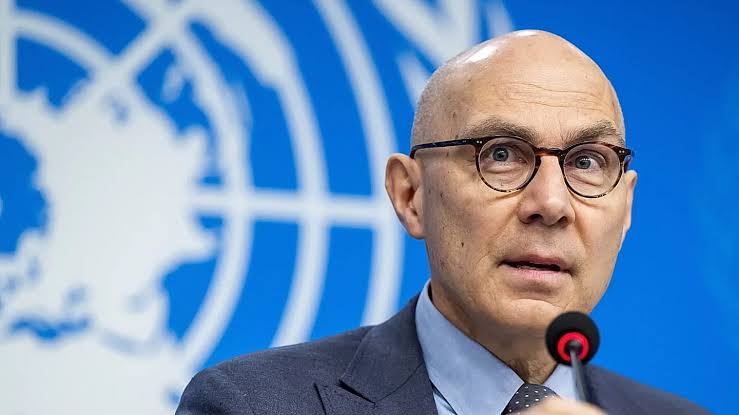
The United Nations High Commissioner for Human Rights, Volker Türk, has warned that armed conflicts across the world have nearly doubled since 2010, describing a growing trend in which the use of force is becoming widely accepted in international relations.
Türk delivered the warning on Friday, February 27, 2026, while addressing the United Nations Human Rights Council in Geneva, Switzerland. The Council is the United Nations body tasked with strengthening the promotion and protection of human rights around the world.
In his global update, he cautioned that violence is increasingly being used to resolve disputes between and within states.
“We must not revert to violence as an organising principle”, he said.
He added that “the threat and use of force to solve disputes is becoming more frequent and normalised”.
According to him, the scale of armed confrontations has grown significantly over the past 15 years.
“The number of armed conflicts has almost doubled since 2010, to around 60,” he said. “The world really is becoming a more dangerous place”.
Türk said the rise in conflicts reflects deeper struggles for political and economic dominance. He criticised what he described as a relentless competition for control and influence.
“Players compete for control over land, energy, and attention. But to what end?” he asked.
“Dominating the global economy? Accumulating more power? Putting AI into space? Surely power must serve other purposes.”
He also expressed concern that some leaders are undermining international institutions created to maintain peace and accountability. He said it was “baffling that political leaders are not taking urgent steps to reverse (current) trends”.
Instead, he said some are “attacking the institutions designed to keep us safe – the United Nations, including International Court of Justice; the International Criminal Court; this Council, and its mechanisms”.
The International Court of Justice settles disputes between countries under international law, while the International Criminal Court prosecutes individuals accused of the most serious international crimes.
Türk pointed to attacks on healthcare facilities as an example of the weakening respect for humanitarian standards.
“A decade ago, an attack on a hospital triggered a global outcry… (But) recent figures show there are now an average of 10 attacks per day on healthcare”.
He concluded with a warning that international legal protections are being eroded.
“The world cannot stand by as the edifice of international humanitarian and human rights law is dismantled before our eyes”.
His remarks highlight rising concerns within the United Nations system about the impact of prolonged wars and political rivalries on civilian populations and the global order.