



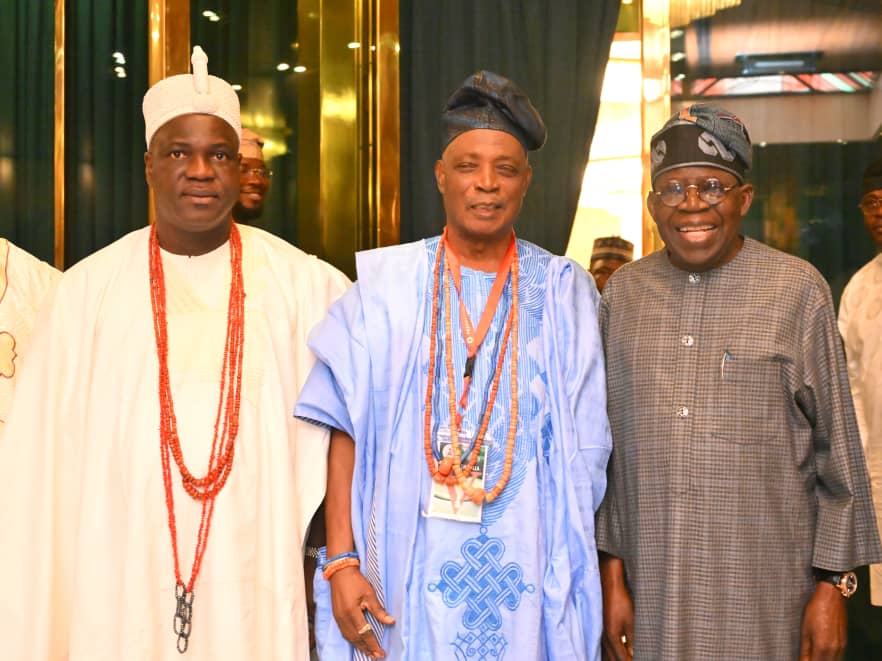
President Bola Ahmed Tinubu has reaffirmed his administration’s hardline stance against terrorism and banditry, declaring that Nigeria will never negotiate with criminals or pay ransom to secure the release of kidnapped victims.
Speaking during a courtesy visit by traditional rulers from Oyo State, led by the Olubadan, Oba Rashidi Adewolu Ladoja, the President said the successful rescue operation in Oyo State demonstrated the effectiveness of the country’s evolving security strategy, attributing the achievement to the support of Nigerians, the prayers of citizens, and the professionalism of the armed forces.

PBAT commended the men and women of the military for their dedication and bravery, pledging to convey the appreciation expressed by the traditional rulers to the security personnel.
The President said recent security challenges had compelled the government to continuously review and strengthen its security architecture, strategies, and operational framework. As part of these reforms, he disclosed that the Armed Forces would expand from eight to 12 divisions to improve response times and enhance the country’s capacity to combat terrorism and banditry.
He also announced that the Federal Government is moving ahead with plans to establish state police, stressing that adequate safeguards would be put in place to prevent abuse of the system. According to him, traditional rulers will play major roles in supporting the new policing structure at the grassroots.
PBAT further revealed that the capacity of forest guards is being upgraded to enable them to actively combat criminal elements operating within Nigeria’s forests rather than performing only conservation duties. He stressed that intelligence gathering remains central to the fight against insecurity and urged Nigerians to remain vigilant by reporting suspicious individuals and activities within their communities.
Reiterating the government’s refusal to negotiate with criminal groups, the President disclosed that kidnappers had demanded the release of detained gang members alongside monetary ransom during recent negotiations. The government, he said, rejected the demands outright, insisting that criminality must not be rewarded.
He noted that insecurity in neighbouring countries, including Mali, Burkina Faso and Niger Republic, has worsened Nigeria’s security situation through the cross-border movement of armed groups. This, he explained, underscores the need to strengthen forest security and establish state police.
The President also challenged state governments to make better use of increased federal allocations by prioritising infrastructure that improves access for security agencies and enhances the quality of life for citizens. He advised governors to focus on road networks and other strategic projects instead of embarking on less impactful developments.
PBAT announced plans to convene meetings with traditional rulers across the country to receive firsthand recommendations on addressing security and other national challenges.
Acknowledging the enormity of the task before his administration, the President said he willingly accepted both the achievements and challenges inherited from previous governments, describing governance as a responsibility he sought and remains committed to fulfilling.
He concluded by expressing satisfaction with the relative peace and stability in Oyo State and maintained that the country’s security situation is steadily improving. PBAT urged Nigerians to continue encouraging members of the military and police for their sacrifices in protecting the nation.