



By Micheal Akanji
The Federal Executive Council on Wednesday approved projects and policy measures valued at more than N1.02 trillion, covering critical road infrastructure, specialised healthcare facilities and other national development initiatives.
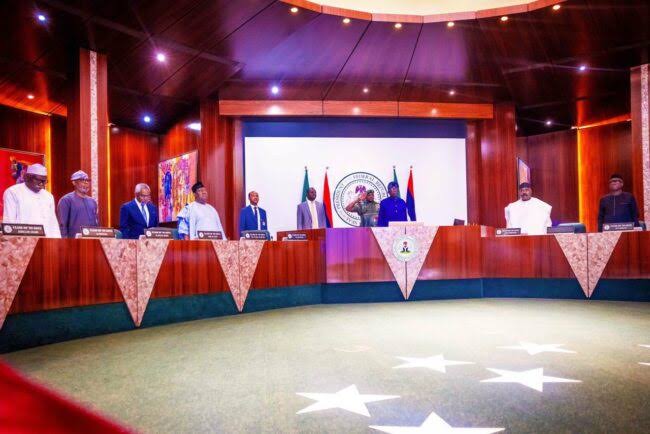
The decisions were taken at the Council’s meeting presided over by President Bola Tinubu at the Presidential Villa, Abuja, its first sitting since June 29.
Among the major approvals were N74.51 billion for the rehabilitation of the Port Harcourt–Onne Port Junction section of the East-West Road, N302.30 billion for a National Institute for Cancer Research and Treatment Centre in Abuja, and a combined investment of about N285 billion in new infrastructure at the National Hospital, Abuja.
The Council also approved the decriminalisation of attempted suicide through an amendment to the National Mental Health Act, endorsed the establishment of a National Centre for Oral Health, and approved measures aimed at strengthening the financial base of the Nigerian Education Loan Fund.
Massive investment in roads
The Minister of State for Works, Bello Goronyo, said the Ministry of Works presented seven memoranda to the Council, six relating to roads and one covering trailer parks and related highway infrastructure.
One of the approvals was the reconstruction of the Ado-Ekiti–Iyin–Aramoko–Itawure–Osun State border road, awarded at N159.83 billion, with a 24-month completion period.
The Council also approved a N54.118 billion variation for the rehabilitation of the Abeokuta–Iboro–Ilaro Road in Ogun State, including a change in pavement design from rigid concrete to flexible asphalt.
For the East-West corridor, the Council approved the N74.51 billion Phase II rehabilitation of the 15-kilometre Port Harcourt (Eleme Junction)–Onne Port Junction section. The contract was awarded to RCC Nigeria Limited, with completion expected within nine months.
Other road projects approved include the N54.52 billion rehabilitation of the Ado-Ekiti–Afe Babalola University Road and the N94.24 billion construction of the Ilara–Iselu Road, Phases II to V, in Ogun State.
The Council further approved public-private partnership arrangements for selected highway facilities, including the 7.9-kilometre Suleja–Minna (Dikko–Maje) road, the operation and maintenance of the Lagos–Ibadan Expressway, and a trailer park at Aro-Ngwa in Abia State.
According to the Works Ministry, the trailer park initiative is designed to move heavy-duty vehicles away from major highways into purpose-built facilities. The projects are to be financed by concessionaires rather than direct Federal Government funding.
National Hospital gets major facelift
The health sector emerged as another major beneficiary of the Council’s decisions.
Coordinating Minister of Health and Social Welfare, Prof. Muhammad Pate, said the Federal Government was embarking on a major infrastructure upgrade at the National Hospital, Abuja, more than two decades after the facility was established.
The approved projects include a N18.74 billion administrative and management block, N64.92 billion for modular clinics and theatres, a N133 billion high-end hospital wing, and a N69 billion Neuroscience Institute.
Together, the projects represent an investment of roughly N285 billion in the hospital’s infrastructure.
Pate said the investment was intended to address years of inadequate infrastructure and equipment at the National Hospital and expand its capacity to provide specialised medical services.
The planned Neuroscience Institute is expected to provide dedicated facilities for neurological and neurosurgical treatment, including diagnostic, interventional and rehabilitation services.
N302.30bn cancer centre approved
Council also approved N302.30 billion for the development of a flagship National Institute for Cancer Research and Treatment Centre in Abuja.
The project covers design, construction, furnishing, medical equipment, supervision and commissioning, with a projected completion period of 36 months.
The approval is part of the Federal Government’s broader effort to strengthen cancer treatment and research infrastructure, following investments in cancer facilities in Katsina, Benin and Enugu.
The Health Ministry said the new centre would expand access to specialised cancer care and reduce the need for Nigerians to travel outside their immediate locations to obtain advanced treatment.
Attempted suicide to be decriminalised
In a major mental-health policy decision, the Federal Executive Council approved an amendment to the National Mental Health Act aimed at removing criminal penalties for attempted suicide.
The proposed amendment will be forwarded to the National Assembly for consideration.
Pate said the reform was intended to move Nigeria’s approach away from punishment and towards treatment, care and psychosocial support for people experiencing severe mental distress.
He noted that attempted suicide is still treated as a criminal offence under provisions of the Criminal Code and Penal Code, a situation the government considers inconsistent with the more recent National Mental Health Act.
The minister said the reform followed consultations involving the Ministries of Health and Justice, mental-health advocates and a task force established after a resolution of the House of Representatives.
The government is targeting a reduction in suicide cases and attempts by 15 per cent by 2030.
National Centre for Oral Health approved
The Council also approved the National Centre for Oral Health Establishment Act 2026 for transmission to the National Assembly as an executive bill.
The proposal dates back to recommendations made at an international oral health research congress held in Lagos in 1982.
The proposed centre is expected to serve as a national referral, research and training institution for oral healthcare and help close a long-standing gap in Nigeria’s specialised health infrastructure.
Pate said the initiative would provide a legal and institutional framework for addressing oral diseases and improving access to specialised services.
Tinubu redirects recovered cash and unclaimed dividends to NELFUND
In the education sector, President Tinubu directed that liquid funds recovered by the Economic and Financial Crimes Commission, as well as eligible unclaimed dividends held through the Capital Market Trust Fund and Dormant Account Trust Fund, should be channelled to the Nigerian Education Loan Fund.
The Minister of Education, Dr Tunji Alausa, stressed that the directive applies to cash recoveries and not properties seized by the EFCC.
Funds that remain subject to legal disputes will also be excluded until such matters are resolved.
The move is aimed at strengthening NELFUND’s capacity to meet its growing obligations to Nigerian students.
The minister said more than 1.2 million students are currently benefiting from the scheme, while NELFUND has disbursed billions of naira in student stipends and institutional fees.
N155bn approved for National Library
FEC also approved an augmentation of about N155 billion for the completion of the long-delayed National Library of Nigeria headquarters in Abuja.
The project, initiated in 2006, was originally scheduled for completion within two years but stalled after construction stopped in 2008.
The new funding package includes approximately N118.3 billion for construction and about N37 billion for furnishing.
The Education Ministry said funding would come from resources including the Tertiary Education Trust Fund, alongside contributions mobilised for the project.
14 universities to receive entrepreneurship programme
The Council approved the rollout of an Entrepreneurship, Innovation and Business Incubation Certification Programme in 14 federal universities.
The programme will provide students with entrepreneurship and enterprise-development training, digital certification, mentorship and access to business incubation opportunities.
The participating institutions are:
– Ahmadu Bello University, Zaria
– Bayero University, Kano
– Nnamdi Azikiwe University
– Obafemi Awolowo University
– University of Abuja
– University of Benin
– University of Ibadan
– University of Ilorin
– University of Jos
– University of Lagos
– University of Maiduguri
– University of Nigeria, Nsukka
– University of Port Harcourt
– Usmanu Danfodiyo University
The government said the initiative is designed to encourage students to become job creators and innovators rather than depend solely on formal employment.
Academy for gifted children gets approval
FEC also approved the transformation of the existing Suleja Academy into an autonomous Academy for Gifted and Talented Children.
The institution will have its own governing board and diversified funding sources, including government appropriations, endowments and donations.
The Federal Government said the initiative would help identify and nurture exceptionally talented Nigerian children and provide them with an environment suited to their abilities.
With the latest approvals, the Tinubu administration has placed substantial emphasis on simultaneous investment in transport infrastructure, specialised healthcare, education financing and human-capital development, while introducing legal reforms in the mental-health sector.