



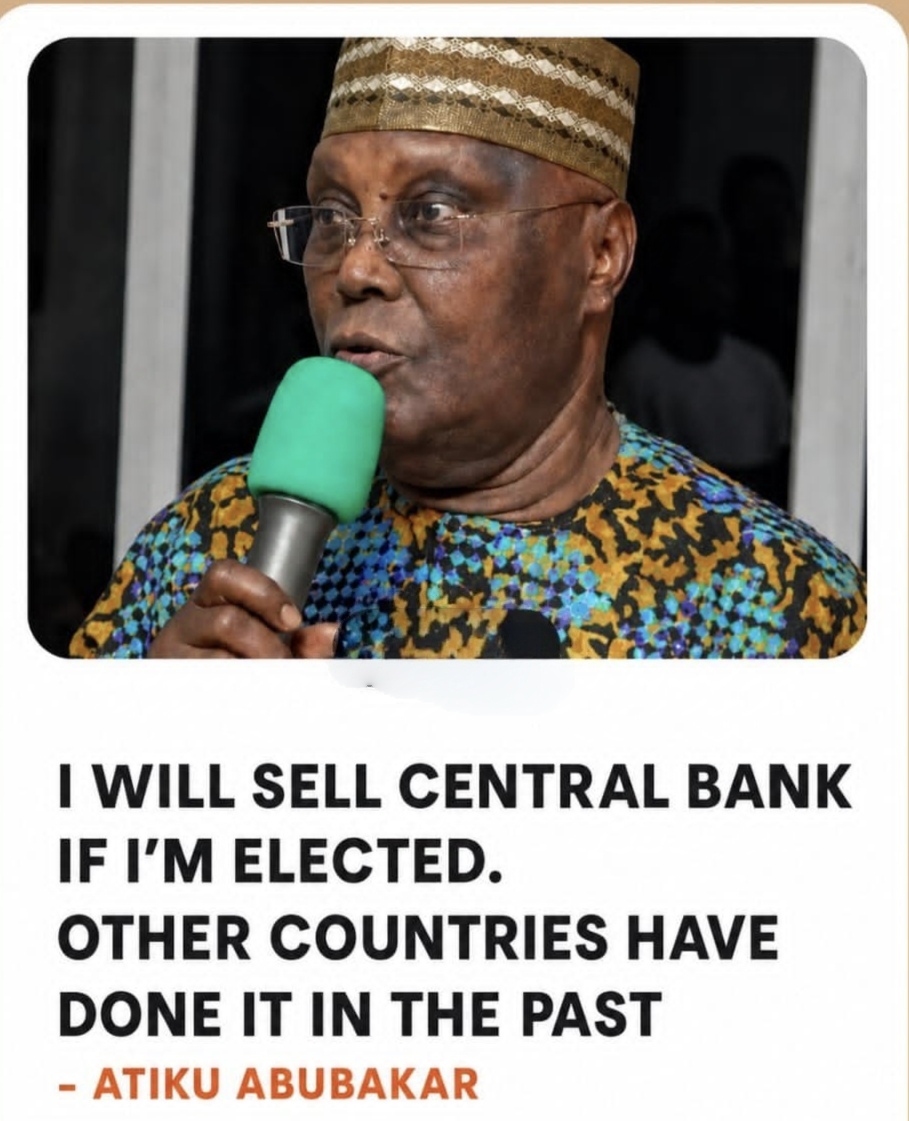
The presidential candidate of the African Democratic Congress (ADC), Atiku Abubakar, has declared that he will sell off the Central Bank of Nigeria (CBN) if elected president in the 2027 general elections. The former vice president made the pledge during a town hall meeting with business leaders in Lagos on Saturday.
Atiku argued that privatising the apex bank would improve efficiency, reduce bureaucratic bottlenecks, and attract foreign direct investment. He dismissed warnings from financial experts, insisting that “we cannot continue to run critical institutions the same way and expect different results.”
His proposal has, however, drawn sharp rebuke from economic analysts and civil society groups. The Centre for Social Justice described the move as “reckless and capable of triggering hyperinflation,” while the Nigerian Economic Summit Group warned that surrendering monetary policy to private interests would undermine national sovereignty. Labour unions have also joined the chorus, vowing to resist any attempt to commodify the country’s reserve bank.
The controversy has revived memories of Atiku’s tenure as vice president and chairman of the National Council on Privatisation (1999–2007). During that period, his administration sold off NITEL, Bacita Sugar, Jebba Paper Mill, Katsina Steel Rolling Mill, Oshogbo Steel Rolling Mill, Aluminium Smelting Plant, Aladja Steel, Jos Steel Rolling Mill, and Iwopin Paper Mill—many of which collapsed under private ownership, leaving thousands jobless.
Atiku officially joined the ADC in November 2025 after resigning from the PDP. As the 2027 race gathers steam, his CBN privatisation pledge is set to dominate economic debates and fuel fresh scrutiny of his track record on state assets.