



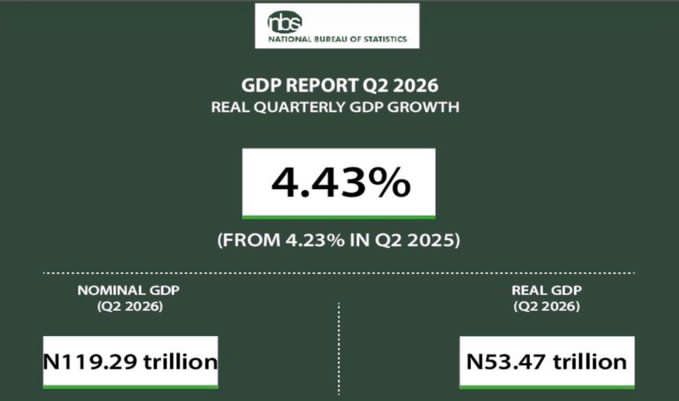
 Nigeria’s GDP expanded by 4.43% year-on-year in Q2 2026, up from 4.23% in Q2 2025 and 3.89% in Q1 2026. First-half growth reached 4.16%, compared to 3.68% in the same period of 2025.
Expansion is increasingly broad-based: 27 subsectors recorded above 3.0% growth in Q2, up from 23 a year earlier. Manufacturing grew 3.24% (more than double 2025’s 1.60%), agriculture rose 4.39% (from 2.82%), and the services sector the largest driver expanded 4.60% (from 3.94%).
The naira appreciated over 12% between H1 2025 and H1 2026, boosting the economy by roughly 17% in U.S. dollar terms. This trend, sustained alongside social programmes, is expected to lift dollar incomes, purchasing power, and reduce poverty.
With this momentum, Nigeria is on track for the government’s $1 trillion GDP target by 2030. The IMF ranks Nigeria among the top 10 contributors to global real GDP growth in 2026, accounting for about 1.5% of world growth ahead of several advanced and emerging economies. Sustained reforms and investor confidence could make Nigeria Africa’s largest economy by 2028.
The government reaffirms its commitment to policy consistency and inclusive growth, ensuring macroeconomic gains translate into shared prosperity for all Nigerians.