



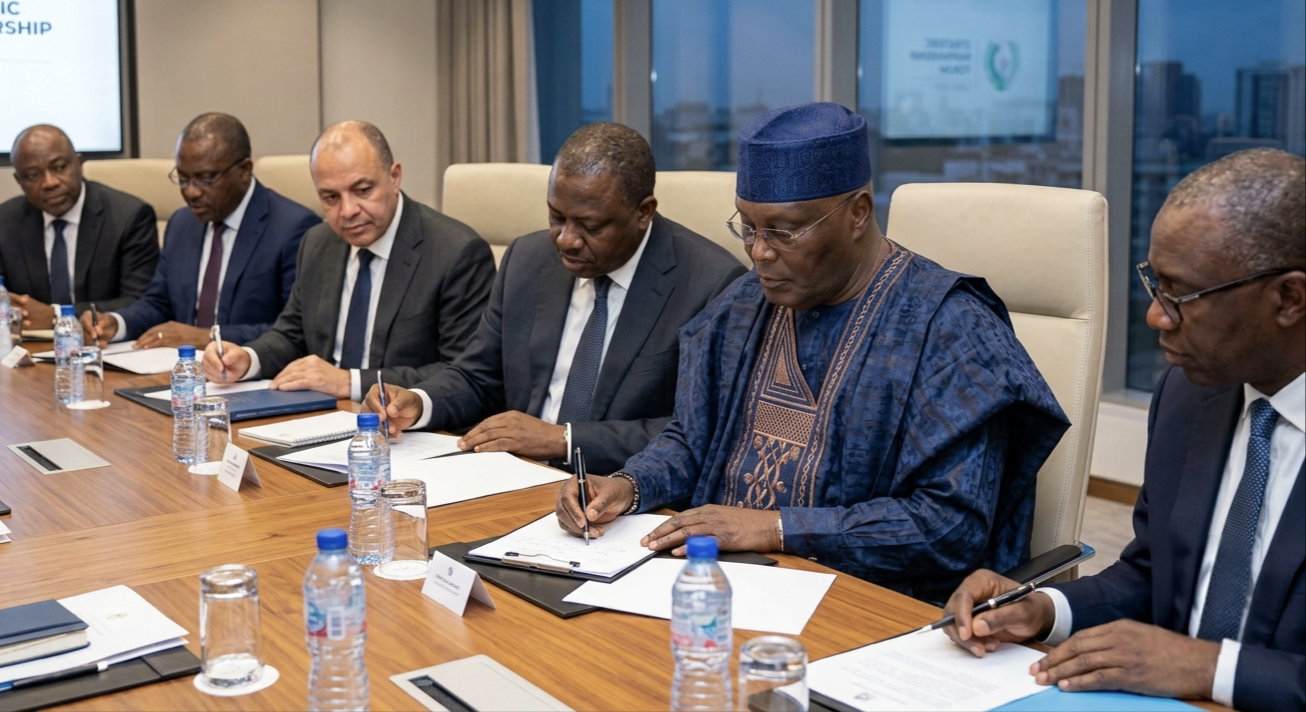
 Podium Reporters obtained intelligence revealing that powerful oil cartels, whose lucrative subsidy racket was dismantled by President Bola Tinubu in 2023, have finalised plans to pour a staggering $2 billion into Atiku Abubakar’s 2027 presidential campaign. Sources close to the cartel say they are “ecstatic” at the prospect of returning to their old, self-serving business model; provided the former vice president delivers on their key demands.
At a closed-door meeting with representatives of the ADC presidential candidate in Abuja about two weeks ago, Atiku made a startling admission that he is financially stranded and desperately needs major backing for what he called his “last shot” at the presidency. This is not the first time the six-time aspirant has faced a cash crunch. In 2022, then-PDP National Chairman Iyorchia Ayu revealed that Atiku had suggested borrowing “N1 billion from banks” to fund the party’s campaign. More alarmingly, in June 2022, the Delta State House of Assembly approved a N25 billion loan for Governor Ifeanyi Okowa; Atiku’s running mate.
Now, in a desperate bid to secure foreign validation, Atiku has reportedly engaged Von Batten-Montague-York, L.C., a Washington D.C.-based lobbying firm, on a $1.2 million, 12-month retainer, filings publicly available under the United States Foreign Agents Registration Act (FARA) confirm the arrangement. The Presidency has slammed the move as “a reflection of desperation and an alleged lack of a coherent political agenda”. However, sources indicate that this is only the tip of the iceberg. Atiku is also lobbying foreign governments and multinational oil companies, promising them a return of the subsidy regime in exchange for campaign funding, a deal that would enrich foreign and local cabals while Nigeria’s economy bleeds.
The Independent Media and Policy Initiative (IMPI) has warned that Atiku’s subsidy restoration plan could scare away over $50 billion in Foreign Direct Investment that Nigeria is currently projected to attract. Forcing commercial entities like NNPC Limited into politically mandated pricing structures would undermine the Petroleum Industry Act (PIA) of 2021, signalling regulatory unpredictability to international markets and freezing vital capital inflows. The proposal functions as a “fiscal illusion” by deducting subsidy costs through discounted crude allocations before revenues enter the Federation account; the plan would strip federal, state, and local governments of essential funds for healthcare, education, and infrastructure.
Atiku has also pledged to fully reopen Nigeria’s land borders with Benin, Cameroon, Chad, and Niger. He claims this would revive transborder trade. But economists and industry stakeholders warn the move would be catastrophic.
Reno Omokri, Nigeria’s ambassador-designate to Mexico, Honduras, Guatemala and Nicaragua, has warned that reopening land borders while bringing back fuel subsidy would unleash massive petroleum smuggling. The Rice Processors Association of Nigeria (RIPAN) reported that as of 2026, rice smuggling has already forced 90 of the 150 industrial-scale rice mills in Nigeria out of business, while the Poultry Association of Nigeria revealed that Nigeria loses $2 billion annually to smuggled poultry.
Full border reopening would flood the Nigerian market with cheaper, inferior imported goods – from rice and textiles to biscuits and electronics – destroying what remains of Nigeria’s manufacturing sector. Estimates indicate that between 70 and 80 per cent of manufactured goods consumed in Nigeria are already imported. Unchecked imports would push factories to operate below capacity or shut down completely, putting thousands of jobs at risk and weakening Nigeria’s industrial base. Nigeria would substitute local labour with foreign goods, limiting job creation and worsening unemployment.
Just last week, Okin Biscuits resumed production at its Offa factory in Kwara State for the first time in 17 years a powerful testament to what is possible when economic reforms create breathing room for local manufacturers. The iconic Nigerian brand, founded in 1980, had collapsed in 2009 due to severe economic headwinds. After years of dormancy, a rehabilitated production line has finally roared back to life. The factory has been reconnected to the national electricity grid, and the company is working towards full commercial production. The resurgence is expected to generate hundreds of direct and indirect jobs and boost commercial activity in Ijagbo and neighbouring communities.
But Atiku’s border-opening pledge threatens to undo all of this. Cheaper imported biscuits from neighbouring countries would flood the market, killing the newly revived Okin factory before it can even fully return to shelves. Why would any investor risk building a factory in Nigeria when a change in government could throw the borders wide open to foreign competitors? Atiku’s promise does not create jobs – it exports them to neighbouring countries while Nigerians are left with unemployment and inferior, smuggled goods.
Atiku’s own words betray his vision. In 2019, he declared: “I will not make my family rich, but I will make my friends rich, don’t my friends have a right to be rich?” He has also promised to privatise NNPC to his associates and recently floated the idea of selling the Central Bank of Nigeria – a move economists call “reckless” and likely to trigger hyperinflation.
Atiku’s 2027 bid, funded by the very cartels that profited from Nigeria’s misery, is not a campaign for change; it is a campaign for the return of exploitation. Reinstating subsidy would blow a massive hole in the national budget, diverting funds from education, healthcare, and infrastructure back into the pockets of smugglers and middlemen. Opening borders without security readiness would recreate the chaos of smuggling and kill the very manufacturing renaissance that brands like Okin Biscuits represent. Nigerians must ask: are we ready to let the subsidy cabals ride back to power with $2 billion of dirty money, sacrificing our factories, our jobs, and our future for the enrichment of a few? The stakes could not be higher.