



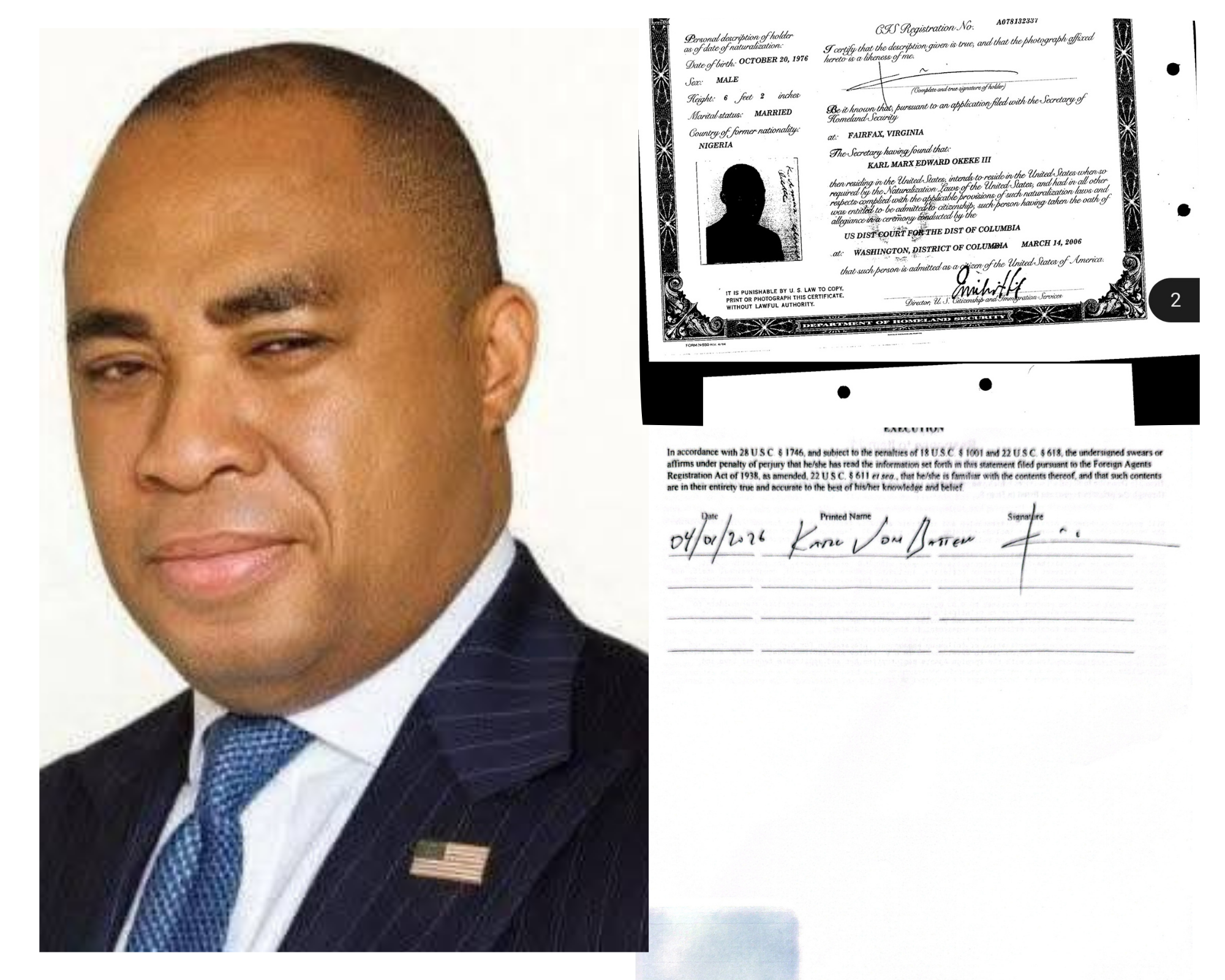
 Newly emerged documents have brought to light allegations against Karl Von Baten, also known as Ikemefuna Okeke, who is accused of perjury related to conflicting claims about his birthplace in US official records. Atiku Abubakar hired Washington-based firm Von Batten-Montague-York, L.C. for $1.2 million annually to boost his image in the US, with Fabiyi Oladimeji of the African Democratic Congress signing the contract. This engagement was registered with the US Department of Justice under FARA. The core controversy involves Okeke’s US documents, where he allegedly claims to have been born in the US in one record, but his naturalisation documents state Nigeria as his birthplace.
His naturalisation certificate, issued on March 14, 2004, lists him as Karl Marx Edward Okeke III, born October 20, 1976, with Nigeria as his former nationality. Falsely claiming US birth could amount to perjury, a serious federal offence. Okeke’s names vary widely: LinkedIn lists “Karl-Marx Edward Ikemefuna William George Okeke-Von Batten,” while FARA filings and contracts show other versions, sometimes including “Von Batten” after marrying Elizabeth Von Batten. These inconsistent identities raise concerns about potential deception, especially among immigration experts. Observers have urged Authorities like ICE, the FBI, and the Department of Justice to investigate. If proven, Okeke risks deportation and imprisonment. Perjury can lead to up to five years in federal prison, and combined with immigration fraud, he could face significant jail time and deportation.
Beyond the lobbyist scandal, questions arise about why Atiku and his associates repeatedly operate outside the law. The former vice president has faced ongoing controversies, including forgery allegations and questionable relationships. Throughout his political career, Atiku has been involved in multiple forgery accusations, often challenging opponents’ credentials in court. International observers and analysts describe his tactics as “extreme lawfare”, using judicial means to pursue political goals instead of letting voters decide. The irony is clear: a man known for attacking others’ documents now faces his own contradictions, with sworn statements that could put him in a US prison.
Experts say his pattern of legal and ethical issues isn’t new. Former President Olusegun Obasanjo has accused Atiku for over 20 years, with specific allegations during their 1999–2007 administration. Obasanjo asked the Senate to investigate claims of misappropriation involving the Petroleum Technology Development Fund (PTDF). Atiku was accused of diverting $125 million from a government agency into his own businesses. The EFCC examined corruption allegations between 2005 and 2006, producing a report titled “The EFCC Report on Vice-President Abubakar Atiku.” Despite promises to act after his immunity ended, no prosecutions occurred, raising questions about how he continued to pursue Nigeria’s highest office.
Recently, a former lawmaker demanded the EFCC reopen and pursue the case against Atiku, citing both the 2006 report and a 2010 US Senate investigation suggesting money laundering. The US probe looked into whether Atiku and his associates laundered money through US banks, adding an international aspect to his legal issues.
Obasanjo’s past words still resonate: in a notable letter to the Senate, he accused Atiku of “gross misconduct” and “financial recklessness,” portraying him as someone unfit to handle public funds. Observers note that Obasanjo’s warnings seem prescient—whether about financial dealings, associates, or respect for legal processes. He said Atiku was “not a man of integrity” and had “compromised his office,” comments that are especially relevant given the current scandal involving Atiku’s chosen Washington lobbyist.
From hiring a lobbyist with questionable legal status, to decades of corruption claims, to using court cases against opponents while his allies face perjury charges, the pattern is concerning. One observer remarked, “Atiku Abubakar appears to be surrounded by a permanent cloud of legal controversy. At what point does coincidence become a pattern?” The question remains as his reputation is once again tarnished by those around him. Atiku’s camp claims the engagement was properly disclosed under FARA. However, with Okeke facing possible deportation and Atiku’s legal troubles resurfacing, he may find his past catching up, this time with American prison implications.