



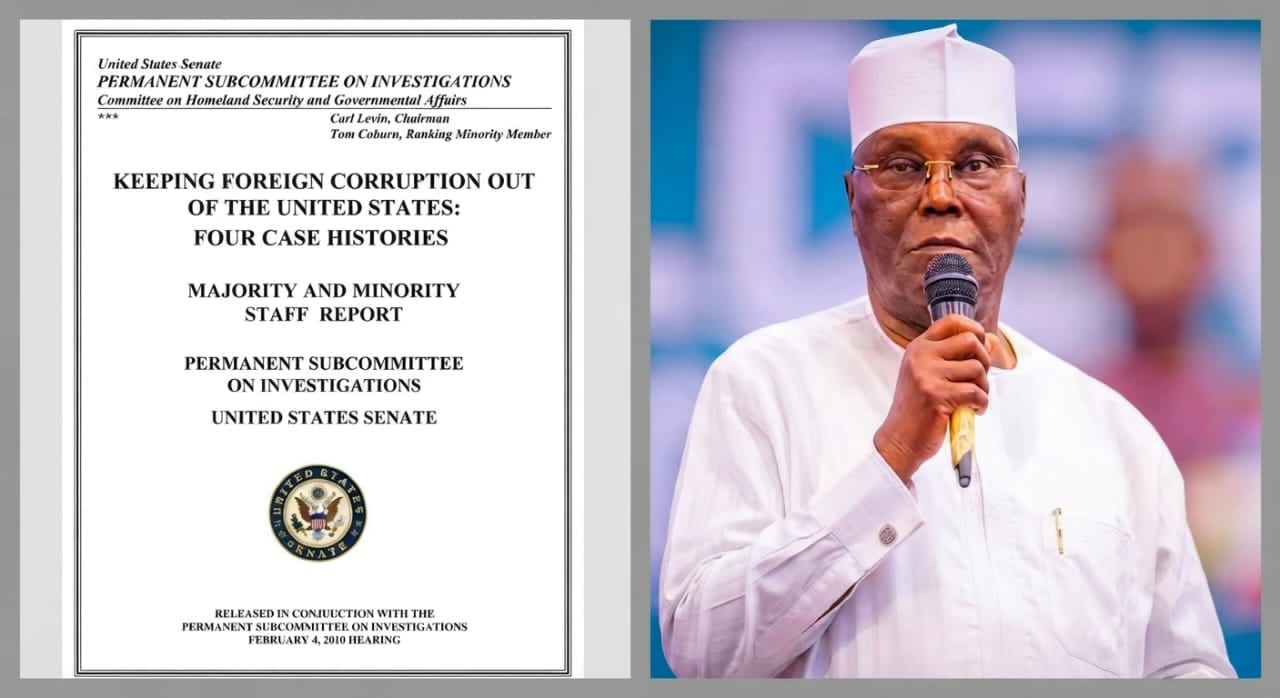
 … Former Vice President’s American spouse received millions through shell companies while couple claimed ignorance of funds’ origins – US Senate Committee
A U.S. Senate investigation has revealed that Jennifer Douglas Abubakar, wife of former Nigerian Vice President Atiku Abubakar, received over $10.4 million in wire transfers from offshore shell companies between 2000 and 2008, funds that investigators say included proceeds from bribery and corruption. The findings were published in a February 2010 staff report by the U.S. Senate Permanent Subcommittee on Investigations, chaired by Senator Carl Levin, titled “Keeping Foreign Corruption Out of the United States: Four Case Histories.” One case study focused entirely on the Abubakar family’s financial dealings.
Subcommittee investigators obtained wire transfer records for Douglas’s Citibank account and traced the flow of funds from two offshore sources tied to Gabriele Volpi described in the report as Abubakar’s “trusted friend and business partner.” The first channel, LetsGo Ltd., routed $7,424,620 through Wegelin & Co. and Banca Del Gottardo between April 2003 and October 2006. Transfers included $249,965 on April 9, 2003; $299,965 on April 25, 2003; $249,985 on November 12, 2004; $450,000 on December 5, 2005; and $350,000 on October 5, 2006. The second channel, Guernsey Trust Company, sent an additional $3,049,940 between June 2006 and May 2007 via Wegelin & Co., with transfers of $100,000 on June 14, 2006; $350,000 on December 29, 2006; $449,980 on April 30, 2007; and $350,000 on May 31, 2007. The combined total deposited into Douglas’s Citibank account from these two channels reached $10,474,560.
The money originated from a legal structure Abubakar created on July 22, 1999, shortly after taking office as Vice President. He established the “Abubakar Blind Trust” under Nigerian law, placing his 16% shareholding in Integrated Logistics Services Inc. (Intels) into the trust. Blind trusts are designed to prevent public officials from knowing or influencing their assets. However, Abubakar did not hand the trust to an independent financial institution. From 1999 to 2003, the trustee was Orlean Invest Holdings Ltd., a Panamanian corporation associated with Intels and Volpi. On October 9-10, 2003, Orlean resigned and was replaced by Guernsey Trust Company Nigeria Ltd. — a shell company formed just one day before it was named trustee. In May 2007, Abubakar left the Vice Presidency. The trust was supposed to transfer its assets back to him, but instead kept operating and continued sending wire transfers to U.S. bank accounts for years. Guernsey Trust’s legal counsel told the Subcommittee its beneficial owners were Volpi, Nigerian lawyer Uyiekpen Giwa-Osagie, and Fati Akintola Kekere-Ekun, the CEO of a bank that sat on the American University of Nigeria’s board of trustees.
The report connected Douglas’s account directly to one of history’s largest foreign bribery scandals. In December 2008, Siemens AG pleaded guilty and agreed to pay over $1.6 billion in fines after the U.S. Department of Justice and SEC alleged the German conglomerate made bribery payments in multiple countries, including Nigeria. The SEC’s complaint revealed that approximately $2.8 million of Siemens bribe payments were routed through a bank account in Potomac, Maryland — in the name of the wife of a former Nigerian Vice President. The Subcommittee independently obtained documentation showing at least $1.7 million of that money moved into Douglas’s account.
When U.S. banks questioned the source of wire transfers, Douglas consistently replied that she didn’t know the offshore entities and assumed the money came from her husband. When the Subcommittee asked directly about Guernsey Trust, LetsGo, Sima Holding, and China Castle Investments, she responded through counsel that she had “no personal knowledge of these entities” and understood all deposits “came from her husband.” Volpi’s counsel offered more detail: the money sent to Douglas “related to a moral agreement” between Volpi and Abubakar, compensation for Intels shares Abubakar had lost when General Sani Abacha seized them in 1996, which Volpi promised to restore once “political circumstances would permit.” Douglas declined to sit for an interview. So did Abubakar. Douglas now resides primarily in the United Arab Emirates, working as a professor at the American University of Sharjah.
Bank records show Douglas spent much of the money sustaining a luxury lifestyle in the United States, credit card and household expenses ranging from $10,000 to $90,000 monthly while also funneling funds into two Nigerian institutions: the Gede Foundation (established 2002) and the American University of Nigeria (founded by Abubakar in 2003). An additional $14 million from LetsGo and Guernsey Trust reportedly went directly to AUN for “consulting fees,” which university officials told investigators they assumed came from Abubakar without questioning the unfamiliar offshore senders.
A sitting Vice President placed his business assets in a trust that was supposed to be independent then staffed it with companies and individuals tied to his own business partner. That trust sent more than $10 million into his American wife’s personal account over roughly four years, with Siemens bribe money moving through the same account. When U.S. banks and Senate investigators asked where it all came from, the answer from everyone involved was the same: someone else must know. Nobody, on the record, ever did.