



By Podium Reporters
Nigeria’s political space is currently awash with varying shades of outrage by some political players and stakeholders over section 60(3) of the Electoral Amendment bill 2025, initially passed by the Nigerian Senate on February 4th, 2026. The contentious debate centers on one phrase: “mandatory electronic transmission of results in real-time“.
In the 2022 Electoral Act, the section that legislates on the transfer of polling unit results is Section 60(5) while in the 2025 Amendment Bill, the equivalent section is 60(3). For clarity, both versions are reproduced here side by side.
In the 2022 Act, section 60(5) reads:
“The presiding officer shall transfer the results including total number of accredited voters and the results of the ballot in a manner as prescribed by the Commission.”
In the draft 2025 Electoral Act Amendment Bill, section 60(3) reads:
“The presiding officer shall electronically transmit the results from each polling unit to the IREV portal in real time, and such transmission shall be done after the prescribed Form EC8A has been signed and stamped by the presiding officer and/or countersigned by the candidates or polling unit agents, where available at the polling unit”.
The fundamental difference between the two clauses lies in the explicit requirement for real-time electronic transmission of results. While section 60(5) of the 2022 Electoral Act left the method of transmitting polling unit results entirely to the discretion of the Independent National Electoral Commission (INEC), the draft amendment sought to explicitly mandate the presiding officer to electronically transmit results from the polling unit in real time to the INEC result viewing (IREV) portal.
On February 4th, the Senate opted instead to retain the provisions of section 60(5) of the 2022 Electoral Act and merely renumbered it to become Section 60(3) in the new Electoral Act Amendment bill. This generated a political storm particularly among opposition parties and some civil society organisations, who mounted pressure on the Senate to adopt mandatory real-time electronic transmission of results from every polling unit.
The Senate eventually reconvened on Tuesday 10th February and revised the Section 60(3) of the amended Electoral Act to read:
“Results shall be transmitted electronically from each polling unit to the IReV after the prescribed Form EC8A has been signed and stamped by the presiding officer and party agents who are available at the polling unit. Provided that where the electronic transmission of results fails as a result of communication failure, the result contained in Form EC8A, signed by the presiding officer and/or countersigned by polling agents shall, in such a case, be the primary source for collation and declaration of results.”
THE SALIENT ISSUES
The controversy surrounding the electronic transmission of results in Nigeria’s political space today is driven more by emotion than any sober logic. Many critics misinterpreted the Senate’s initial position to retain INEC’s discretion on mode of transfer of polling unit results to mean rejection of electronic transmission of votes itself. But this is not correct.
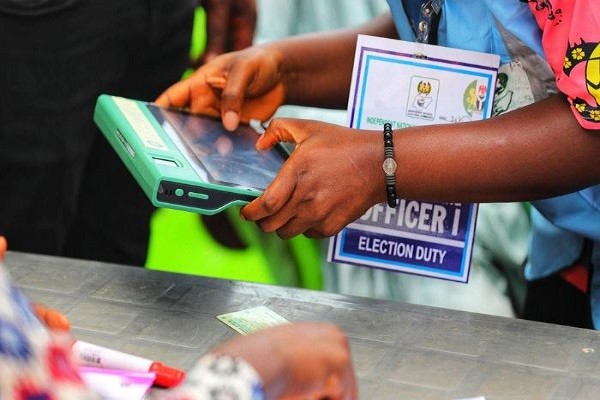
For the 2023 general election, INEC – empowered by section 60(5) of the 2022 Electoral Act – already introduced the electronic transmission of scanned polling unit result sheets to the IREV portal. INEC through Section 38(ii) of its Regulations and Guidelines for the 2023 elections specifically mandated presiding officers in Section 38(ii) to upload scanned copies of Form EC8A using the BVAS device to the INEC Result Viewing Portal (IReV). Nothing in the amended Electoral Act prevented this from continuing.
Sadly, amidst the ongoing debate about e-transmission of results, it appears that a lot of people are overlooking the more critical issues necessary for a robust and manipulation-resistant electoral process in Nigeria. The reality is that many Nigerians do not properly understand the e-transmission issue they are so emotionally invested in. In 2023, a lot of people believed that the presidential election was flawed simply because scanned polling unit results were not uploaded in “real-time” into the IREV portal. To them real-time upload of result sheets into IREV portal is synonymous with election credibility. But the issue of election credibility is far more complex. I will highlight three salient issues that are going under the radar:
Rigging cannot be solved by “real-time upload to IREV” alone
If there is anything that the 2023 general elections and subsequent off-cycle elections has demonstrated, it is the fact that manipulation of results can occur at the polling unit, before any upload takes place. It is possible to manipulate what is entered on form EC8A right at the polling unit level if the prevailing political atmosphere in the locality enables it. If form EC8A is fraudulently filled, the scanned copy uploaded to IREV portal in real-time merely becomes a digitally preserved fraud and does not reflect the actual outcome of voting at the polling unit.
It is true that election rigging can literally occur at any point in the collation process, however, the major place where rigging actually takes place in Nigeria today is at the polling unit level. This is where over-voting takes place with presiding officers and party agents known to sometimes collude to make it happen. In such instances, what is recorded on the polling unit result sheet is a product of fraud. So, even if the result sheet is scanned and uploaded to IREV by the Presiding Officer in the so-called “real-time”, before leaving the polling unit, rigging has already taken place and the fraudulent form EC8A enters the collation process whether as the physical form EC8A or the scanned copy uploaded on the IREV portal. Therefore, e-transmission alone is insufficient to solve election rigging.
Electronic Transmission of vote tallies is a recipe for anarchy
A lot of people have different notions of what real-time e-transmission of votes means. To the majority however, it simply means uploading polling unit result sheets to IREV portal immediately after entering the vote figures on the result sheet. Some people, as seen in 2023, even erroneously believe that IREV is meant to collate votes uploaded to the portal. Well, that is not what IREV does, it is only a portal for viewing physical result sheets of polling units. Collation of results is still MANUAL, but some want collation to be electronic, hence their insistence on mandatory real-time e-transmission of votes (vote count figures and not scanned physical result sheets).
Well, that is where the big issue lies – electronic transmission of votes can only make some level of sense if there is ELECTRONIC VOTING. But in Nigeria today, we do not use electronic voting. Ballots are cast, sorted, counted and recorded MANUALLY. If e-transmission of votes was to become mandatory in the Electoral Act with our manual voting process, it will then require presiding officers to MANUALLY key the number of votes garnered by each political party into an electronic collation system, which would then automatically collate the results and one can view the performance of each political party in real-time as results trickle into the portal from across the polling units.
The danger in adopting this method in Nigeria currently cannot be overstated – it will ultimately lead to anarchy. We are still struggling to ensure paper result sheets are not manipulated, imagine leaving the task of inputting and transmitting manually-derived election figures into the e-collation platform/portal in the hands of adhoc polling unit presiding officers. That is a recipe for anarchy! Besides the risk of compromised presiding officers tampering with the figures in favour of their paymaster(s), the e-collation infrastructure can be remotely targeted by hackers and the results compromised leading to post-election chaos. That is of course beside the other lesser problem of poor or lack of internet connectivity in some areas that may hinder the process.
Sanctity of election results rest on a tripod of safeguards
Electronic transmission of result sheets to IREV portal, in itself, does not confer absolute credibility on the elections, other important safeguards MUST be in place simultaneously for that high level of credibility to be attained. Sadly, those who want to see a credible electoral process are not paying attention to these areas. A credible electoral process rests on three key pillars:
1. Ensuring number of votes cast is not greater than number of voters accredited by the BVAS.
2. Ensuring vote count is accurately recorded on Form EC8A by the presiding officer.
3. Political parties having trusted agents in all polling units to guard against over-voting and falsification of results as well as to get a duplicate copy of the correctly filled and signed form EC8A.
In essence, uploading the filled form EC8A into the IREV portal is more of a quality assurance process and not necessarily the foundation of electoral credibility.
SENATE’S REVIEW OF SECTION 60(3) IS A SMART CONCESSION
In 2023, the Supreme Court ruled that inability to upload result sheets into IREV portal before proceeding with the collation of results and return of a winner does not invalidate the result. It is therefore understandable that some political stakeholders wanted to see mandatory upload of polling unit result sheets into IREV enshrined in the Electoral Act as a pre-requisite before commencement of manual collation of result at the ward collation level. However, it is important that important legislations like the Electoral Act are not enacted from a shortsighted point of view.
If real-time electronic transmission (upload) of scanned result sheets is explicitly made mandatory in the Electoral Act, it may end up creating unintended roadblocks to a smooth and credible electoral process. One of such roadblocks is that if network challenges or cyber attacks delay or prevent upload of form EC8A to IREV portal, collation of results at the ward level cannot proceed despite the availability of the valid physical form EC8A. This alone can lead to election day violence.
Therefore, the review of section 60(3) of the Electoral Act Amendment bill by the Senate to explicitly mention the electronically transmitted result sheets on IREV portal as a source for collation and declaration of results alongside the original physical form EC8A was a smart concession by the Upper legislative Chamber instead of making the IREV copy the exclusive requirement for collation.
In one breathe, the Senate reassured those who erroneously felt the Senate delegitimised upload of results to the IREV portal simply because it initially retained giving INEC powers to determine how to transfer results from the polling units to the collation stage. On the other hand, the Senate also ensured that there are alternative legal means of carrying on with collation in the event that IREV portal is down for whatever reason including as a result of election day cyber attacks or that an incompetent or mischievous presiding officer is unable to upload form EC8A to IREV portal – an occurrence we have repeatedly seen on the IREV portal where some upload unrelated pictures in place of form EC8A.
So, the Senate did well by retaining the original form EC8A as a critical source for the collation process especially where no result is uploaded by a presiding officer to IREV or the uploaded copy is blurry and the results/accreditation data entered on the form difficult to make out. It would have been disruptive and reckless to rely wholly on the IREV portal for collation.
THE PATH NIGERIA MUST NOW TAKE…
Nigeria’s electoral reform conversation must now graduate from the narrow obsession with “real-time transmission” to a broader, more mature engagement with the entire architecture of election integrity. Electronic upload or transmission of result sheets is useful, but it is neither a silver bullet nor a substitute for stronger safeguards at the polling unit where results are actually determined.
What Nigeria truly needs going forward is a deliberate, long-term strategy that includes: sustained investment in BVAS integrity and security; comprehensive training and monitoring of INEC officials saddled with election duties at all levels; every political party putting in place an effective oversight mechanism of the election process right from the polling unit level; and incremental adoption of electronic voting technologies.
Until Nigeria fixes the pressure points where rigging truly occurs, real-time uploads of result sheets, whether mandated or optional, will only produce digital versions of whatever happens at the polling units. The Senate’s revised Section 60(3) offers a pragmatic bridge toward a more reliable electoral system. Now, the responsibility shifts to INEC, political actors, and citizens to strengthen the foundations that guarantee credible elections rather than remaining fixated on a single buzz word.