



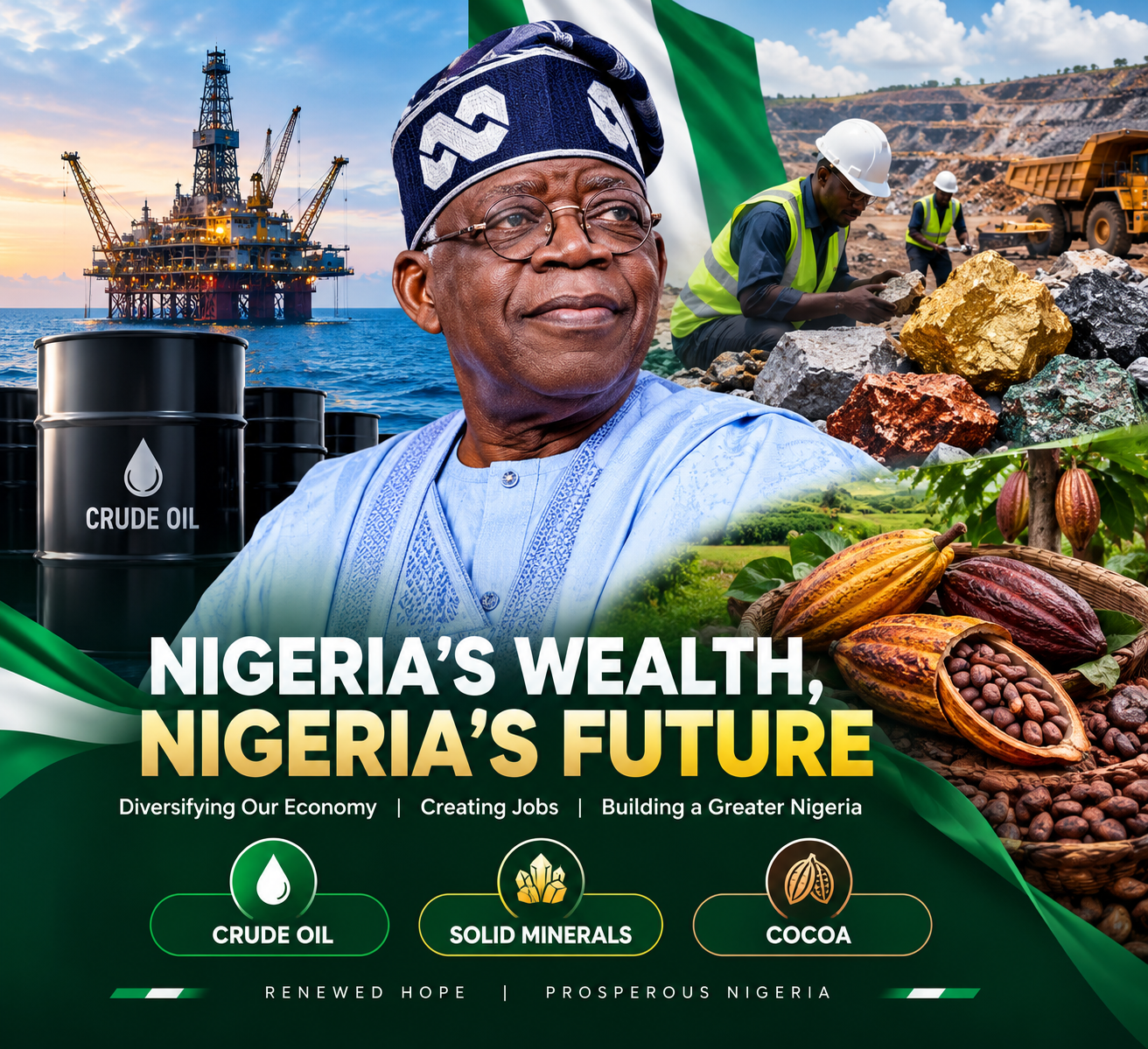
Nigeria is a country blessed with enormous natural resources, but for decades, much of the nation’s wealth has left the country in raw form, while Nigerians received only a fraction of the value created from those resources. President Bola Ahmed Tinubu’s Renewed Hope Agenda is increasingly focused on changing that model by encouraging production, local processing, investment, value addition and stronger revenue management.
In the crude oil sector, the administration is pursuing reforms designed to restore investor confidence, increase production and make Nigeria’s petroleum resources generate greater value for the Federation.
Nigeria produced an average of 1.68 million barrels of crude oil and condensate per day in August 2026, while crude-only production reached about 1.50 million barrels per day, marking the fourth consecutive month the country met its OPEC quota.
Beyond increasing production, the PBAT administration is also paying greater attention to how oil revenues are managed. In February 2026, the President signed an Executive Order aimed at safeguarding oil and gas revenues, reducing waste and ensuring that relevant revenues are remitted directly to the Federation Account. This has the potential to strengthen the resources available to the Federal, state and local governments for infrastructure and public services.
The broader petroleum reform programme is equally important because Nigeria cannot depend indefinitely on simply exporting crude. The Presidential Petroleum Reform and Value Optimisation Task Force established in 2026 is expected to develop the next phase of reforms, including measures aimed at unlocking investment, increasing production, improving foreign exchange earnings and strengthening the contribution of the energy sector to GDP.
For ordinary Nigerians, a stronger petroleum industry can mean more government revenue, more investment, more jobs and greater opportunities across the oil and gas value chain.
But Nigeria’s economic future cannot rest on crude oil alone. Cocoa represents another major opportunity, particularly because millions of Nigerians depend directly or indirectly on agriculture. The PBAT administration is therefore pushing a shift from simply exporting cocoa beans to processing, branding and manufacturing cocoa products in Nigeria.
At the 2026 Cocoa Value Addition Summit, the Federal Government outlined plans to expand domestic processing and industrialisation. More than 350,000 Nigerian farming families reportedly cultivate cocoa across more than 1.4 million hectares, while national cocoa grinding capacity has crossed 120,000 tonnes annually.
A 70,000-tonne processing facility under construction in Sagamu is expected to further expand Nigeria’s capacity to capture value within the country.
The advantage is straightforward: when Nigeria exports finished cocoa products instead of predominantly raw commodities, more of the value chain remains at home. That means opportunities for farmers, processors, transporters, manufacturers, packaging companies, exporters and young Nigerians entering the agricultural and manufacturing sectors.
The government has also clarified that its policy is about value addition rather than banning raw cocoa exports, while encouraging investment in domestic processing and higher farmer incomes.
The administration has also introduced measures aimed at increasing cocoa productivity from the farm level. In July 2026, the Federal Government launched a One Million Improved Cocoa Seedlings Roll-Out Programme, with improved varieties designed to mature faster, produce higher yields and offer greater resistance to diseases and changing climatic conditions. Such investments are particularly important because they can improve farmers’ productivity and strengthen the competitiveness of Nigerian cocoa over the long term.
Then comes Nigeria’s vast solid minerals sector, an area that has remained largely underdeveloped despite the country’s deposits of gold, lithium, tin, tantalite, iron ore and other minerals. The PBAT administration is seeking to reposition mining as a major pillar of economic diversification, with emphasis on responsible mining, investment, local processing and stronger regulation. The Federal Government has said reforms are already attracting investment into areas such as lithium processing, gold refining and mineral value addition.
The importance of this strategy goes beyond government revenue. Properly developed mining can create employment in exploration, extraction, transportation, processing, engineering, manufacturing and technology. It can also help Nigeria participate more meaningfully in global supply chains for critical minerals. President Tinubu has consistently argued that African countries must move beyond supplying raw materials and begin capturing more value through processing and industrialisation.
For the common Nigerian, the real significance of these reforms is that they can gradually move the economy from one that extracts and exports to one that produces, processes and creates wealth at home. A stronger oil sector can provide more reliable public revenue; a modern cocoa industry can raise agricultural incomes and create agro-industrial jobs; while a properly regulated solid minerals industry can bring investment, technology and new employment opportunities to communities across the country.
The bigger picture is therefore about intergenerational prosperity. Nigeria’s oil reserves remain substantial, while agriculture and solid minerals provide opportunities that can outlive the current generation. NUPRC reported total oil and condensate reserves of 37.01 billion barrels and gas reserves of 215.19 trillion cubic feet as of January 1, 2026.
The challenge is to convert these resources into enduring institutions, industries, jobs, infrastructure and human capital.
President Bola Ahmed Tinubu’s economic strategy is ultimately about ensuring that Nigeria’s natural wealth is not merely something that exists beneath Nigerian soil or grows on Nigerian farms, but something that works for Nigerians.
If the reforms in oil, cocoa and solid minerals are sustained, implemented transparently and matched with investment in infrastructure and human capital, they can help build an economy where today’s difficult adjustments translate into stronger opportunities, better jobs and greater prosperity for future generations.