



President Bola Ahmed Tinubu has assured Nigerians that ongoing reforms in the country’s security architecture will lead to the defeat of terrorism, banditry and kidnapping, while expressing confidence that the economy has stabilised and prosperity is on the horizon.
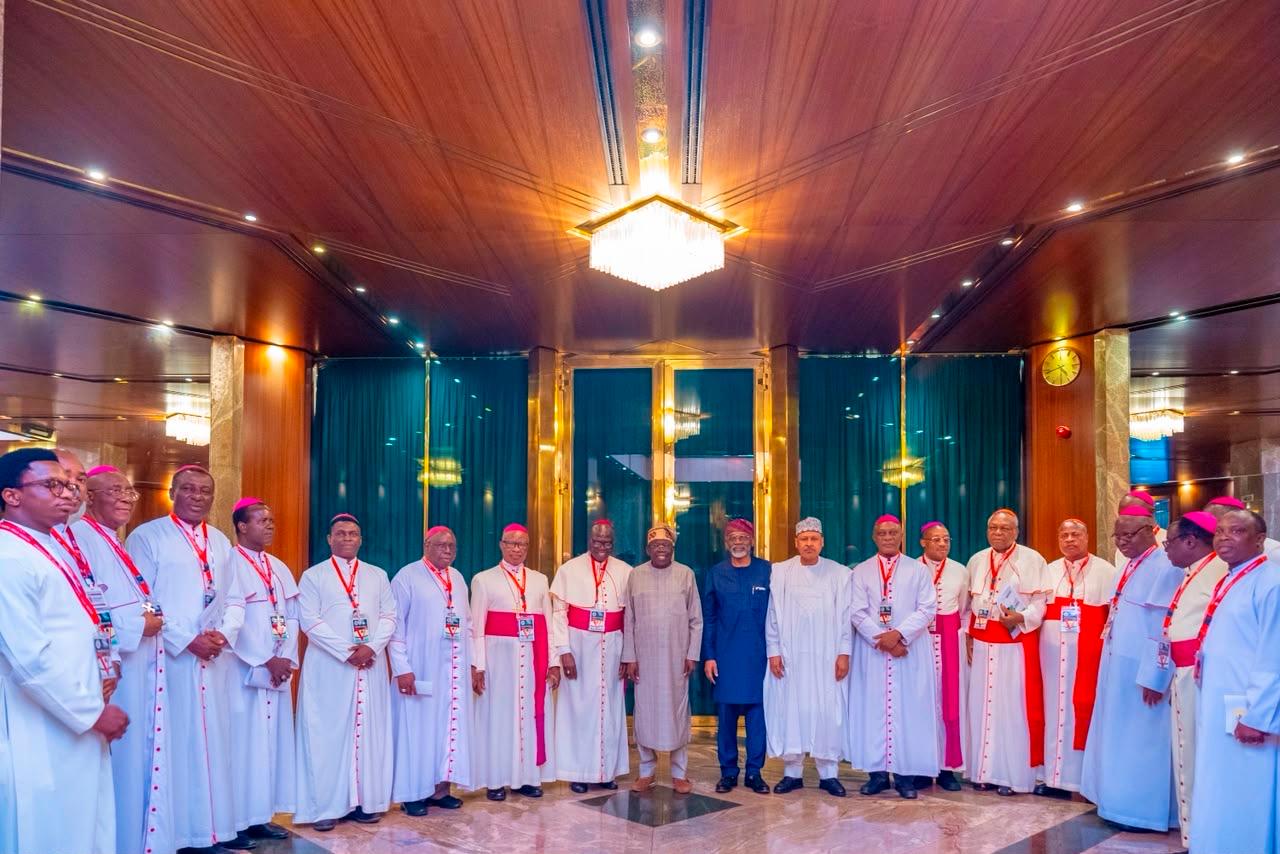
The President gave the assurance on Tuesday while receiving the leadership of the Catholic Bishops’ Conference of Nigeria (CBCN), led by its President, Archbishop Matthew Ndagoso of Kaduna, at the State House in Abuja.
Speaking during the meeting, Tinubu said his administration was repositioning Nigeria’s security institutions through enhanced intelligence gathering, institutional restructuring, improved logistics and greater attention to the welfare of frontline security personnel.
He disclosed that he had approved the expansion of the armed forces, including the acquisition of more military equipment and the construction of new barracks, expressing confidence that terrorism would be defeated. The President also urged religious leaders to continue preaching peace and condemning violence in their sermons.
On the economy, Tinubu maintained that his administration had rescued Nigeria from financial instability, noting that the country was now on a stronger economic footing than when he assumed office.
According to him, the fears of bankruptcy that greeted the beginning of his administration had been overcome, while the nation’s economic outlook was improving. He added that government interventions, including the Nigerian Education Loan Fund (NELFUND), would continue to support education and improve the living conditions of Nigerians.
The President encouraged citizens to embrace education, entrepreneurship and skills acquisition, stressing that these remained key pathways out of poverty. He also called on all stakeholders to prioritise national unity, stability and prosperity.
Highlighting progress in the education sector, Tinubu noted that universities were operating without disruptions from industrial actions, describing the uninterrupted academic calendar as a positive development. He also revealed that additional universities had been approved to accommodate increasing demand for higher education.
Addressing concerns about the country’s democratic process, the President expressed confidence in the independence of the Independent National Electoral Commission (INEC), insisting that the electoral body remained neutral and had not intimidated any political group ahead of future elections.
On the issue of mission schools, Tinubu said state governors have the constitutional authority to determine whether such schools should be returned to their original owners. He recalled that as Governor of Lagos State, he returned mission schools, a decision he said could be confirmed by Catholic leaders.
Earlier, Archbishop Ndagoso commended President Tinubu for the reception accorded to the Holy See’s Secretary for Relations with States and International Organisations, Archbishop Paul Gallagher, during the 50th anniversary of diplomatic relations between Nigeria and the Vatican.
The CBCN President, however, raised concerns over insecurity, poverty, access to quality tertiary education, the need to strengthen democratic institutions, credible elections and the return of mission schools. He also called for equal treatment of all religious groups and urged the government to ensure free, fair and credible elections in 2027.
Archbishop Ndagoso noted that President Tinubu’s democratic credentials positioned him to leave a lasting legacy by strengthening Nigeria’s democratic institutions.
The meeting was attended by 19 senior Catholic clerics, including Cardinals John Onaiyekan and Peter Okpaleke, Archbishop Ignatius Kaigama of Abuja, Archbishop Alfred Martins of Lagos, Bishop Matthew Kukah of Sokoto and several other bishops and church officials from across the country.