



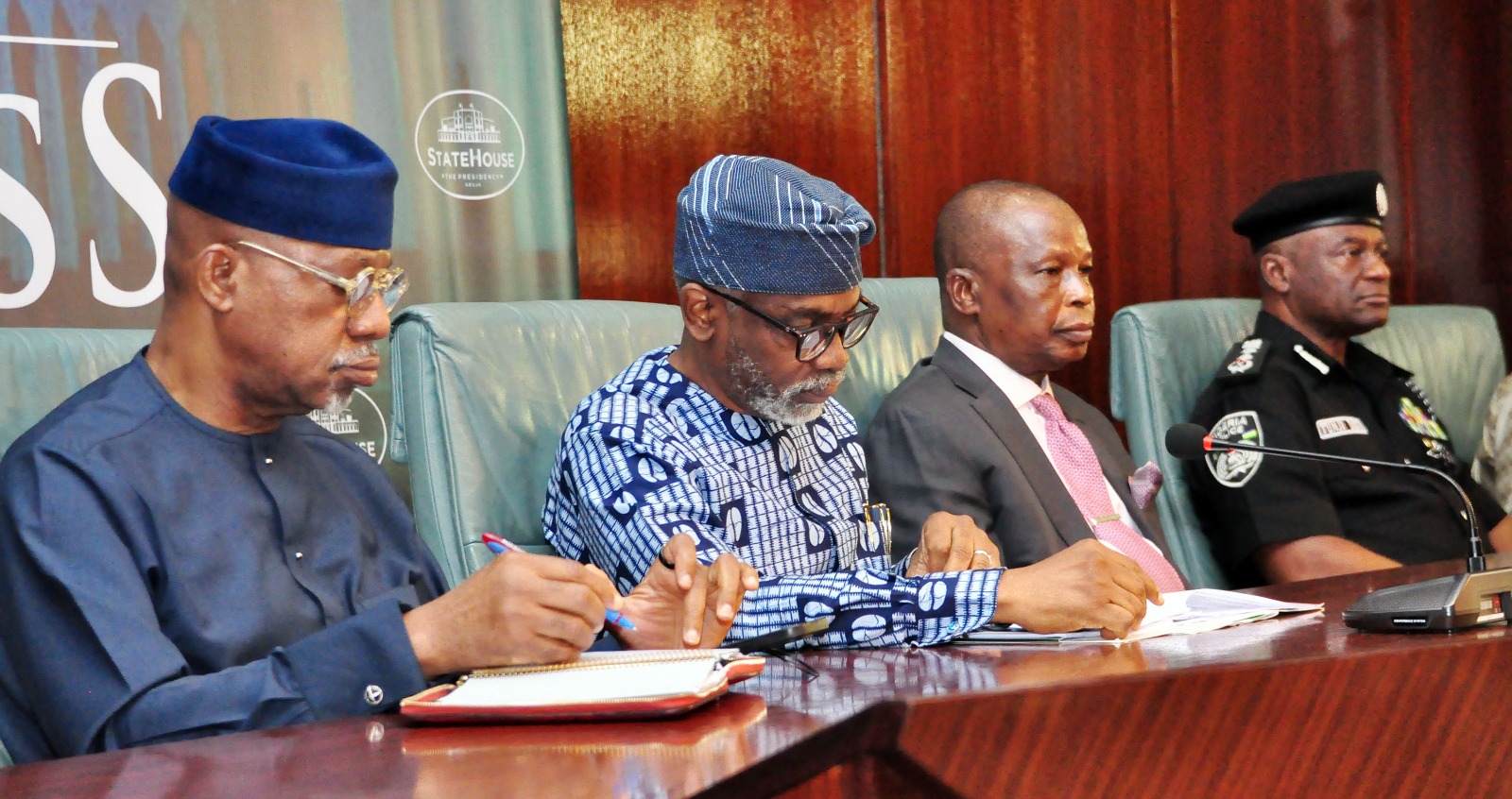
The Chief of Staff to the President and Chairman of the Presidential Working Group on the National Policing Bill, Rt. Hon. Femi Gbajabiamila, has announced the formal commencement of work on the National Policing Bill, describing it as a landmark reform aimed at establishing a sustainable dual policing system in Nigeria.
Following the inaugural meeting of the Presidential Working Group at the State House Press Centre in Abuja on Monday, Gbajabiamila said the initiative is designed to prepare the legal and operational framework for federal and state policing once the constitutional amendment establishing state police is fully ratified.
“This is a monumental reform that Nigerians have debated over for many years. Our central task is now to design a lawful, professional and sustainable federal and state policing system that places greater capability closer to the people while preserving national standards, national security and the rights of every Nigerian,” he said.
Gbajabiamila explained that although the National Assembly has made significant progress on the constitutional amendment for state police, the process remains incomplete pending approval by the required number of State Houses of Assembly.
“Until that process is concluded and the necessary implementing laws are enacted, there is no operational State Police Service anywhere in Nigeria, and the Nigeria Police Force remains the constitutionally recognised police institution,” he stated.
According to him, the National Policing Bill will provide the detailed legal framework for issues such as recruitment, training, funding, operational standards, command structure, firearms regulation, pensions, data management, complaints mechanisms and cooperation between federal and state police institutions.
He disclosed that President Bola Ahmed Tinubu established the Presidential Working Group to ensure the country is fully prepared to implement the reforms once the constitutional process is completed.
“Our mandate is to produce a technically robust, implementation-ready draft National Policing Bill and supporting legislative package. We are building the legal and operational framework required to move from one federal police institution to a workable dual-policing architecture,” Gbajabiamila said.
The Chief of Staff also announced the inauguration of a multidisciplinary Policy Advisory Committee chaired by Hon. Justice Mohammed Abdullahi Liman to provide technical oversight and review successive drafts of the proposed legislation before executive consideration.
He said the reform programme would run on a seven-week, milestone-driven timetable ending on September 14, with the Executive Bill package scheduled for presentation to President Tinubu on September 3 before nationwide consultations and eventual transmission to the National Assembly.
Gbajabiamila stressed that the creation of state police would be guided by strict safeguards to prevent abuse.
“State Police cannot mean thirty-six state militias, just as national standards cannot become a disguised method of re-centralising day-to-day State policing. Officers must answer to the Constitution and the law, not to personal or partisan instruction,” he said.
He added that no state would be allowed to establish a police service without demonstrating adequate readiness in areas including recruitment, training, funding, oversight, discipline and financial sustainability.
“Operational commencement must also be based on readiness, not announcement. No Nigerian should receive a lower standard of protection because of where they reside,” he said.
Gbajabiamila also announced an open call for memoranda, position papers and policy proposals from Nigerians, civil society organisations, professional bodies, security institutions and other stakeholders to strengthen the proposed legislation.
“We recognise the concerns that accompany this reform… Those concerns are legitimate. Safeguards are not obstacles to State Police; they are what make State Police credible, lawful and sustainable,” he said.
He maintained that while the proposed reforms would not solve every security challenge facing the country, they would provide a stronger policing structure tailored to Nigeria’s size and diversity.
“This reform will not, by itself, solve every security problem in Nigeria. But Nigeria has an opportunity to build a policing system better matched to the scale and diversity of the country,” Gbajabiamila added.
The Governor of Ogun State, Dapo Abiodun; the Chief of Staff to the President, Femi Gbajabiamila; the Attorney General of the Federation and Minister of Justice, Lateef Fagbemi; and other members of the Presidential Working Group were present at the State House Press Gallery for the briefing.