



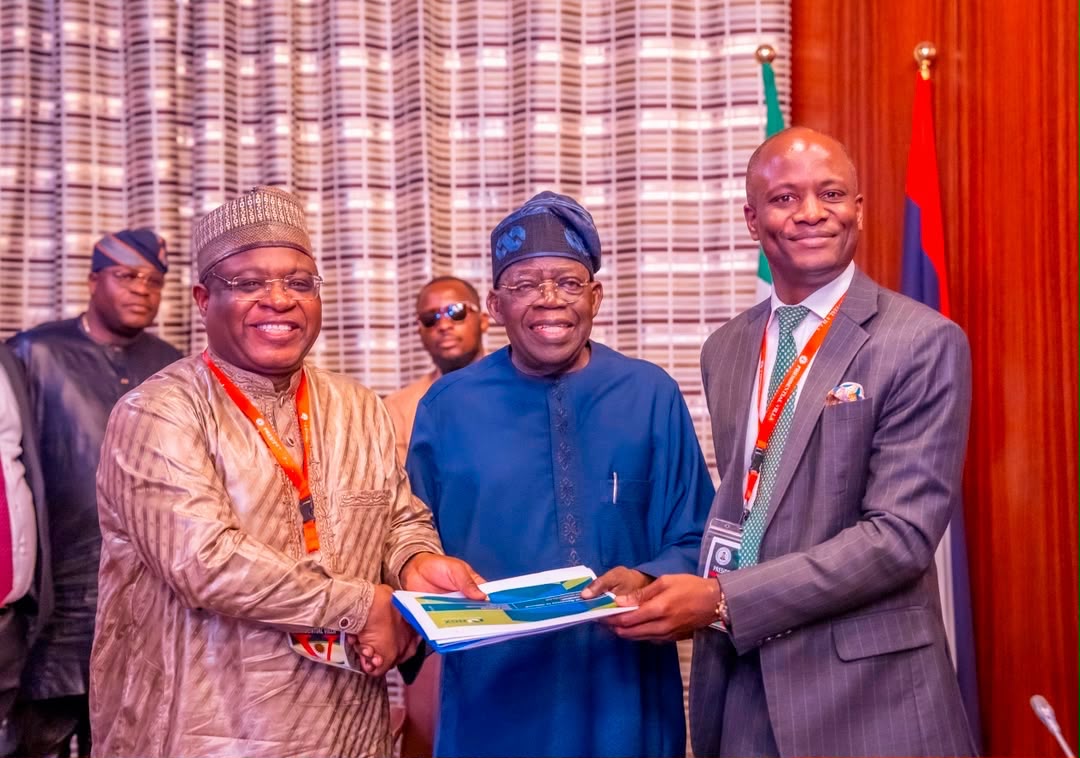
President Bola Ahmed Tinubu has commended members of his economic management team and the Nigerian Exchange Group (NGX) for what he described as the successful stabilisation of Nigeria’s economy and the remarkable rebound of the country’s capital market.
While receiving the Board and Management of the NGX at the Presidential Villa, Abuja, the President said growing confidence in Nigeria’s economy, reflected in positive assessments by experts and improving economic indicators, points to a brighter future for the country.
The NGX delegation, led by its Chairman, Dr Umaru Kwairanga, and Group Managing Director/Chief Executive Officer, Temi Popoola, informed the President that the total value of stocks listed on the Exchange has grown from about N30 trillion in 2023 to N160 trillion, with projections that it could reach N230 trillion before the end of 2026.
President Tinubu attributed the gains to his administration’s economic reforms and praised the Economic Management Team for its commitment and foresight. He singled out the Governor of the Central Bank of Nigeria (CBN), Yemi Cardoso, the Minister of Finance and Coordinating Minister of the Economy, Wale Edun, the Minister of Budget and Economic Planning, Atiku Bagudu, and the Chairman of the National Revenue Service (NRS), Dr Zacch Adedeji, for their roles in restoring economic stability.
Reflecting on the challenges his administration inherited, Tinubu said difficult but necessary policy decisions had laid the foundation for sustainable economic growth.
“If the stock market is doing well, then we are doing well,” the President said, adding that Nigeria possesses the capacity to build a prosperous economy through sound policies and strong collaboration between government and the private sector.
He reaffirmed his administration’s commitment to achieving a $1 trillion economy, describing the target as realistic considering Nigeria’s population and economic potential. He also disclosed plans to reform the Nigerian National Petroleum Company (NNPC) and eventually list it on the capital market.
Tinubu stressed that private sector investment remains critical to job creation and economic expansion, noting that his administration would continue to support initiatives capable of unlocking growth.
The Minister of Finance said Nigeria’s capital market has become one of the best-performing globally, driven largely by ongoing economic reforms. He added that efforts are underway, in collaboration with the Securities and Exchange Commission (SEC), to introduce innovations that will attract more young Nigerians to legitimate investment opportunities instead of speculative ventures.
He challenged the NGX and SEC to work towards expanding the market to a valuation of $1 trillion, arguing that a deeper capital market would create wealth for millions of Nigerians.
NGX Chairman, Dr Umaru Kwairanga, described the Exchange’s recent performance as a direct outcome of the administration’s economic reforms. He said international investors had taken notice of Nigeria’s progress, citing discussions at the London Stock Exchange where Nigeria’s capital market recovery attracted global attention.
Providing further details, NGX Group Managing Director Temi Popoola said the market’s benchmark All-Share Index had risen from 52,000 points in 2023 to 244,000 points, while the reforms had created significant wealth for investors.
According to him, between 500,000 and 900,000 Nigerians are estimated to have become millionaires through gains recorded in the capital market since the reforms began.
Popoola added that Nigeria is increasingly being viewed as a model for capital market development across Africa.
Also speaking, NRS Chairman Dr Zacch Adedeji credited the administration’s reforms, particularly the removal of fuel subsidy and ongoing tax reforms, with laying the foundation for the country’s economic turnaround.
CBN Governor Yemi Cardoso said the successful recapitalisation of Nigeria’s banking sector demonstrated renewed confidence in the country’s financial system, noting that about 75 per cent of the capital raised came from domestic investors, a significant shift from previous exercises that depended heavily on foreign participation.
He expressed confidence that sustained macroeconomic stability would continue to attract investment, deepen confidence in the financial system and support growth in the real sector of the economy.