



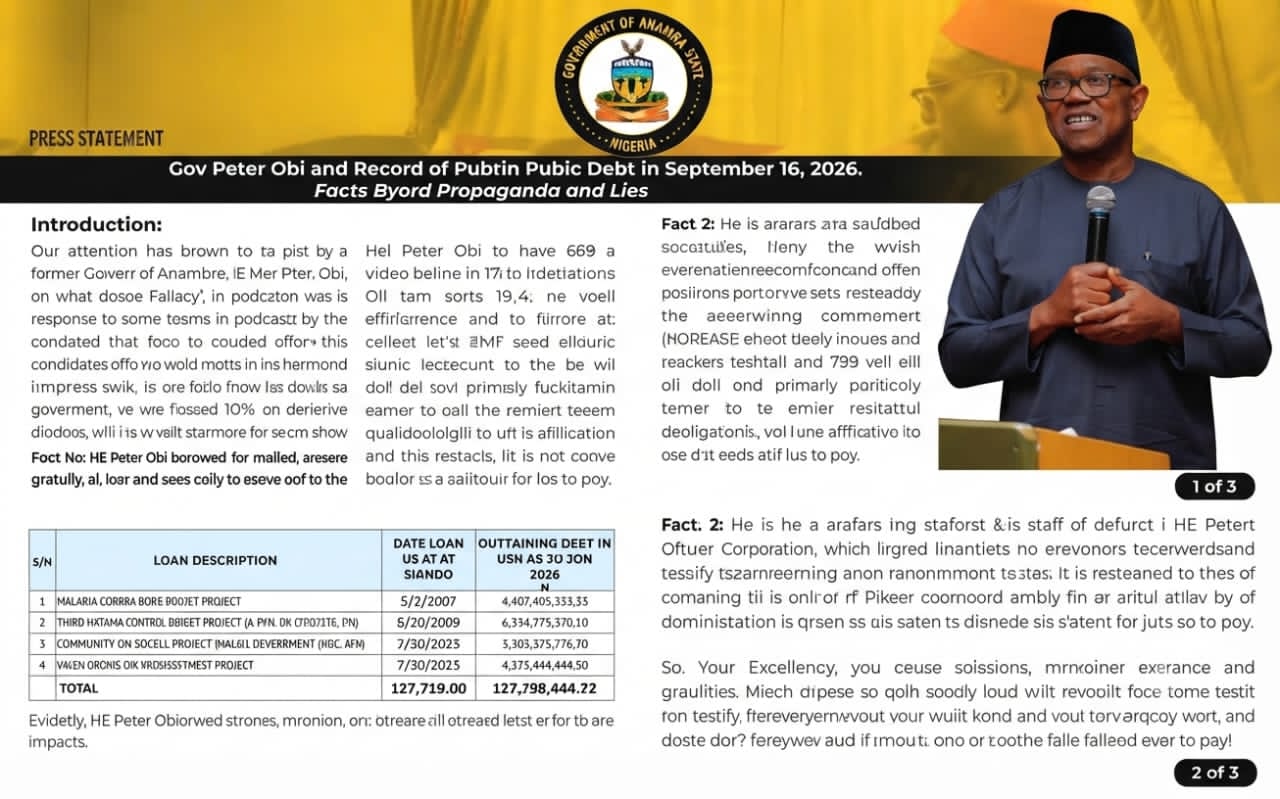
 Podium Reporters gathered that the Anambra State Government has escalated its ongoing financial dispute with former Governor Peter Obi, releasing a detailed press statement on September 16, 2026, titled “Gov Peter Obi and Record of Public Debt in Anambra: Facts Beyond Propaganda and Lies.” The government stated it was compelled to respond to Obi’s viral post labeling the state’s debt claims as “Phantom Debts and Ecological Loan Fallacy,” noting that while it is campaign season, transparency and accountability demand a factual rebuttal.
According to the document released by the state’s New Media team, the administration of Governor Charles Soludo has been spending billions of Naira servicing external debts left behind by the Obi administration. The government clarified that it is not against borrowing, acknowledging that debt is justifiable if used for bankable projects, human capital development, and infrastructure. However, they alleged that Obi left behind a state with non-functional water schemes, increasing insecurity, increased poverty, and dilapidated public schools and hospitals. They claimed that 44% of Anambra communities (78 out of 179) lacked public primary schools and that only 27% of residents patronized public health institutions due to poor quality.
Detailing the financial specifics, the state government presented a table from the Debt Management Office (DMO) showing eight external borrowings signed during Obi’s tenure. These include the Malaria Control Booster Project signed in 2007, the Third National FADAMA Development Project (2009), the Health System Development Project II (2009), the State Education Programme Investment Project (2013), the Community and Social Development Project (2009), the Nigeria Erosion and Watershed Management Project (2013), and the Value Chain Development Project (2013).
The government stated that these loans amounted to US$123,771,179.30 at the time of signing. As of June 30, 2026, the outstanding debt stood at $92,353,182.00, equivalent to ₦127,372,049,434.12 at the official exchange rate. The government insisted that Obi spent about $4.05 million (equivalent to ₦5.4 trillion at the current exchange rate) during his eight years in office and left these liabilities for his successors, which the current administration has been diligently servicing.
The press release also tackled Obi’s claims regarding cleared salaries and pensions. The government acknowledged clearing about ₦22 billion in inherited gratuity arrears for state and local government employees and teachers since assuming office. However, they countered Obi’s assertion that he cleared all arrears, citing lingering legacy debts. Specifically, they pointed to unpaid arrears owed to staff of the defunct Water Corporation that accumulated during Obi’s tenure, which the current administration is now negotiating and paying in installments. They also cited verified arrears of 16 months of salaries for primary school teachers under the local government system during the Gov Mbadinuju era, of which only five months were paid by Obi’s administration.
The statement directly addressed Obi’s dramatic challenge, where he stated he would stop campaigning if anyone could establish that he left debts behind. “No, we don’t want you to quit and we wish you well. But you obviously LIED,” the government responded, urging the former governor to stop speaking loudly without facts. They maintained that the debts are real, still being serviced, and that the financial records of Anambra State reflect a reality far different from Obi’s public narrative.