



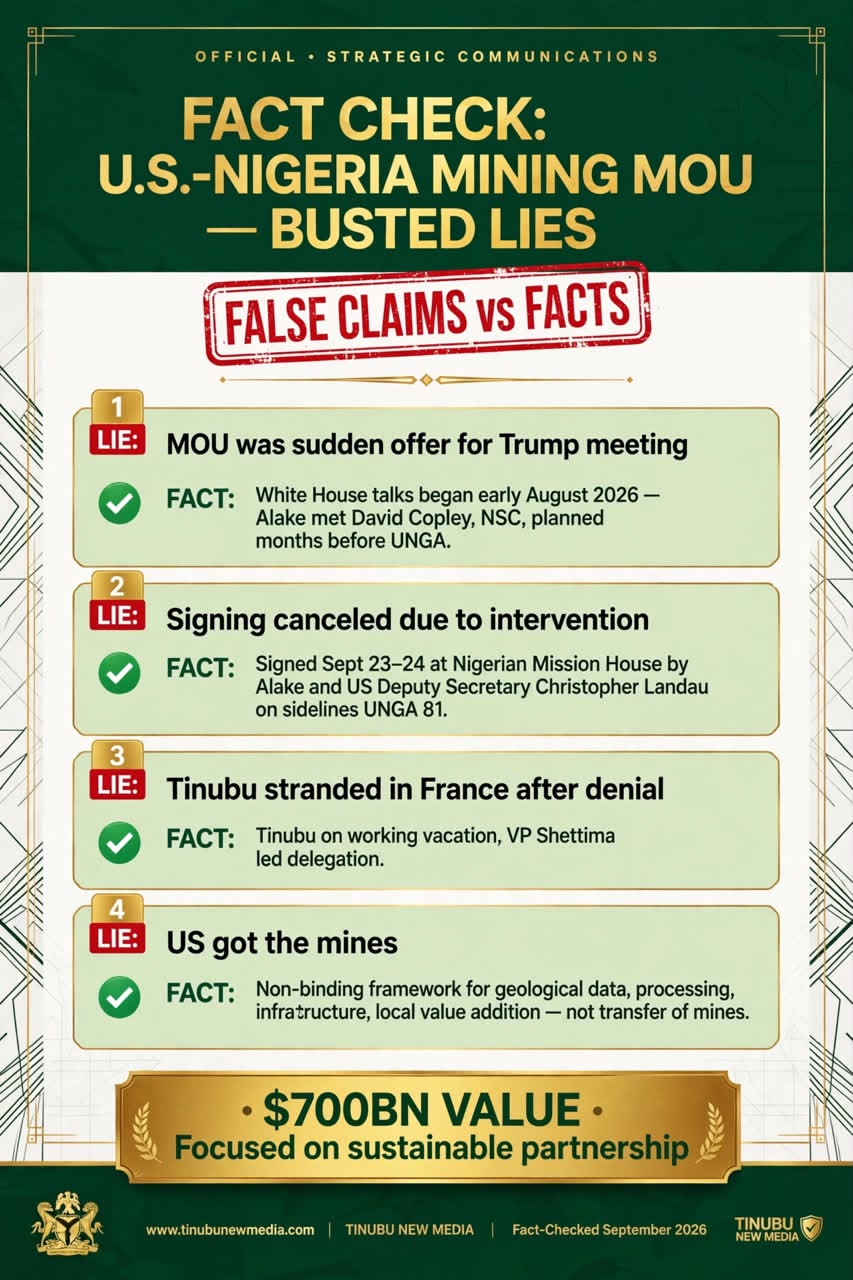
 Claims About U.S.–Nigeria Minerals Deal as Trump Meeting Bargain Are False, Public Record Shows. Framework was signed as planned at UNGA 81 after months of engagement, not canceled by lobbying intervention
Claims by Von Batten-Montague-York that the U.S.–Nigeria mining and critical minerals framework was a last-minute “offer in exchange for a Trump meeting,” was canceled because of their intervention, and represented a sudden first step in cooperation are false or heavily distorted, according to a review of public statements and reporting.
The framework agreement, often called an MOU, was not a last-minute proposal. Negotiations and engagement predated the UNGA announcement by months, with earlier U.S.–Nigeria mining discussions going back further. The signing proceeded as planned on the sidelines of UNGA 81.
According to the public timeline, in early August 2026, Nigeria’s Minister of Solid Minerals Development, Dele Alake, led a Nigeria Solid Minerals Company delegation to the White House. They met David Copley, Special Assistant to the U.S. President and Senior Director for Global Supply Chain at the National Security Council, and others. Talks focused on expanding cooperation across the critical minerals value chain geological exploration, mining, processing, value addition, refining, and resilient supply chains. The meeting was publicly reported at the time.
A meeting between Alake and U.S. Embassy Chargé d’Affaires Keith Heffern in Abuja was a direct follow-up to the White House talks. On or around 13 September 2026, the Nigerian side publicly stated that both countries were targeting the sidelines of UNGA in New York for the signing of an MOU on mining cooperation. It was framed as the next step in an ongoing process, not a brand-new proposal.
The signing happened as planned. On Wednesday, around 23–24 September 2026, Alake and U.S. Deputy Secretary of State Christopher Landau signed the framework agreement at the Nigerian Mission House in New York on the sidelines of the 81st UN General Assembly. Reuters, Nigerian media, and other outlets reported it. The agreement covers geological data and exploration, mineral development and processing, infrastructure, and technical capacity building. It is a government-to-government framework intended to facilitate later business-to-business investment and local value addition, not a transfer of “the mines.” No specific projects, companies, or financing commitments were announced at signing. Landau referenced broader positive momentum under Presidents Trump and Tinubu over the preceding roughly 18 months.
Earlier U.S.–Nigeria mining engagement also existed. For example, Alake met a U.S. Embassy official in 2024 and expressed interest in partnership on investment, technology, and security in the sector. The 2025–2026 talks built on Nigeria’s broader push for solid minerals investment and local processing.
The claim that the MOU was the “first step of cooperation” and was “first announced by the Nigerian government last week” is incorrect. Engagement and planning predated the mid-September public announcement. The UNGA signing was the planned ceremonial and symbolic step for a process already underway. Tinubu did not need to personally sign it; the minister signed with the U.S. Deputy Secretary of State. It was never presented as requiring a presidential-level bilateral meeting with Trump as a precondition.
The claim that it was “one of the proposals” Tinubu allegedly offered in exchange for a meeting with Trump is unsupported. Credible reporting treats it as the product of ministerial and NSC-level technical and commercial talks on critical minerals supply chains, consistent with broader U.S. interest in diversifying away from China-dominated sources. Von Batten’s firm is a registered lobbyist for interests opposed to Tinubu linked in reporting to Atiku Abubakar’s side and its “allegedly” framing is advocacy, not verified fact.
The claim that outreach to the Trump administration resulted in the article being taken down, the UN signing being canceled, and Tinubu staying in France—with the U.S. getting the mines and Tinubu getting no meeting, is false. The signing was not canceled; it occurred on schedule with Alake and Landau.
Tinubu’s absence from UNGA was a pre-announced decision: he was on a working vacation or leave in Europe, including France, and Vice President Kashim Shettima led the Nigerian delegation. It is the third consecutive year Tinubu has not attended UNGA in person. Official Nigerian statements dismissed claims of U.S. travel restrictions or arrest fears. There is no independent evidence linking the mining MOU to his schedule or any “deal for a meeting.”
No credible reporting supports that Von Batten’s outreach caused an article takedown or canceled the minerals signing. The framework was signed and publicly celebrated by both sides. The United States did not “get the mines.” It is a non-binding cooperation framework to encourage investment, data sharing, processing capacity, and partnerships—aligned with Nigeria’s stated goal of local value addition rather than pure raw-material export. Implementation, including identifying projects and attracting capital, is the next phase, as Alake noted.
The negotiation and cooperation track began well before mid-September 2026, including White House talks in August, earlier contacts, and public planning for a UNGA signing. The UNGA event was the planned formalization and symbolic signing of work already in progress. Claims that it was a desperate Tinubu “offer for a meeting,” that intervention by the firm canceled it, or that the U.S. somehow extracted “the mines” while denying Tinubu a meeting are unsupported by the public record and contradicted by the fact that the agreement was signed as planned.