



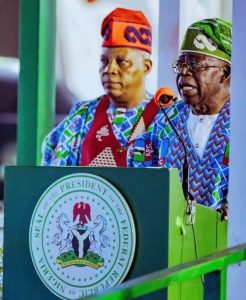
 Speaking to a packed audience at the All Progressives Congress presidential campaign rally in Dutse, President Bola Ahmed Tinubu drew a clear line on the fuel subsidy question. Addressing those promising a return of the old system, he stated plainly: “Don’t let them lie to you. Subsidy is not coming back.” He explained that no administration can sustainably fund major infrastructure while simultaneously bankrolling an open-ended fuel subsidy that drained public resources for decades. The resources previously lost to that regime, he said, are now being redirected into productive investments that strengthen livelihoods.
In place of the former subsidy, the President outlined a different approach focused on agriculture and infrastructure. Rather than restoring the old fuel subsidy, his administration would continue to subsidise farming inputs, expand road networks, and provide interest-free loans to farmers. He stressed the need to invest in the future of young Nigerians through education and agriculture instead of spending resources in ways that leave little for tomorrow. These commitments, he noted, form part of broader efforts to secure better livelihoods and build lasting infrastructure across the country.
The declaration landed in a state where farming remains central to the economy. Jigawa has already seen federal support for dry-season wheat cultivation on large hectarages, date-palm development, irrigation schemes, and the distribution of farm machinery. At the state level, Governor Umar Namadi’s administration has rolled out a substantial mechanisation package that includes hundreds of tractors, combine harvesters, boom sprayers and seeders. Federal and state road rehabilitation projects continue to improve access between farming communities and markets. These measures align with the President’s stated preference for targeted agricultural support over a blanket fuel subsidy.
The fiscal room for such interventions stems from the reforms introduced in 2023. Ending the fuel subsidy and unifying the exchange rate reduced major leakages and increased the volume of resources available through the Federation Account. States, including Jigawa, have used the higher allocations to expand capital programmes in agriculture, roads, skills training and basic services. The President’s remarks in Dutse framed this shift as deliberate: resources once absorbed by subsidy payments can now support farmers directly and finance the roads and facilities that raise productivity.
Residents at the rally heard the message against the backdrop of ongoing project delivery in the state. The same visit included the commissioning of skills acquisition facilities and the formal unveiling of agricultural equipment. For many in the crowd, the choice between restoring an unsustainable fuel subsidy and directing funds toward farming support, rural roads and credit for producers was presented as a practical trade-off rather than an abstract debate.
President Tinubu’s statement in Dutse therefore restated both the boundary of his policy and the alternative path his administration is pursuing. By rejecting a return to the old subsidy and committing instead to continued support for farmers, road construction and interest-free agricultural loans, he linked the reforms of 2023 to the work still unfolding on the ground in Jigawa.
The people of Jigawa, who have watched these resources translate into visible agricultural and infrastructure programmes, are prepared to respond at the polls. Come January 2027, they stand ready to re-elect President Bola Ahmed Tinubu and all All Progressives Congress candidates so that the present direction of investment in farming, roads and productive capacity can continue.